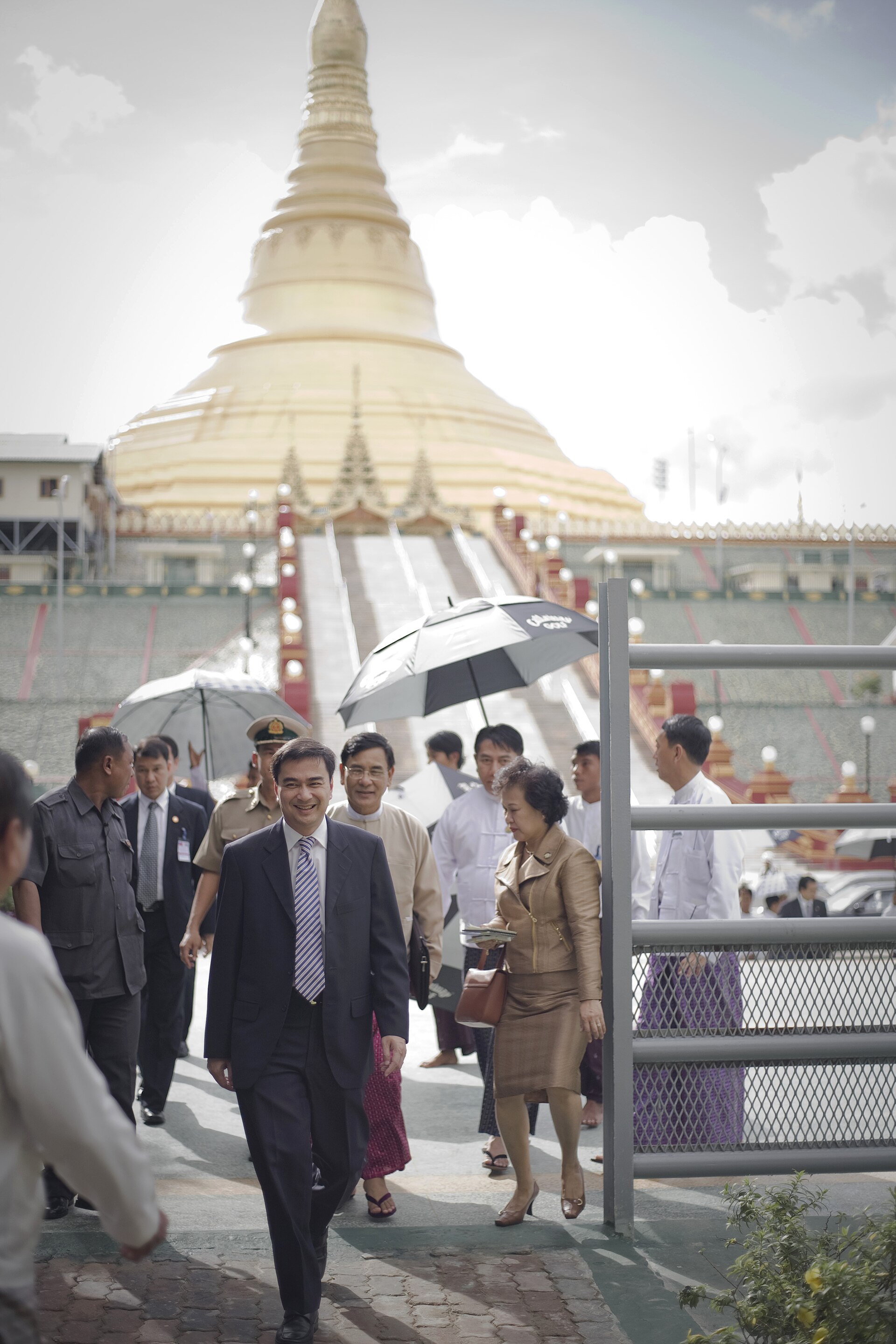
Uppatasanti Pagoda rises from the center of Naypyidaw, Myanmar’s purpose-built capital, its golden spire catching the light long before you reach it. Built in the early 2000s, it was part of the military government’s abrupt decision to move the country’s administrative heart inland from Yangon. The name translates roughly to “protection from calamity,” and though the pagoda is young by Buddhist standards, it has quickly become one of the city’s defining landmarks. Surrounded by wide boulevards and manicured parks, the structure feels strangely timeless—more like an ancient relic than a modern construction, despite being barely two decades old.
From the outside, Uppatasanti is nearly a replica of Yangon’s famous Shwedagon Pagoda, though slightly shorter at ninety-nine meters. The number isn’t arbitrary; it represents the jewels said to adorn the Buddha’s crown. The gilded spire is capped with a diamond that glints in the sunlight, while four stairways lead up to the main terrace, each flanked by statues of mythical guardians—lions, dragons, and naga serpents—standing watch over the sacred grounds. At dusk, when the lights come on, the pagoda glows like a beacon, visible from nearly every corner of Naypyidaw.
Inside, the space is airy and bright, with high ceilings and marble floors that reflect the soft light filtering through stained glass. The walls are lined with murals depicting scenes from the Buddha’s life, and along the galleries, hundreds of statues stand in various poses—meditating monks, serene bodhisattvas, and figures caught in moments of quiet devotion. At the center of the main hall rests one of Myanmar’s most revered relics: a tooth of the Buddha, brought from China and encased in a small shrine where lamps burn continuously and prayers are offered day and night. Unlike older temples, where crowds can feel overwhelming, Uppatasanti retains a sense of spaciousness, though the atmosphere remains deeply reverent.
Beyond its religious significance, the pagoda serves as a gathering place for the city. During national holidays and festivals, especially Thingyan—the Burmese New Year—it hosts ceremonies, processions, and communal prayers. On ordinary days, locals come to pray, tourists wander the grounds, and monks in maroon robes move slowly through the halls, chanting sutras. There’s no strict formality here, no rigid rules for visitors. Instead, the mood is quiet and unhurried, as if the place exists outside the rush of the modern world.
The grounds around the pagoda are just as inviting as the structure itself. A vast park stretches out in all directions, with neatly trimmed lawns, flowerbeds, and shaded pathways. Benches line the walkways, often occupied by elderly men playing chess or families enjoying the cool of the evening. On the edge of the park, a small lake with fountains becomes a gathering spot at dusk, where people come to unwind after work. There are no loud cafes or souvenir stalls—just the sound of wind through the trees and the occasional chime of bells.
Uppatasanti’s construction was part of Naypyidaw’s broader transformation, a city conceived as a futuristic capital with wide roads and sleek government buildings. Yet it’s the pagoda, rooted in centuries of tradition, that has become the city’s true center. In a way, it bridges the old and the new, offering a quiet counterpoint to the rapid changes around it. For many in Myanmar, it’s more than a landmark—it’s a place of reflection, where the noise of daily life fades into something deeper.
Visiting the pagoda is one of the few ways to glimpse the real rhythm of Naypyidaw. The city is often dismissed as artificial, a capital built by decree rather than necessity, but here, at the base of the golden spire, the place feels alive. Some come daily, others once a year, but all become part of the same quiet ritual. That’s perhaps the pagoda’s greatest quality: it isn’t just a monument, but a living space where faith, history, and everyday life intersect. Even if you’re not Buddhist, the sense of calm here is palpable—a rare thing in any modern city.