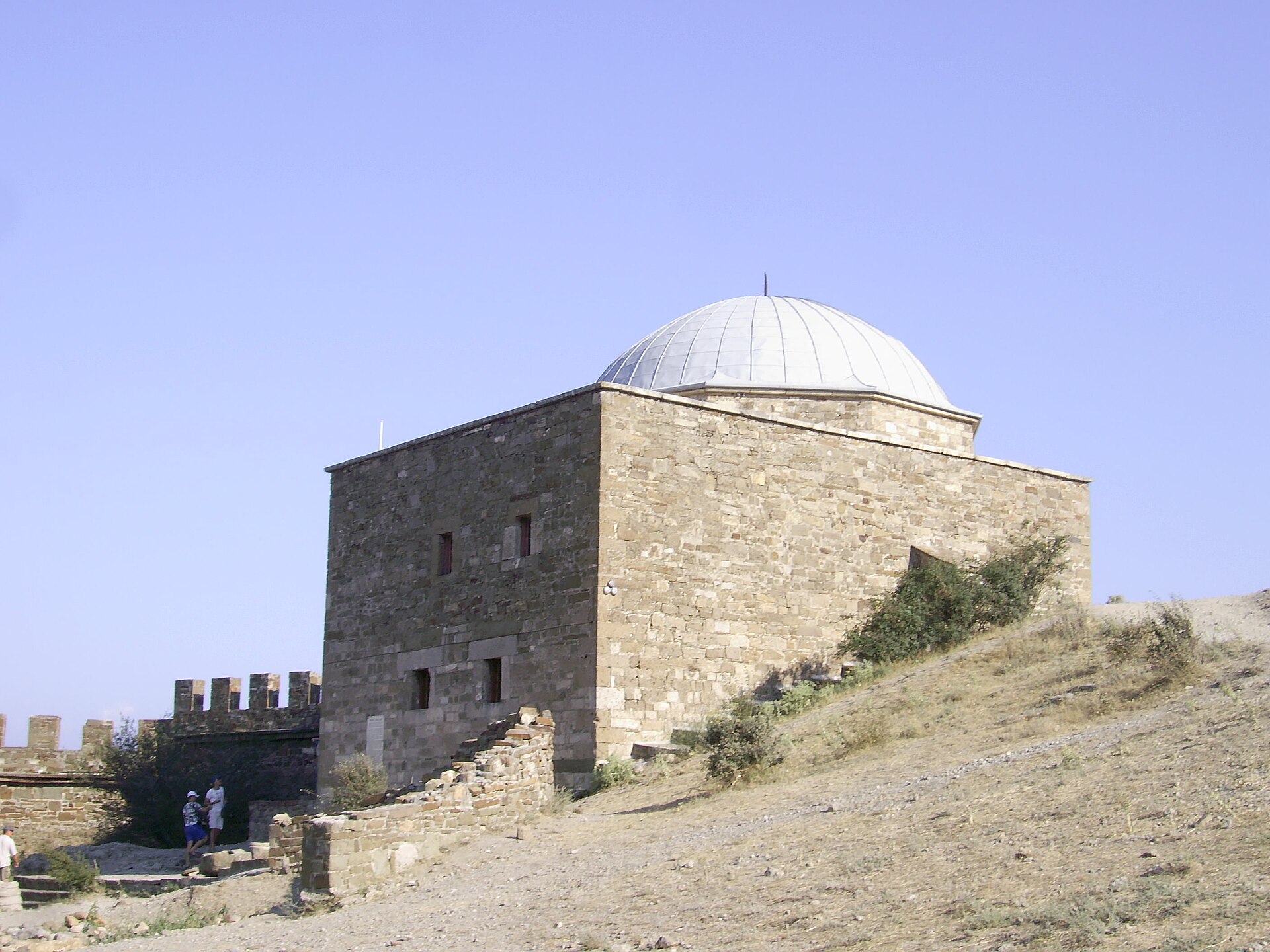
Perched on a gentle slope above Sudak, the Padishah Mosque overlooks the old town and the coastline beyond. Built in the early 18th century, its weathered stone walls and slender minaret have stood for centuries, bearing the marks of time. The structure is simple yet striking, its golden-hued limestone blending with the landscape while the pointed spire of the minaret cuts a clean line against the sky.
For generations, this mosque was more than a place of worship. It served as a gathering point where the Muslim community of Sudak came together—not just for prayer, but to discuss daily life, settle disputes, and share news. In a town where Greeks, Armenians, Karaites, and Turks lived side by side, the mosque was a quiet witness to the rhythms of coexistence under Ottoman rule. Named after Sultan Ahmed III, it stood as a symbol of the empire’s presence in this strategic Crimean port.
The architecture reflects the understated elegance of Ottoman design. The entrance is framed by a semicircular arch, a hallmark of the era, while the interior retains traces of its original beauty—fragments of frescoes and stucco work, though faded by time. The main prayer hall is spacious, with high ceilings that create a sense of openness, a place where the air feels still and cool even on the warmest days.
Like much of Crimea’s layered history, the mosque has seen periods of neglect. After the region became part of Russia, the Muslim population dwindled, and the building fell into disrepair. For decades, it served as a storage space before being abandoned entirely. Restoration efforts in the late 20th century brought it back to life, though today it functions more as a historical site than an active place of worship. The doors are open to visitors, offering a rare moment of quiet reflection away from the usual tourist paths.
From the base of the minaret, the view stretches across Sudak—rooftops, the distant silhouette of the Genoese fortress, and the rolling hills that frame the town. On clear days, the horizon seems endless, a reminder of why this land has drawn people for centuries. Climbing the narrow steps to the top, if allowed, reveals a perspective that feels almost timeless. The sea glints in the distance, the same sea that once brought traders, soldiers, and settlers to these shores.
What makes the Padishah Mosque special is its unassuming presence. There are no crowds here, no guided tours rushing through, no souvenir stalls clamoring for attention. Just the sound of the wind, the occasional cry of a gull, and the weight of history in the stones beneath your feet. It’s a place where the past doesn’t feel distant—it lingers in the cool shade of the walls, in the way the light falls through the arched windows, in the silence that settles over the courtyard.
Visiting in the early morning or late afternoon offers the best experience. The sun casts long shadows across the stone, softening the edges of time. There’s a sense of melancholy here, not the heavy kind, but the quiet sort that comes from standing in a place where countless lives have unfolded. The mosque doesn’t demand attention; it simply exists, a silent thread connecting the present to the stories of those who came before.
Sudak is full of grander landmarks—the Genoese fortress, the vineyards, the beaches—but it’s often the quieter places that leave the deepest impression. The Padishah Mosque is one of them. If you find yourself in this part of Crimea, take the time to wander up the hillside streets, away from the bustle. Stand for a moment in the courtyard, listen to the wind, and let the layers of history settle around you. That’s the real reason people come to places like this—not just to see, but to feel.