- Home
- North Korea
- Nampo
- Ryugyong Hotel (Nampo)
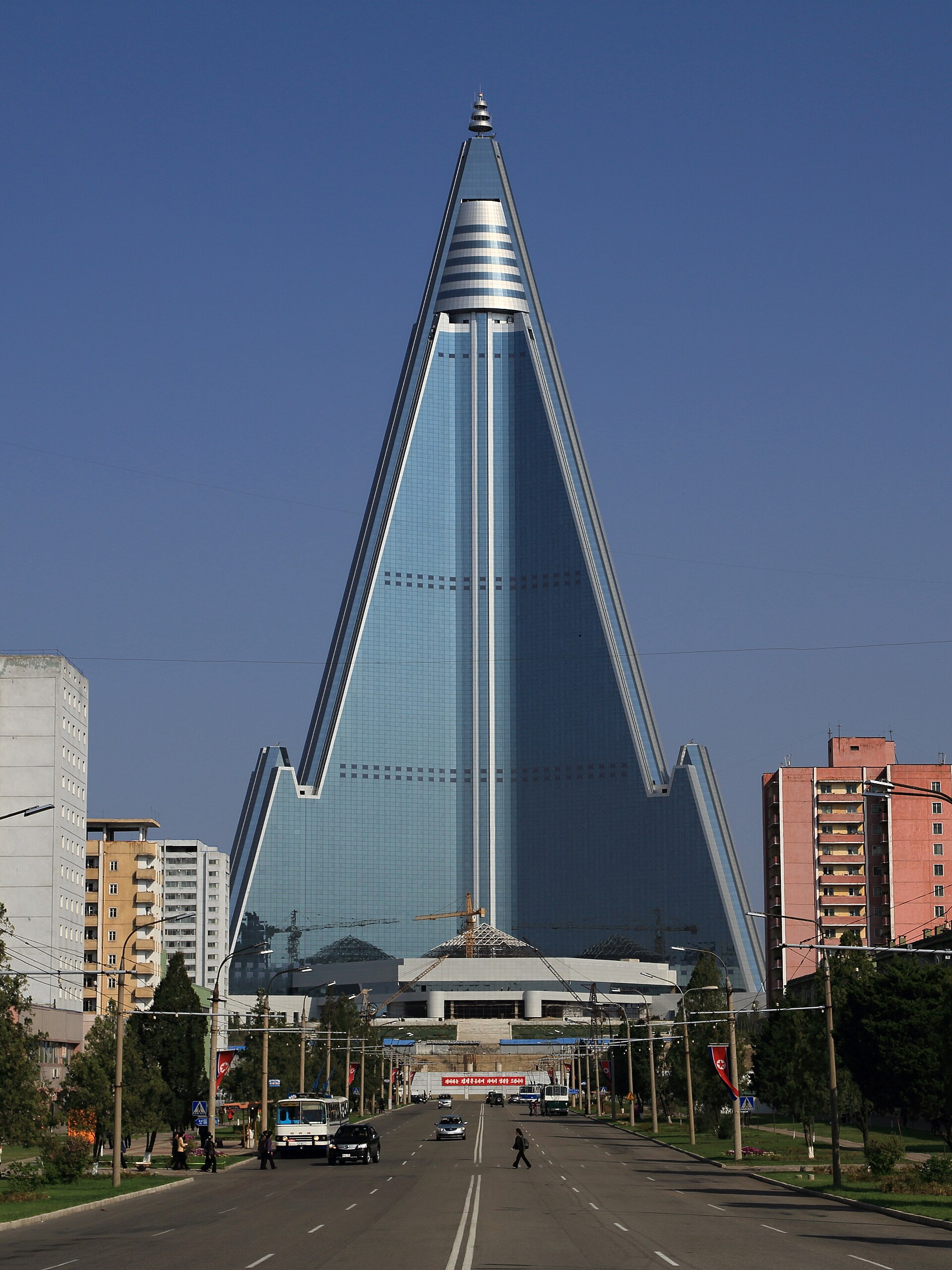
Photo: Martin Cígler, CC BY-SA 3.0
Ryugyong Hotel (Nampo)
out of 5 0 ratingsThe Ryugyong Hotel in Nampo is one of those places that leaves you with more questions than answers, even as it dominates the skyline. Rising on the outskirts of North Korea’s third-largest city, its pyramid shape is impossible to miss—a towering structure of glass and steel that was meant to symbolize ambition on a grand scale. With 105 floors, 3,000 rooms, and five revolving restaurants planned for its upper levels, it was designed to be more than just a hotel; it was supposed to be a statement. Yet decades after construction began, the building remains unfinished, a silent monument to a vision that never quite materialized.
The idea took shape in the late 1980s, when North Korea was briefly experimenting with economic openness and courting foreign investment. The goal was to build the tallest hotel in the world, eclipsing even the Raffles in Singapore and the Waldorf Astoria in New York. The project was ambitious, to say the least—too ambitious, as it turned out. Construction began with great fanfare, but by the early 1990s, progress had stalled. The collapse of the Soviet Union, North Korea’s primary economic partner, cut off vital support, while international sanctions further isolated the country. What was meant to be a gleaming symbol of progress instead became a hollow shell, its skeletal frame looming over Nampo like a relic of another era.
From the outside, the Ryugyong looks like a futuristic glass pyramid, its facade shimmering under the sun. But appearances can be deceiving. Much of the exterior is little more than decorative cladding, a thin veneer over a structure that was never fully realized. North Korea lacked the technology to build something of this scale at the time, so materials and expertise had to be sourced from abroad. Rumors persist that some components came from Europe or even South Korea, though no official records confirm this. The design itself is a mix of bold futurism and Soviet-era monumentality—clean lines, rigid symmetry, and an almost clinical precision that gives the building an otherworldly quality.
Inside, the hotel was meant to be just as extravagant. Plans included luxury suites, casinos, nightclubs, and even an internal metro system to shuttle guests between floors. But none of it came to pass. The interior remains largely unfinished, a maze of empty corridors and bare concrete. Over the years, there have been sporadic attempts to revive the project, often with foreign investment promised but never delivered. In the early 2000s, there was talk of Egyptian and Chinese firms stepping in, but nothing materialized. The building stood empty, a testament to the gap between ambition and reality.
Today, the Ryugyong is a ghost of its intended self. Occasionally, there are whispers of renovation or even plans to open it to tourists, but these claims rarely go beyond speculation. In 2018, LED lights were installed on the facade, flickering to life some evenings as if to suggest the building is still alive. Yet most experts agree that the hotel will never fulfill its original purpose. The technical challenges are immense, and the world has moved on since the 1980s, leaving the Ryugyong as a curious anachronism.
For the people of Nampo, the hotel is simply part of the landscape. Visible from nearly every corner of the city, it’s become a local landmark, though one that’s often met with dry humor. Some call it the world’s tallest unfinished building; others joke that it’s a monument to North Korean optimism. Around it, myths have taken root—stories of workers still toiling inside, or of secret government use. But like so much about the hotel, these tales are impossible to verify. Access is tightly controlled, and visitors are only allowed to photograph it from certain angles.
Despite its unfinished state, the Ryugyong has become one of North Korea’s most recognizable symbols. It appears in foreign documentaries, on postcards, and even in North Korean films, often serving as a visual shorthand for the country itself—grand, mysterious, and slightly unsettling. To outsiders, it embodies the contradictions of North Korea: a place of towering ambition and equally towering limitations. It’s a reminder that even the most audacious dreams can falter when reality intervenes.
In recent years, there’s been speculation about repurposing the building—perhaps as offices or apartments. But for now, these remain just ideas. The Ryugyong continues to stand on the edge of Nampo, a silent witness to a time when North Korea dared to dream big. Whether it will ever be completed is anyone’s guess. For now, it remains what it has always been: a vast, empty structure, full of unanswered questions and the echoes of what might have been.
Day around this place
Where else to go on the same day
Building the day…
Where it is
39.03665, 125.73114