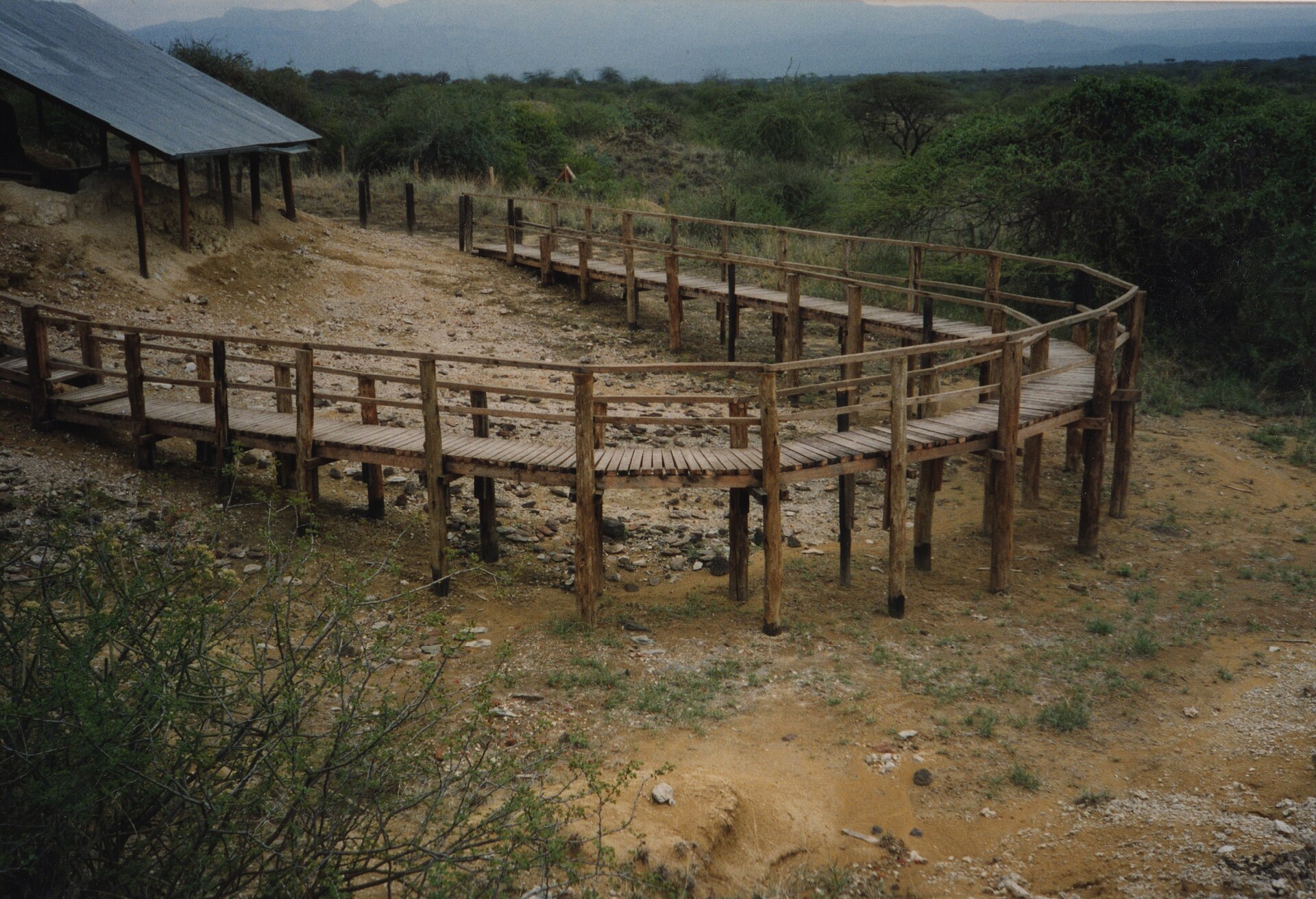
Olorgesailie is where the past feels almost tangible. Tucked into a semi-arid valley south of Nairobi, between rolling hills and dry riverbeds, this site holds some of East Africa’s most significant traces of early human life. The landscape itself is a kind of open-air archive—stone tools, animal bones, and the faint outlines of ancient hunting camps lie scattered across the ground, left behind hundreds of thousands of years ago.
The layers of earth here tell a story of adaptation and survival. From the Acheulean tools of the Early Paleolithic to later periods, the artifacts reveal how early humans shaped their world. Hand axes, scrapers, and spear points speak of a time when people hunted large game and learned to thrive in a changing environment. Alongside these tools, the bones of long-extinct creatures—giant baboons, ancient elephants—hint at the rich ecosystems that once flourished here.
A small museum near the excavation sites helps visitors make sense of the discoveries, but the real draw is the chance to walk the same paths as those early hunters. The terrain is stark: reddish soil, sparse shrubs, and the distant silhouettes of hills. In the dry season, the ground cracks underfoot; during the rains, the valley briefly transforms, turning green and alive with birdsong.
Researchers first began uncovering Olorgesailie’s secrets in the 1940s. Their work revealed how resourceful these early communities were—using local obsidian for tools, seasonal rivers for water, and the land’s natural traps to hunt large animals. These findings reinforced the idea that East Africa was a crucial cradle of human development, where some of the earliest chapters of our story were written.
Today, Olorgesailie offers a rare kind of quiet. There are no crowds, no distractions—just the vastness of the land and the weight of time. Visitors come not for entertainment, but for the chance to stand where human history took shape, to feel the connection between then and now.
The journey here passes through Maasai villages, where life has changed little over generations. The contrast between the ancient past and the living present adds another layer to the experience. It’s a reminder that while the world has transformed, some things endure.
For those drawn to history or simply seeking a break from the noise of modern life, Olorgesailie provides a space to reflect. The best times to visit are early morning, when the sun is still gentle, or late afternoon, when the light stretches shadows across the land. A walk through the valley can take a few hours, but time here moves differently—slower, deeper.
There’s something humbling about standing in a place where human ingenuity first took root. The same hills, the same sunsets—people have looked upon them for millennia. Olorgesailie doesn’t just preserve the past; it invites you to consider what it means to be part of something far older and larger than yourself.