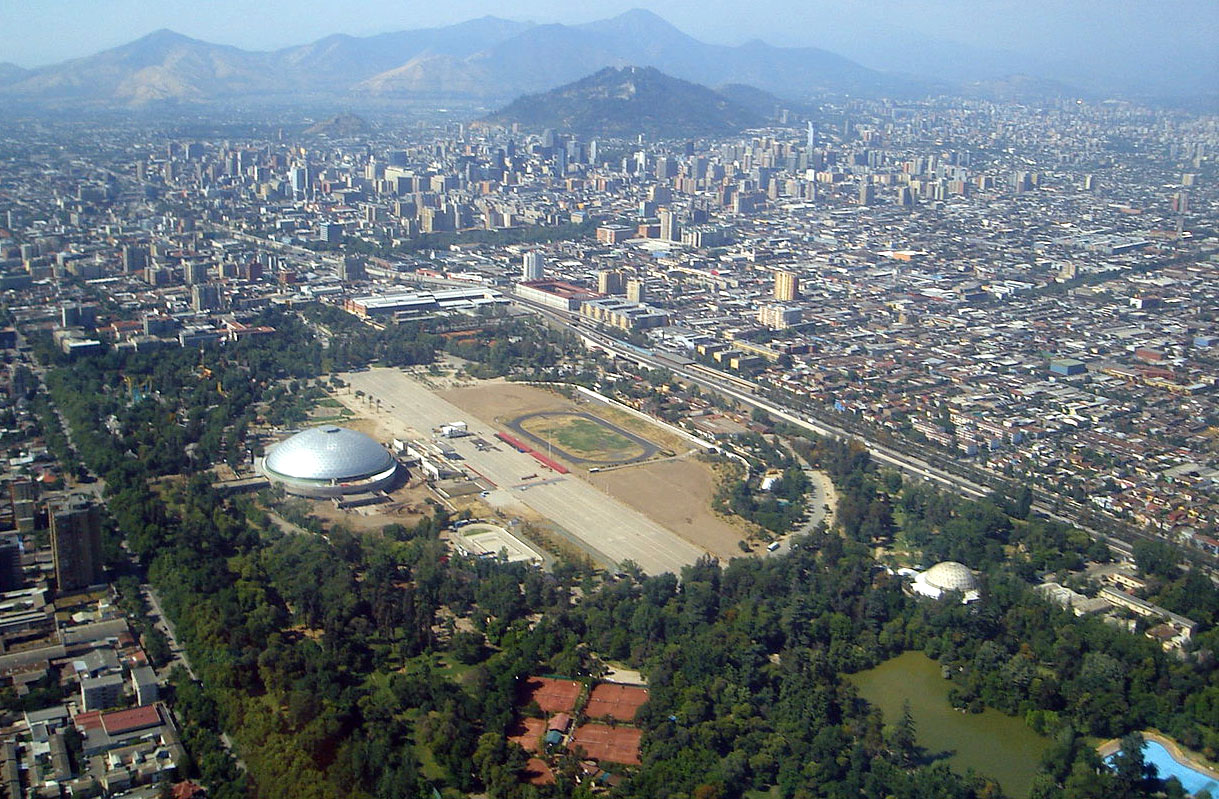
O’Higgins Park is one of those places in Santiago that doesn’t immediately catch the eye of visitors but becomes a favorite among those who call the city home. Spanning over seventy hectares, its history stretches back to the nineteenth century, when the land belonged to the Jesuit order. Later, it passed into government hands, and by the mid-twentieth century, the decision was made to transform it into a public park, named in honor of Bernardo O’Higgins, a central figure in Chile’s struggle for independence. Today, it’s more than just a green space—it’s where history, daily life, and a touch of urban charm intersect.
The park’s design is understated, yet there’s a quiet harmony to it. The main entrance leads visitors down a broad avenue toward a central plaza, where a monument to O’Higgins stands. The statue itself is a classic example of mid-century memorial sculpture: a bronze rider on a tall pedestal, flanked by symbolic figures. Around it, a formal garden unfolds with neat flowerbeds and fountains that come alive in spring, when magnolias and cherry trees bloom. Beyond this ordered center, the park loosens into winding paths, shaded groves, and gentle hills that offer glimpses of the city and the distant Andes.
There are no grand palaces or open-air museums here, but the park feels like a living archive of the past. The old racetrack that once occupied part of the land is long gone, yet its spirit lingers in the horseback rides still offered by local stables. The former exhibition pavilion, which hosted international fairs in the 1960s, now houses a cultural center with free exhibits and workshops. Even the artificial lake, created in the 1970s, feels like it has always been part of the landscape—complete with ducks, rowboats, and weekend fishermen.
For Santiaguinos, O’Higgins Park is first and foremost a place to unwind. You could easily spend an entire day here without noticing the time pass. Mornings bring joggers and yoga enthusiasts, afternoons see families picnicking on the lawns, and evenings find students and retirees gathered on benches. In summer, an open-air cinema screens classic films, while winter brings an ice-skating rink. The park is at its liveliest during national holidays, when concerts, craft fairs, and traditional cueca dances fill the air.
But the park isn’t just for leisure—it’s also woven into the city’s infrastructure. Bike paths crisscross through it, connecting different neighborhoods, and in winter, when snow blankets the Andes, ski enthusiasts train on the artificial slope. There are sports courts, playgrounds, and even a small botanical garden showcasing native Chilean plants. In recent years, the park has become a hub for festivals and public events, from environmental rallies to charity markets.
The atmosphere here is relaxed but never dull. Unlike more tourist-heavy spots like Plaza de Armas or Parque Metropolitano, O’Higgins Park doesn’t draw crowds of foreigners with cameras. Instead, it feels lived-in: someone reads under a tree, others play chess on the café terrace, and some just sit and watch the world go by. In summer, the air carries the scent of freshly cut grass and fried empanadas from nearby stalls; in winter, it’s warm chocolate and the smoky aroma of anticuchos grilling over open fires.
O’Higgins Park isn’t the kind of place that dazzles at first sight. You have to experience it—walk its paths when petals drift from the trees, sit by the lake on a quiet weekday, or visit in the early morning when the city is just waking up and the air is crisp. There’s no grandeur here, just a quiet comfort shaped by the people who come not for photos, but to spend time in a space where nature and the city coexist. That’s why, despite Santiago’s many more famous landmarks, the park remains a cherished part of local life.