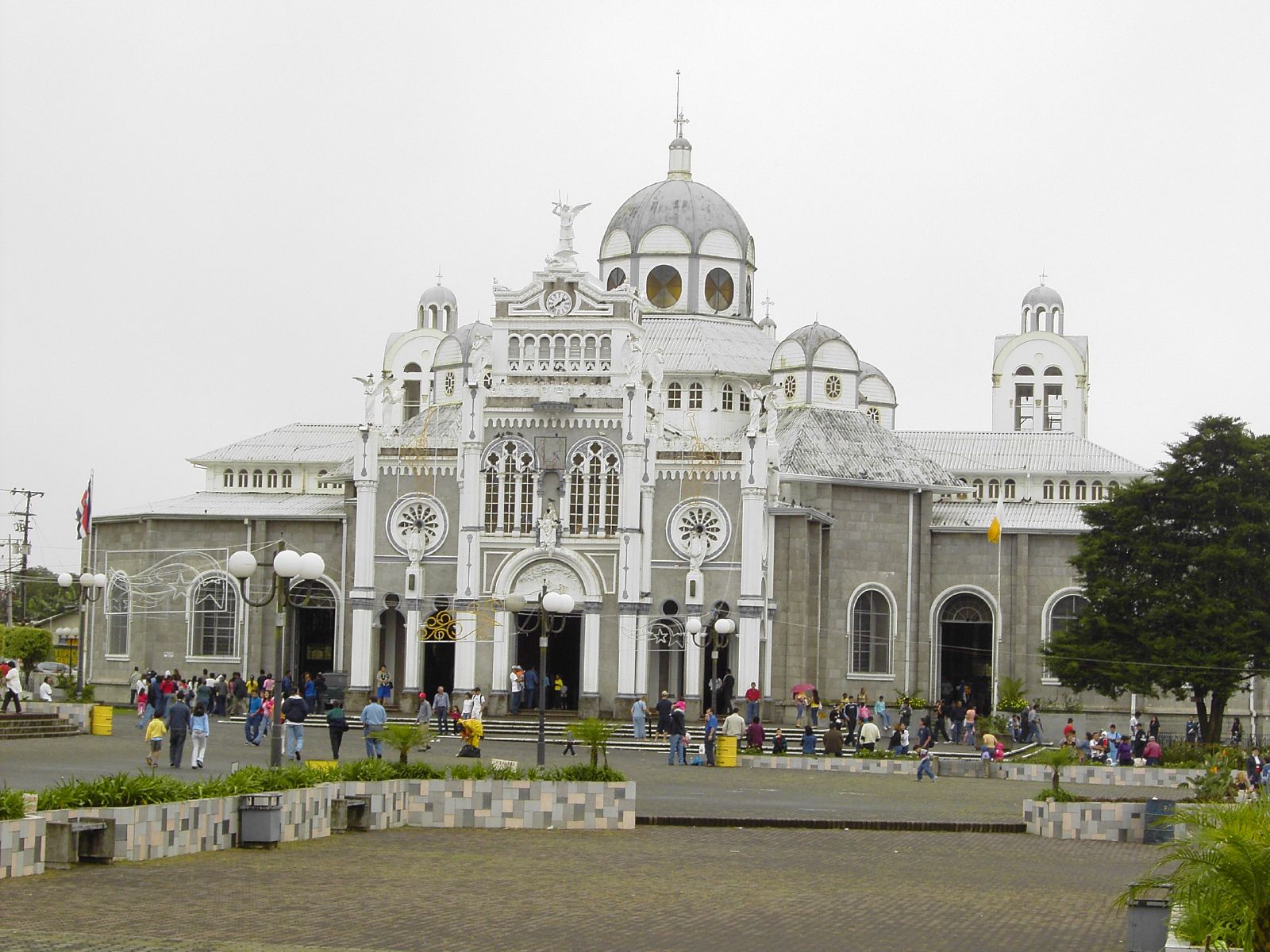
Cartago was once the heart of Costa Rica, a city where the country’s fate was decided long before the capital moved to San José. Today, it feels quieter, less hurried than the coastal towns, as if holding onto the weight of its past. At the center of this history stands the Basilica of Nuestra Señora de los Ángeles, a place that draws not only the devout but anyone curious about what shaped this nation. The church is dedicated to the Virgin of the Angels, Costa Rica’s patroness, and every August, thousands make their way here, some walking for days, to honor her. Yet even outside of pilgrimage season, the basilica remains a place of quiet significance, where architecture and legend intertwine.
The building itself is a rarity in Latin America, designed in the neo-Byzantine style that evokes the grandeur of Constantinople’s ancient churches. Its domes rise above the city like silent sentinels, while inside, the space unfolds with a sense of solemnity. Light filters through stained glass, casting soft hues over marble columns and gilded details. The effect is one of reverence, though not overwhelming—more like stepping into a space that has been carefully tended for centuries. The focal point is the small statue of the Black Madonna, nestled in the main altar. For believers, she is a source of miracles; for visitors, she is the reason this place exists at all.
The story of how the basilica came to be is as much a part of its identity as the stone it’s built from. According to local tradition, in the early 1600s, a young girl found a tiny figure of the Virgin Mary resting on a rock. She took it home, only for it to vanish and reappear in the same spot the next day. This happened several times before the villagers understood the message: the place was sacred. A small chapel was built, and over time, it grew into the basilica that stands today. The original rock, now embedded in the church floor, remains a point of devotion, a tangible link to the legend that started it all.
Cartago’s history is written in its streets, though much of it has faded with time. Founded by the Spanish in 1563, it was the colonial capital, a city of power and unrest, where decisions were made and rebellions sparked. When the capital moved to San José in the 19th century, Cartago’s political influence waned, but its spiritual and cultural role endured. The basilica became its anchor, a place that still draws people from across the country. The city itself feels like a pause in the rush of modern life—less crowded than the beaches, more introspective, with colonial-era buildings that hint at its former importance.
The August pilgrimage to honor the Virgin of the Angels is one of Costa Rica’s most profound traditions. For days, the roads leading to Cartago fill with people walking, some covering dozens of miles, their journey a mix of devotion and endurance. The procession is a river of faith, with prayers, songs, and the shared weight of history. Families pass the tradition down through generations, and even those who don’t consider themselves religious often join, drawn by the sense of belonging. The basilica, usually a place of quiet reflection, becomes the center of a national moment, where faith and identity merge.
Inside the church, the atmosphere shifts with the seasons. On ordinary days, it’s a place of stillness, where visitors might light a candle or sit in contemplation. But during festivals, the space hums with activity—people touching the statue of the Black Madonna, leaving notes of gratitude or pleas for help, offering flowers and small gifts. The air is thick with the scent of wax and incense, the murmur of prayers blending into a low, constant sound. Outside, vendors sell candles, rosaries, and sweets, their stalls adding a touch of everyday life to the sacred setting. It’s a place where the past and present coexist, where devotion feels both personal and communal.
The basilica has also become a symbol of resilience. Cartago sits in an earthquake-prone region, and the church has weathered its share of disasters. After a devastating quake in 1926, the building had to be reinforced, its structure strengthened to withstand future tremors. Today, it stands firm, a testament to the determination of those who rebuilt it. The scars of those earthquakes are part of its story, a reminder that faith, like the land itself, must sometimes endure upheaval.
Visiting the basilica isn’t just about seeing a historic site; it’s about sensing the layers of meaning that have accumulated over centuries. The small park surrounding the church offers a place to sit and absorb the quiet, while the streets of Cartago hold traces of its colonial past. The city may no longer be the capital, but in its own way, it still shapes the country’s identity. The Basilica of Nuestra Señora de los Ángeles is more than a church—it’s a living piece of Costa Rica’s soul, where history, faith, and culture converge in a way that feels both timeless and deeply human.