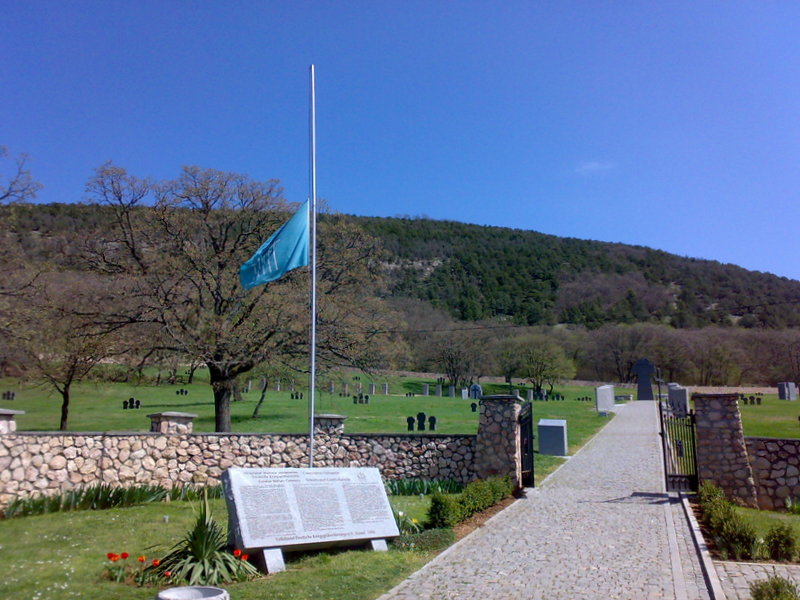
The German War Cemetery in Balaklava is a quiet place for reflection. It stands because of the brutal fighting in Crimea during World War II, when Balaklava’s strategic port changed hands repeatedly. After the war, thousands of German soldiers lay unburied or in unmarked graves across the peninsula. Their fate went unaddressed for decades until the late 20th century, when efforts to create a proper memorial began.
The cemetery is tucked away from tourist paths, set in a peaceful landscape where low trees and shrubs have grown undisturbed. The approach winds through gentle hills, unchanged for decades. There are no grand monuments here. Instead, rows of modest granite slabs mark the graves—some with names, others with only dates or *Unknown Soldier*. The simplicity is deliberate; it shows how war erases individuality, even in death.
The design is understated. A central path leads to a small memorial stone with German words. Graves are arranged in neat rows, separated by narrow walkways. The uneven terrain makes it feel natural, as if it belongs to the landscape. There’s no pressure to react in any particular way. It asks only for a moment of quiet.
The cemetery’s history reflects shifting attitudes toward war memory in the post-Soviet era. Soviet policy once discouraged memorials for enemy soldiers, leaving many German dead forgotten. In the 1990s, as relations between Russia and Germany changed, the idea of a proper burial site became possible. The German War Graves Commission and local groups recovered and identified remains, ensuring dignified resting places. Today, the Commission maintains the site.
Visiting isn’t like touring a museum. There are no guides, no detailed plaques—just silence, broken by leaves or birds. Sometimes, relatives of the fallen leave flowers, photographs, or notes. For locals, it’s a familiar place, treated with respect but not reverence. It reminds us that history isn’t just about grand narratives but also about personal connections to the past.
Crimea’s history and present intertwine at every turn. The German War Cemetery isn’t a major tourist attraction, but for those interested in World War II’s human stories or how nations preserve war memory, it offers quiet insight. There’s no glorification or condemnation—just the fact that lives were lost, and people want to remember. That restraint gives it meaning.
The seasons change the light but not the place. In summer, trees offer shade. Autumn and spring soften the landscape. Winter snow deepens the peace. Yet the cemetery remains unassuming, as it was meant to be.
The German War Cemetery in Balaklava is more than a burial ground. It shows how war memory can bridge divides, even between former enemies. It reminds us that war is always a tragedy, no matter who won. There are no grand ceremonies here, and that’s what makes it powerful. For some, it’s a place to reflect on history. For others, a chance to honor those who never returned. For a few, it’s simply where the past feels close.