Nairobi doesn’t fit into postcard images of polished capitals or the chaotic sprawl some expect from African cities. It sits between these ideas—where history and today collide, where nature and urban life share the same space, and where each street corner holds a different story. The city began as a colonial railway outpost in the late 19th century. Now, glass skyscrapers stand over tin-roofed settlements, and traffic noise mixes with the calls of wild animals.
The city started small. In 1899, British engineers picked this swampy land, then used by Maasai herders, as a stop on the Uganda Railway. The name "Nairobi" comes from a Maasai phrase for "cool waters," referring to the rivers that once flowed here. By 1907, it became the capital of British East Africa, a title it kept after Kenya’s independence in 1963. The railway brought more than tracks—Indian laborers stayed, British administrators shaped its early buildings, and workers from across the region arrived for jobs. The city grew in layers, like sediment over time.
Those layers appear in its buildings.
Colonial-era structures stand with wide verandas to block the heat. Churches with pointed arches remain from when the city was a British stronghold. Nearby, modern office towers rise, their glass reflecting sunlight. On the edges, neighborhoods of corrugated iron and mud bricks stretch far. Kariokor, where Kenya’s first middle-class high-rises appeared in the 1950s, now shows the city’s constant change—old buildings come down, new ones go up, and construction never stops.
Nairobi is Kenya’s political and economic center, but it’s also East Africa’s cultural heart. The National Museum, once a colonial railway headquarters, holds the country’s history—prehistoric fossils, independence struggles. Its most famous exhibit is Turkana Boy, a 1.6-million-year-old hominid skeleton that changed how we see human evolution. The city’s arts scene thrives too. Theaters stage Shakespeare and Kenyan plays. Galleries show local artists mixing traditional and modern techniques. Music clubs play jazz and benga, a genre blending Luo rhythms with Congolese rumba. Writers like Ngũgĩ wa Thiong’o and Binyavanga Wainaina have lived here, capturing the city’s complexities in their work.
What makes Nairobi different is its wild side.
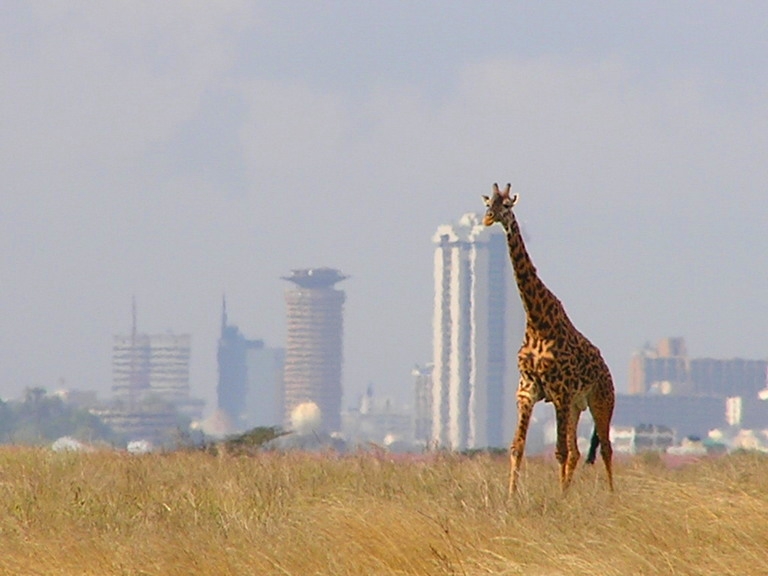
Nairobi National Park sits just outside the city center. Lions, giraffes, and rhinos move with skyscrapers in the background. It’s the only national park bordering a capital city. On weekends, locals visit to escape the city, picnicking under acacia trees or watching zebras near the airport fence. The park isn’t untouched—it’s a compromise between development and conservation. But it shows Nairobi hasn’t lost its connection to the land.
The city’s energy comes from its people. In Westlands and Upper Hill, banks, tech startups, and multinationals keep the streets busy. Step into a side alley, and the pace changes. Markets like Maasai Market sell handwoven baskets and beaded jewelry. Street vendors grill nyama choma over open flames, filling the air with charcoal and spices. Matatu minibuses, painted in bright designs, weave through traffic as drivers shout destinations in Swahili. English and Swahili are common, but you’ll also hear Hindi, Kikuyu, Luo, and others.
Nairobi’s contrasts are clear. Wealth and poverty exist side by side. In Karen and Runda, mansions stand behind high walls. A few kilometers away, Kibera and Mathare house hundreds of thousands in cramped homes. Traffic turns short drives into long waits. Crime exists, though not as overwhelming as some think. Yet the city doesn’t let its challenges define it. There’s a resilience here, a sense of moving forward even when the path isn’t clear. Those who live here call themselves Nairobian—they admit its flaws but defend it fiercely. It’s not a city for everyone, but those who stay find it hard to leave.
At sunset, Nairobi changes. The heat eases, and the city comes alive in new ways. Rooftop bars fill with people drinking cold Tusker beers. Restaurants serve ugali, sukuma wiki, biryani, and samosas—a mix of Kenyan and Indian influences. In Langata, jazz clubs draw crowds with live music spilling onto the streets. In Westlands, young professionals gather in lounges, talking in Swahili and English. The nightlife isn’t about glamour—it’s about connection, stories, and debates over drinks. Nairobi doesn’t slow down early; it finds a second wind.
Many travelers see Nairobi as a stopover, a place to catch a flight to the Maasai Mara or Mombasa. But those who explore it find more. It’s where Africa’s past and future meet, where a young nation’s energy is visible, and where each visit leaves you with questions. Nairobi doesn’t offer easy comforts. It’s raw, sometimes frustrating, but always real. Whether you’re watching a giraffe against the skyline or getting lost in a market, it stays with you.