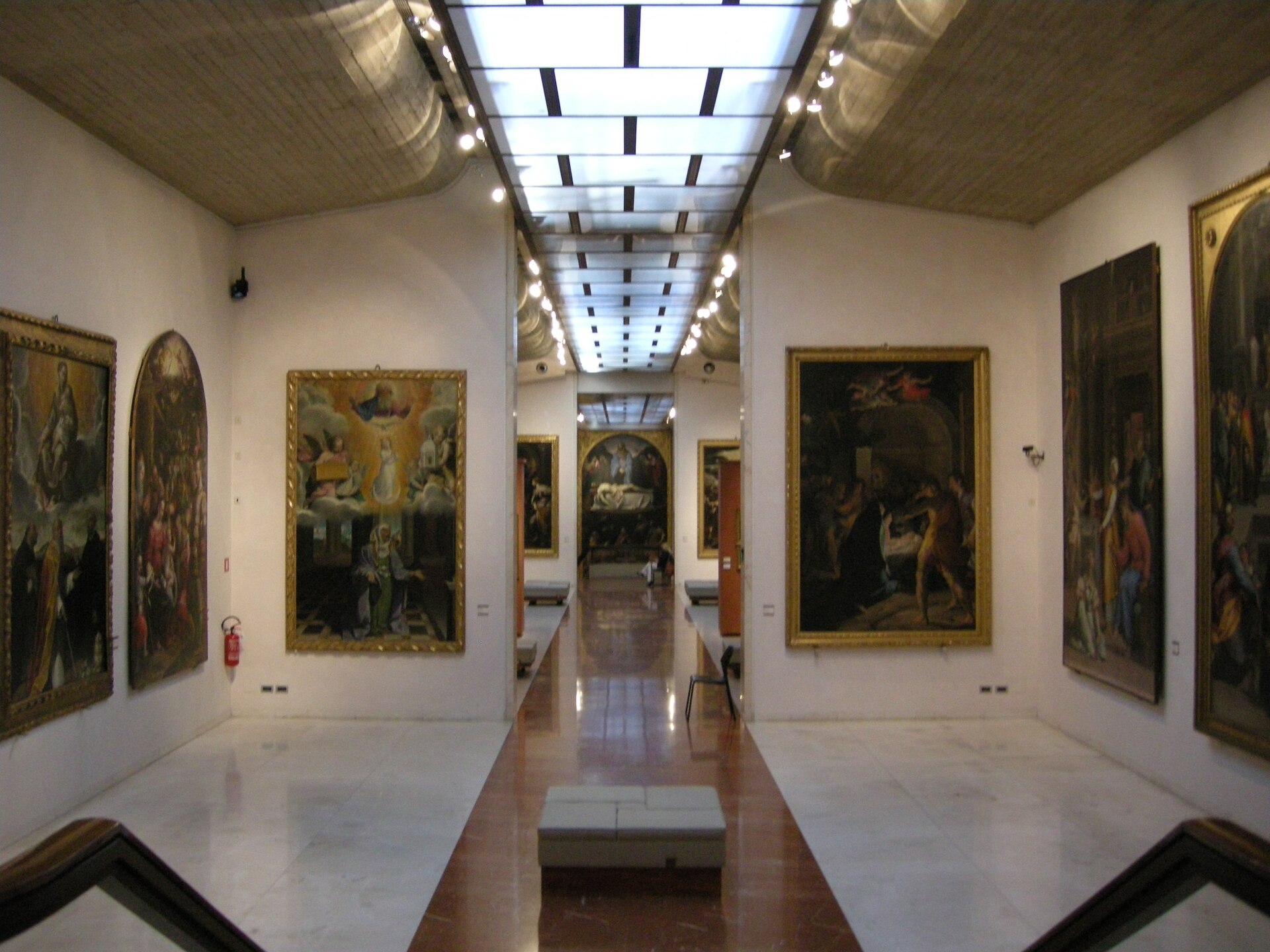
The National Pinacoteca of Bologna is one of those rare places where art doesn’t just hang on the walls—it breathes, unfurling slowly for those willing to listen. Tucked into the heart of the city, the museum holds a collection that spans centuries of Bolognese painting, from medieval masters to the Baroque era. Unlike the crowded halls of larger galleries, where visitors rush past masterpieces as if checking items off a list, the Pinacoteca offers something quieter: a chance to step into history, where each painting is a window into the past and every room tells a chapter of the city’s long artistic story.
The building itself is part of that story. Constructed in the late 18th century as part of the University of Bologna—the oldest in Europe—it was originally a Jesuit college before passing into state hands after the order’s suppression. Its restrained, almost austere facade gives little hint of the grandeur within. High ceilings, intricate stucco work, and spacious galleries create an atmosphere that feels both scholarly and reverent, a fitting backdrop for the art it houses. The architecture isn’t just a container for the collection; it’s a continuation of the era when art and learning were inseparable.
The museum’s holdings begin with works from the 14th and 15th centuries, when Bologna was a vibrant center of the Italian Renaissance. Here, you’ll find frescoes and altarpieces that bridge the Gothic and early Renaissance styles. A standout is the work of Vitale da Bologna, one of the first artists to break from the rigid conventions of medieval painting, imbuing his figures with movement and emotion. His dramatic, expressive scenes seem to pulse with life. Nearby are the delicate Madonnas and saints of Francesco Francia, whose graceful compositions became a hallmark of the Bolognese school.
By the 16th century, Bologna had established itself as one of Italy’s leading artistic hubs. The city attracted talents like Lorenzo Costa and Amico Aspertini, but it was the Carracci family—founders of the Accademia degli Incamminati—who left the deepest mark. Their works in the Pinacoteca trace the shift from Mannerism to a more naturalistic style, later dubbed Bolognese academicism. Annibale Carracci’s paintings, in particular, are masterclasses in composition and psychological depth. His *Madonna with Child and Saints* isn’t just a religious image; it’s a drama unfolding on canvas, rich with human emotion.
No discussion of Bolognese art would be complete without Guido Reni, whose 17th-century works became the gold standard of Baroque painting in the city. Reni’s canvases are suffused with light and air, his idealized figures radiating nobility and grace. Whether depicting biblical scenes or mythological tales, his paintings exude a sense of harmony and technical perfection. The Pinacoteca holds several of his works, including the serene *Madonna with Child*, where tenderness and mastery intertwine. Alongside Reni’s pieces are those of his contemporaries, like Domenichino and Guercino, whose works round out the picture of Bologna’s artistic golden age.
The museum isn’t limited to paintings. Its collection includes sculptures, engravings, and decorative arts that help reconstruct the aesthetic world of past centuries. Intricately carved wooden altarpieces, ecclesiastical objects, and even fragments of frescoes salvaged from demolished churches offer glimpses into how art once adorned the city’s churches, palaces, and homes. These pieces aren’t mere supplements to the collection; they’re evidence of how deeply art was woven into daily life, shaping both public spaces and private devotion.
Walking through the Pinacoteca’s galleries, it’s impossible not to feel the weight of history in these halls. Generations of artists studied and worked here, debating beauty and meaning, giving rise to ideas that would spread across Europe. Bologna has always been a city of thinkers and creators, and the museum serves as a chronicle of that intellectual and artistic legacy. Even if you’re not an art historian, the space invites you to sense the ebb and flow of tastes and ideals, to see how one generation of artists built upon the work of those who came before.
Time moves differently inside the Pinacoteca. There’s no need to rush—you can linger in front of a single painting, noticing details that might seem insignificant at first but reveal entire worlds upon closer inspection. Many of the works by Bolognese masters feature landscapes of the surrounding Emilia-Romagna region: rolling hills, ancient towns, quiet rivers. These backdrops aren’t just scenery; they’re proof of how deeply the artists were tied to their land, how it nourished their creativity. Even a short visit to Bologna feels richer after seeing the city through their eyes, as it was centuries ago.
Of course, the Pinacoteca isn’t the only place in Bologna where art comes alive. The city is filled with churches, palaces, and galleries, each holding its own treasures. But there’s something special about this museum—it doesn’t try to dazzle with scale or spectacle. Instead, it offers a quiet invitation: to step inside, look around, and spend time with beauty in its most enduring form. Perhaps that’s why it feels so compelling. It doesn’t demand attention; it earns it, one painting at a time.