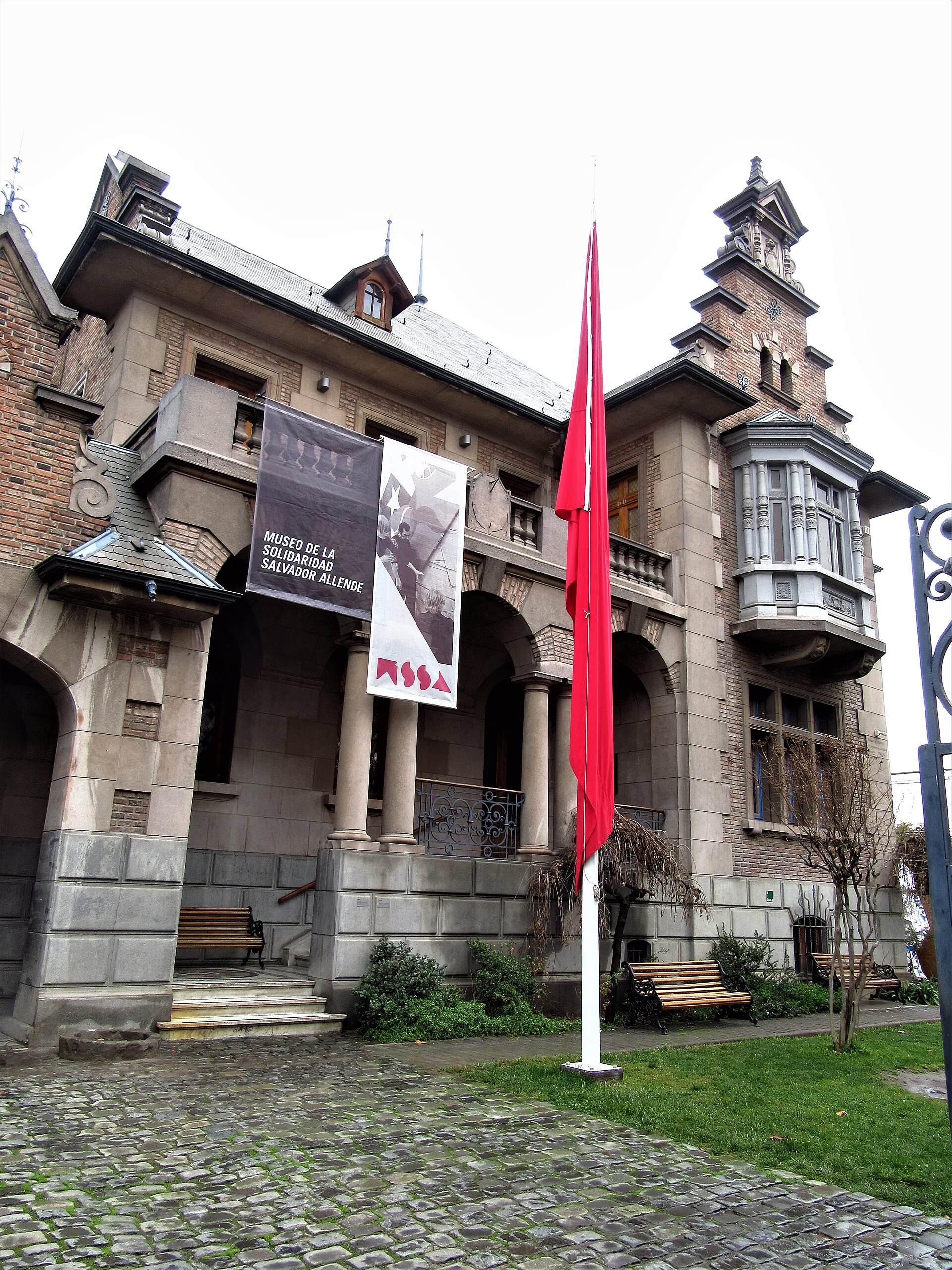
The Salvador Allende Museum of Solidarity is one of those places in Santiago where history, art, and politics intertwine so seamlessly that the walls seem to remember not just the paintings hanging on them, but the very breath of the past. It began in the early 1970s as an extraordinary project, bringing together artists from around the world in support of the Chilean people and the socialist government of Salvador Allende. At the time, the idea of a museum without walls—where art became a voice of solidarity—felt almost utopian. Even after the 1973 coup, the collection didn’t vanish; it simply went underground, only to resurface in the new millennium when Chile began to confront its recent history without fear.
Today, the museum occupies an old mansion in the Recoleta neighborhood, once home to Santiago’s affluent families. The building itself is a piece of history, with its massive wooden doors, high ceilings adorned with intricate moldings, and an inner courtyard where a fountain once set the scene for high-society gatherings. Now, the space is quiet but far from lifeless, filled with works by artists who, at different times, answered the call to stand with Chile. Some are world-renowned, others known only to a small circle of admirers, but each piece carries not just aesthetic value but the memory of a moment when art became a weapon or a consolation.
What makes the museum’s collection unique is that it isn’t just a gathering of artworks—it’s a living archive of international solidarity. The earliest pieces were donated between 1971 and 1973, when artists from Europe, Latin America, and even the Soviet Union sent paintings, sculptures, and prints as gestures of support for Chile’s socialist experiment. After the coup, the collection was scattered—some works disappeared, others ended up in private hands—but in 1991, as Chile returned to democracy, a long process of recovery began. Today, the museum holds around three thousand works, and they’re more than just exhibits. They’re testaments to how art can be both a personal statement and a collective act.
Walking through the galleries feels like stepping into the hopes and disillusionments that defined Chile’s recent past. In one room, works by Chilean artists from the dictatorship years hang silently, their lines and colors carrying a quiet protest against oppression. There are no loud slogans, just the weight of absence and distorted faces. In another section, pieces by foreign artists sent after 1973 reflect the world’s shock and sorrow over the violence in Chile. These works don’t preach; they bear witness, their power lying in their restraint.
A special part of the collection belongs to contemporary artists who continue the tradition started half a century ago. Their works address modern struggles—memory, human rights, identity—but they do so within the same spirit of solidarity. The museum isn’t frozen in time; it evolves, remaining a place where art doesn’t just decorate walls but engages visitors in conversation. There’s no strict chronology or rigid theming, just a space for reflection, where each piece exists in dialogue with the history that shaped it.
Visiting the museum is less about viewing an exhibition and more about encountering history that still resonates in Chilean society. The halls often fill with school groups, students taking notes, or older visitors who come to remember. For many Chileans, this isn’t just a cultural landmark but a place of memory, where they can reconnect with what once seemed lost forever. There’s no grandiosity or official solemnity here, just the sense of stepping into a home where paintings and personal stories are kept side by side.
The Salvador Allende Museum of Solidarity is a rare example of art not just reflecting an era but actively shaping it. It doesn’t tell history from the perspective of winners or victims but presents it as it is—complex, contradictory, and alive. There are no easy answers, only the questions posed by each artwork, each room, each corner of the old mansion. And perhaps that’s the museum’s greatest value: it reminds us that art and politics, personal fate and collective history, have always walked hand in hand.