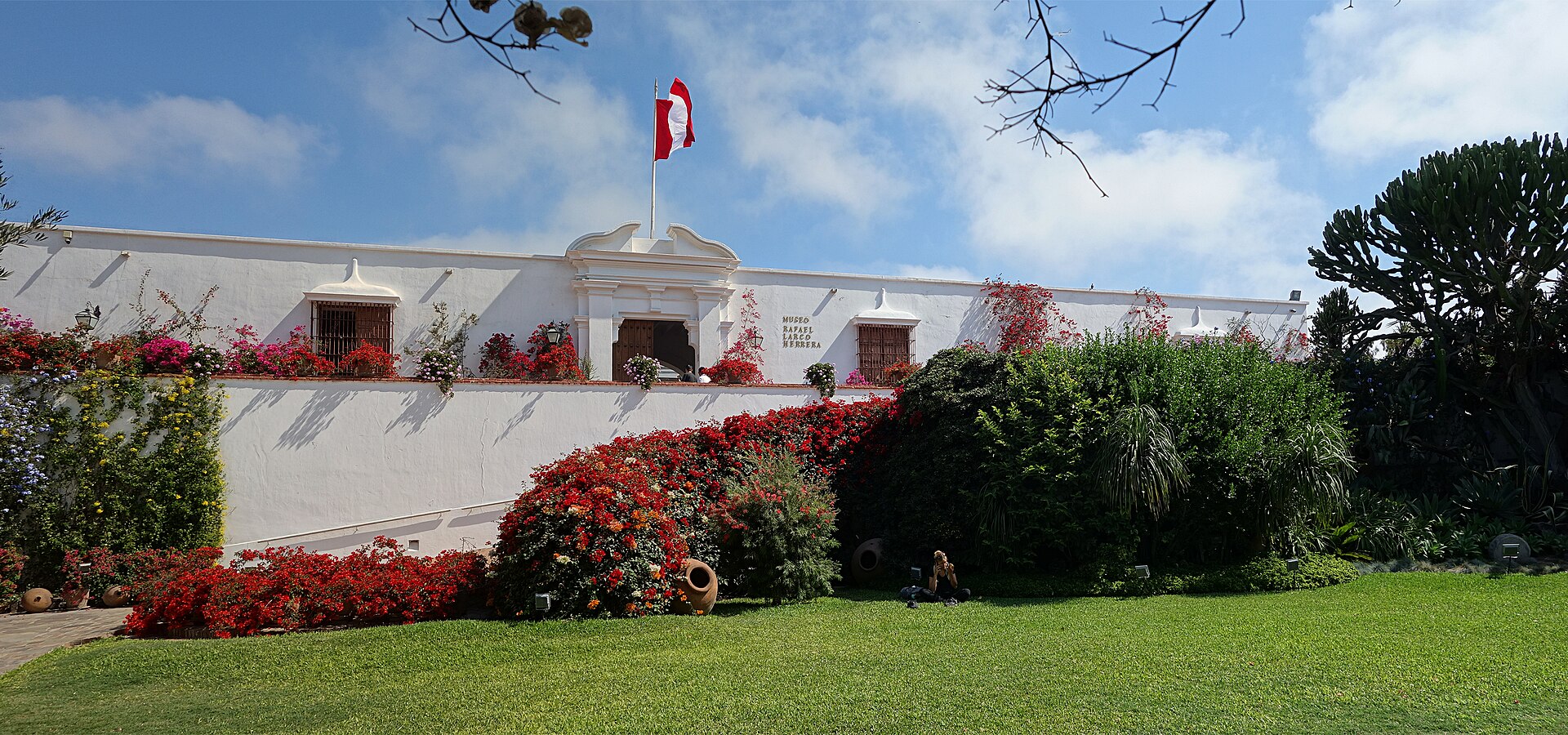
Lima has a way of revealing itself through places that linger in your memory long after the crowds have moved on. The Larco Museum is one of those rare spaces where history isn’t just observed—it’s felt. Housed in an 18th-century colonial mansion, the building itself is a quiet testament to time, constructed over the foundations of a pre-Columbian pyramid. The surrounding gardens, with their swaying palms and bursts of flowering shrubs, offer a place to sit and absorb what you’ve just seen. There’s no rush here, no pressure to move on to the next exhibit. The air carries the scent of earth and old stone, as if the past is still breathing beneath the surface.
What makes the Larco Museum different is the way it presents its collection. The artifacts aren’t trapped behind thick glass or roped off like prisoners. Instead, they occupy airy, sunlit rooms where you can step close enough to trace the delicate patterns on a ceramic vessel or study the intricate weave of an ancient textile. The museum doesn’t just display history—it invites you to engage with it. The high ceilings and uncluttered spaces allow each piece to exist on its own terms, without the usual museum fatigue that comes from being surrounded by too much at once.
The collection spans over three thousand years of Peruvian history, with a particular focus on the cultures that thrived long before the Inca Empire. These civilizations—Moche, Chimú, Nasca, Wari—are often reduced to footnotes in textbooks, but here they take center stage. The Moche, for instance, were master potters, and their ceramics are some of the most expressive in the ancient world. The museum’s pottery hall is a revelation, filled with vessels that range from the whimsical to the profound. Tiny figurines of people and animals sit beside massive ritual jars, their surfaces telling stories of daily life, mythology, and even humor. Some pieces are unapologetically sensual, depicting themes of fertility and sexuality with a frankness that might surprise modern visitors. The ancient Peruvians saw no shame in these subjects, and the museum doesn’t either.
Then there’s the gold. Not just as decoration, but as a language—one that spoke of power, divinity, and the cosmos. The museum’s collection of pre-Columbian metalwork is breathtaking, from delicate ear ornaments to ceremonial knives called *tumi*, their blades still gleaming after centuries. The gold masks are particularly striking, their features so lifelike that they seem to watch you as you move past. Some are stylized, others almost portrait-like, as if the artisans were trying to capture the essence of a person rather than just their likeness. Silver, too, plays a role in this visual vocabulary, often used in ways that highlight its contrast with gold. Together, these metals tell a story of craftsmanship and belief, where every hammered curve and etched line had meaning.
Nearby, the mummies offer a different kind of encounter with the past. Wrapped in layers of textiles and accompanied by burial offerings, they are remarkably well-preserved. Hair, skin, even the expressions on their faces remain intact, a silent testament to the advanced techniques of preservation developed long before European contact. It’s impossible not to wonder about the lives of these individuals—who they were, what they hoped for, how they ended up here, centuries later, still holding onto their secrets.
The museum owes its existence to Rafael Larco Hoyle, who began collecting artifacts in the early 20th century at a time when many were being looted or lost to neglect. What started as a personal passion grew into one of the most important private collections in Peru. That independence is still felt today. There are no rigid rules about photography, no guards hovering over your shoulder. The staff treat visitors like guests rather than intruders, allowing you to move at your own pace. It’s a rare kind of trust, one that makes the experience feel more like a conversation than a lecture.
For those who want to go deeper, the museum’s storage rooms are open by appointment. This isn’t some dusty archive—it’s a treasure trove where thousands of artifacts wait their turn to be seen. Shelves of ceramics, drawers of textiles, and cases of metalwork line the space, each piece with its own story. It’s a reminder that what’s on display is only a fraction of what the museum holds, and that history is never truly complete.
The Larco Museum isn’t just about the past, though. It also serves as a bridge to the present, hosting temporary exhibitions of contemporary art and workshops on traditional crafts like pottery and weaving. These events aren’t just about preservation—they’re about keeping traditions alive, adapting them to modern life without losing their essence. It’s a way of saying that history isn’t something frozen in time, but a living, evolving thing.
The building itself is a layering of histories. The colonial mansion, with its arched doorways and wooden balconies, sits atop the remains of a pyramid built by the Lima culture. During renovations, parts of the ancient structure were uncovered and left visible beneath glass floors, a subtle but powerful reminder of the continuity of time. The contrast between the colonial architecture and the pre-Columbian artifacts isn’t jarring—it feels natural, as if each era is simply another thread in the same tapestry.
Visiting the Larco Museum isn’t about ticking off a tourist attraction or snapping the perfect photo. It’s about stepping into a space where the past feels immediate, where you’re not just looking at history but walking through it. The museum doesn’t try to dazzle or entertain—it simply presents the story of Peru as it was, without embellishment. That honesty is why it doesn’t draw the same crowds as Machu Picchu, and perhaps why those who do find their way here leave with a deeper, quieter kind of awe. It’s the kind of place that stays with you, not because it’s grand or famous, but because it feels real.