The Groeninge Museum sits quietly in the heart of Bruges, tucked away on a narrow street just steps from the bustling Markt square. It occupies the site of a former abbey, though little remains of that history beyond the building’s modest, unassuming facade. Inside, the museum holds one of the world’s finest collections of early Flemish painting, a legacy of the city’s golden age when Bruges was a thriving center of trade, wealth, and artistic patronage. The works here were created in the 15th century, when the city’s merchants and clergy commissioned art with a devotion that bordered on obsession, demanding meticulous detail and technical perfection.
The undisputed masterpiece is Jan van Eyck’s *Madonna of Canon van der Paele*, painted in 1436. The canon himself kneels in prayer, his round spectacles perched on his nose, every thread of his rich ecclesiastical robes rendered with such precision that the fabric seems to ripple under your gaze. The painting is less a devotional image than a demonstration of skill—each pearl on the Madonna’s crown, each vein in the marble floor, each reflection in the saint’s polished armor is captured with almost unsettling clarity. Van Eyck didn’t just paint a scene; he constructed a world so tangible you half-expect to feel the weight of the canon’s brocade if you reached out. Nearby, works by Hans Memling, Rogier van der Weyden, and Gerard David line the walls, their compositions equally dense with symbolism and craftsmanship. One of the most striking is David’s *Judgment of Cambyses*, a grisly diptych commissioned by the city council as a warning to corrupt judges. The left panel shows the arrest of a dishonest magistrate; the right, his flaying alive. The brutality is rendered with such dispassionate precision that it feels more like a historical record than a moral lesson.
Hieronymus Bosch’s *Last Judgment* triptych offers a different kind of intensity. The central panel teems with tiny, writhing figures—sinners tormented by demons in a landscape of fire and ruin. There’s no grand narrative here, just chaos, and the longer you look, the more details emerge: a man impaled on a lute, a bird-headed monster devouring a soul, a pair of ears wielding a knife. Bosch’s nightmarish vision feels almost modern in its surrealism, a stark contrast to the ordered piety of the earlier works. The triptych is one of those paintings that rewards patience, revealing new horrors with each glance.
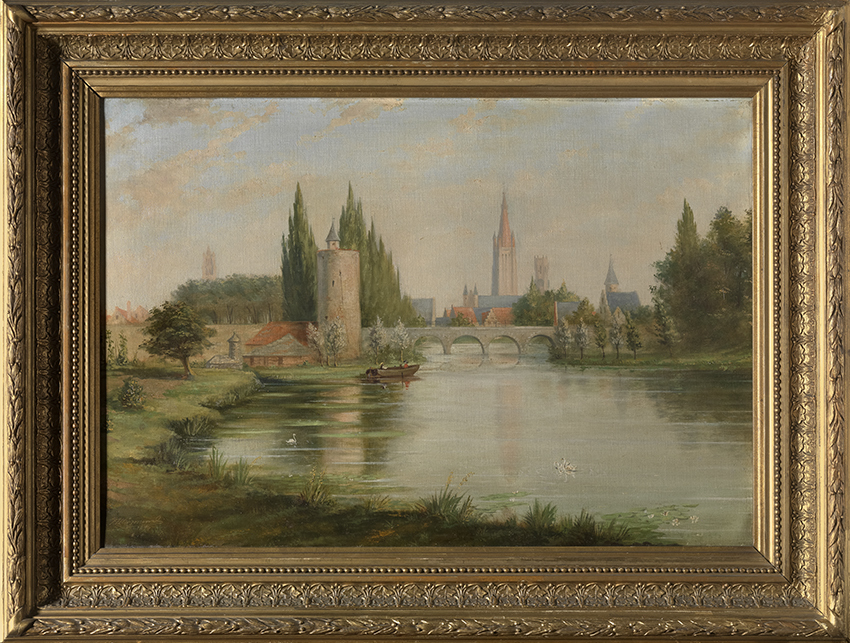
While the museum’s reputation rests on its 15th-century collection, the later galleries offer a quieter, more reflective counterpoint. The 18th and 19th centuries are represented by Flemish landscapes and genre scenes, their muted tones and domestic subjects a world away from the opulence of the primitives. The 20th century brings a shift into modernism, with works by Flemish expressionists like Constant Permeke and surrealists René Magritte and Paul Delvaux. Magritte’s *The Assassin* is here, its eerie stillness and unsettling juxtaposition of objects—a corpse, a man in a bowler hat, a gramophone—typical of his ability to turn the ordinary into something disquieting. Delvaux’s dreamlike cityscapes, populated by nude women and classical architecture, feel like fragments of a forgotten myth.
The museum is small enough to explore in an hour or two, a scale that works in its favor. There’s no risk of museum fatigue here; the collection is intimate, the lighting soft, and the rooms arranged in a way that encourages lingering rather than rushing. Photography is allowed, provided you don’t use a flash, and the absence of crowds means you can stand in front of a painting for as long as you like without feeling pressured. The building itself is unremarkable, but the courtyard garden at the entrance offers a moment of calm before stepping into the hushed galleries. On weekdays, the museum is often quiet, with only a handful of visitors drifting between rooms.
One of the museum’s strengths is its audio guide, which is almost essential for navigating the 15th-century works. The labels are sparse, and without context, many of the religious and allegorical references would be lost on modern viewers. The guide doesn’t just describe the paintings; it unpacks their symbolism, explains the techniques, and even points out details you might otherwise miss—the hidden signatures, the political subtexts, the ways in which artists played with perspective. For those who prefer to explore without one, the museum’s size makes it manageable, but the audio guide adds a layer of depth that transforms the experience from a simple viewing into something closer to a conversation with the past.
The Groeninge Museum isn’t the kind of place that announces itself with grand architecture or blockbuster exhibitions. It doesn’t need to. Its power lies in the quiet accumulation of masterpieces, each one a testament to a time when Bruges was at the center of the artistic world. The city’s wealth may have faded, its political influence waned, but the paintings remain, as vivid and precise as the day they were created. Walking through the galleries, you get the sense that you’re not just looking at art—you’re stepping into a moment when craftsmanship, faith, and commerce converged in a way that would never quite happen again. The museum doesn’t overwhelm; it invites. And in a city as saturated with history as Bruges, that invitation is rare and worth accepting.