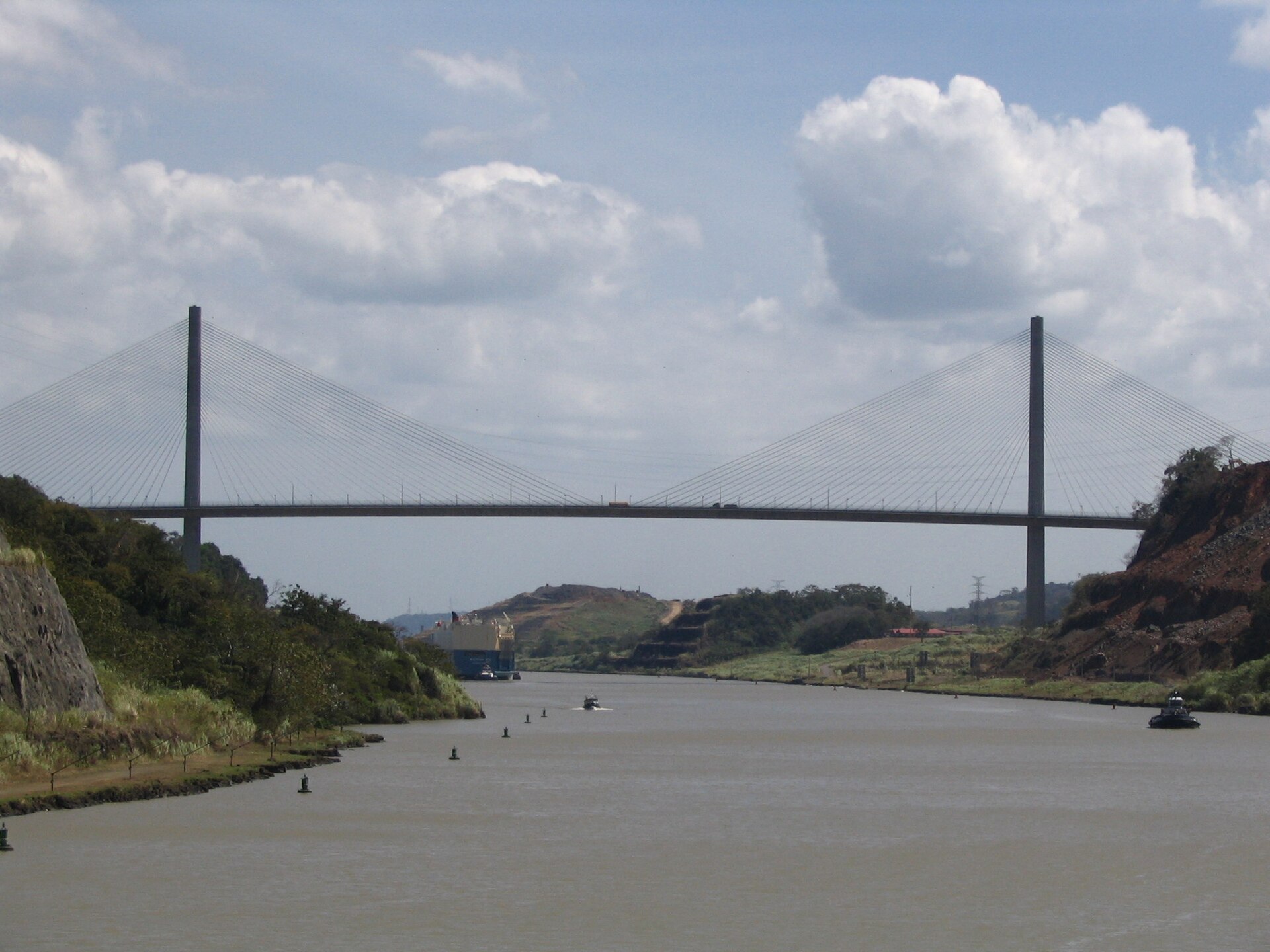
The Centenario Bridge is one of those places in Panama that doesn’t demand attention at first glance, yet it quietly becomes part of the journey. Spanning the Panama Canal, it connects not just two banks but different chapters of the country’s history. Built in the early 2000s, the bridge marked a turning point in Panama’s infrastructure, signaling a shift from being merely the nation of the canal to a dynamic, forward-looking country with ambitions of its own.
The canal itself has always been Panama’s lifeline, but before the Centenario Bridge, crossings were limited. The older Bridge of the Americas, opened in the mid-20th century, could no longer handle the growing traffic, especially after the canal’s expansion. The new bridge was the answer—a wide, modern structure capable of accommodating not just cars but heavy trucks moving between ports and industrial zones. It wasn’t built for spectacle but for necessity, and it serves its purpose well.
Architecturally, the bridge is straightforward and functional. Its two towering pylons, supporting the cable-stayed design, create a distinctive silhouette visible from a distance. The effect is most striking at dusk, when the setting sun glints off the canal’s waters and the bridge’s lights begin to flicker in the gathering dark. Unlike many tourist landmarks, the Centenario Bridge doesn’t try to impress—it simply works, and that reliability is part of its appeal.
For locals, the bridge is an everyday fixture. Those living in Las Cumbres or commuting to Panama City pass over it without a second thought, as if it’s always been there. But for travelers encountering it for the first time, the bridge can be an unexpected discovery. Approaching from the highway, the view suddenly opens up to the canal below and the ships stretching into the distance, a reminder of the waterway’s global significance.
The bridge’s history is intertwined with that of the canal itself. When Panama gained independence from Colombia in the early 1900s, the canal became more than an economic asset—it was a symbol of national identity and a ticket to the world stage. A century later, as the country celebrated its independence, the bridge was named Centenario, meaning "centennial." The name honored the past while signaling confidence in the future.
Today, the bridge carries traffic toward Tocumen International Airport, meaning many visitors cross it without realizing its significance. But if you take a moment to stop at one of the viewpoints along the canal, you can watch massive container ships glide beneath the bridge while the skyline of Panama City looms in the distance. It’s a place where global trade routes intersect with the daily life of the country, where the scale of the world’s commerce meets the quiet rhythm of local roads.
There’s no tourist infrastructure around the bridge—no souvenir shops, no cafes with canal views. Everything here is built for function: wide lanes, highway interchanges, clear signage. Yet that very lack of pretense is what makes the Centenario Bridge interesting. It doesn’t try to be anything more than what it is, and in that honesty, there’s a certain charm.
If you ever find yourself in Panama and venture beyond the capital, the Centenario Bridge could be a worthwhile stop—not for photos or guided tours, but to experience the country’s pulse. Here, the global and the local coexist without fanfare. There are no crowds, no overbearing services, just the road, the canal, and the sky above. It’s a place where you can feel the steady, unassuming heartbeat of Panama.