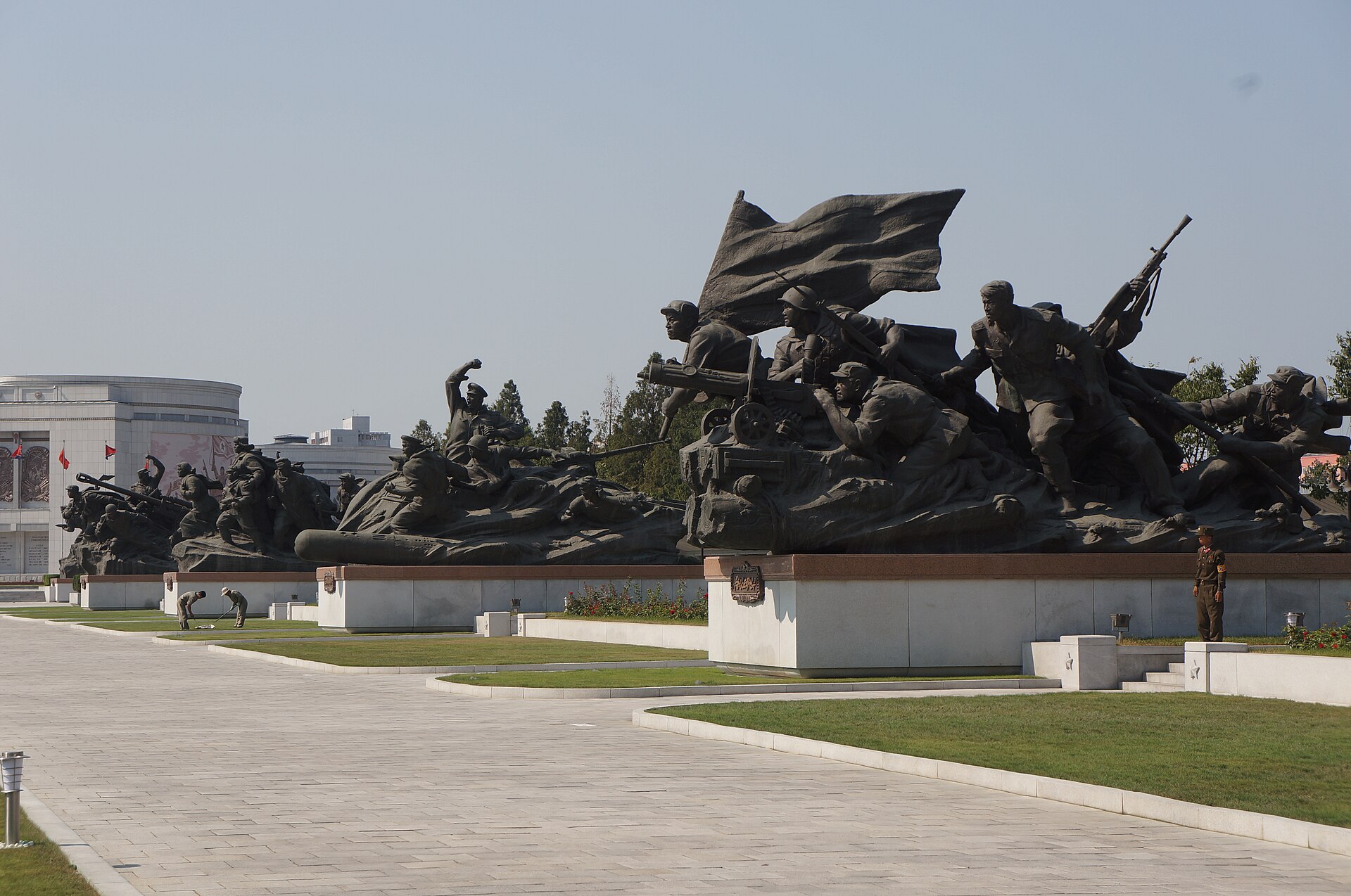
Perched on a hill overlooking Pyongyang, the Monument to the Victorious Fatherland Liberation War stands as one of the city’s most imposing landmarks. Unveiled in 1993 to mark the 40th anniversary of the Korean War’s end—a conflict known here as the Fatherland Liberation War—the monument is more than a memorial. It is a statement of national resilience, a physical embodiment of the ideals that shape North Korea’s identity. The war, which divided the peninsula and left deep scars, is remembered here not just as a historical event but as a defining moment of defiance and triumph.
At the heart of the monument is a towering obelisk, crowned with a bronze wreath and rising nearly forty meters into the sky. At its base, three soldiers dominate the scene, their figures frozen in a moment of collective victory. One raises a rifle, another a flag, and the third a sword, their postures dynamic, their expressions resolute. The sculptors captured not just the bravery of the fighters but the unity of a nation standing together against overwhelming odds. The obelisk itself is adorned with intricate bas-reliefs depicting key moments of the war, from early battles to the signing of the armistice, each scene rendered with a sense of motion and purpose.
Flanking the central structure are two curved walls, their surfaces covered in vibrant mosaics. These panels tell a different kind of war story—one of everyday endurance. Women operate machinery in factories, farmers harvest crops under the threat of airstrikes, children tend to the wounded. The scenes are not grim but almost celebratory, painted in bright, almost defiant colors. The contrast between the subject matter and the vivid hues is striking, reinforcing the idea that survival itself was a form of victory. The mosaics are less about the horrors of war and more about the quiet strength of a people who refused to break.
The monument is set within a carefully landscaped park, its manicured lawns and wide pathways offering space for reflection. On national holidays, particularly Victory Day, the area comes alive with ceremony. Schoolchildren in crisp uniforms lay flowers at the base of the obelisk, veterans share stories of the past, and speeches echo across the square. For many North Koreans, this is not just a tourist site but a place of personal and collective memory, where the past feels immediate and alive. The monument’s location is no accident—it was built on the site of an earlier memorial commemorating liberation from Japanese rule, a deliberate choice to link two struggles for sovereignty.
The architectural style reflects the era in which it was built, blending socialist realism with distinctly Korean elements. The figures’ poses and gestures draw from traditional art, while the use of granite, bronze, and marble lends the structure a sense of permanence. Even the hilltop setting was chosen with care, ensuring the monument is visible from across the city, a constant reminder of the values it represents. Every detail, from the placement of the sculptures to the angle of the mosaics, was designed to convey strength, unity, and unyielding resolve.
For foreign visitors, the monument often leaves a lasting impression. Guides explain the symbolism behind each element, recounting stories of heroes whose names are etched into the memorial. Yet it’s important to recognize that the narrative here differs from the one told elsewhere. In North Korea, the Korean War is framed as a victory over American aggression, and the monument serves as a testament to that perspective. The experience is less about historical debate and more about understanding how this country chooses to remember its past.
As evening falls, the monument is bathed in light, its silhouette sharp against the darkening sky. The illumination brings the bas-reliefs to life, their details emerging with unexpected clarity. In these moments, the structure feels less like a static memorial and more like a living witness to history, its presence both solemn and stirring. Even those who approach it with skepticism often find themselves moved by the atmosphere—by the weight of memory and the unshakable sense of pride that permeates the site.
Beyond its role as a memorial, the monument is woven into the fabric of Pyongyang’s daily life. It is a place where history is not just remembered but actively celebrated, where the past is invoked to reinforce the present. The stories told here, the ceremonies held, and the emotions evoked all serve as reminders of how deeply this country’s identity is tied to its struggles. The monument does not let the past fade; instead, it keeps it vivid, relevant, and ever-present in the minds of those who visit.