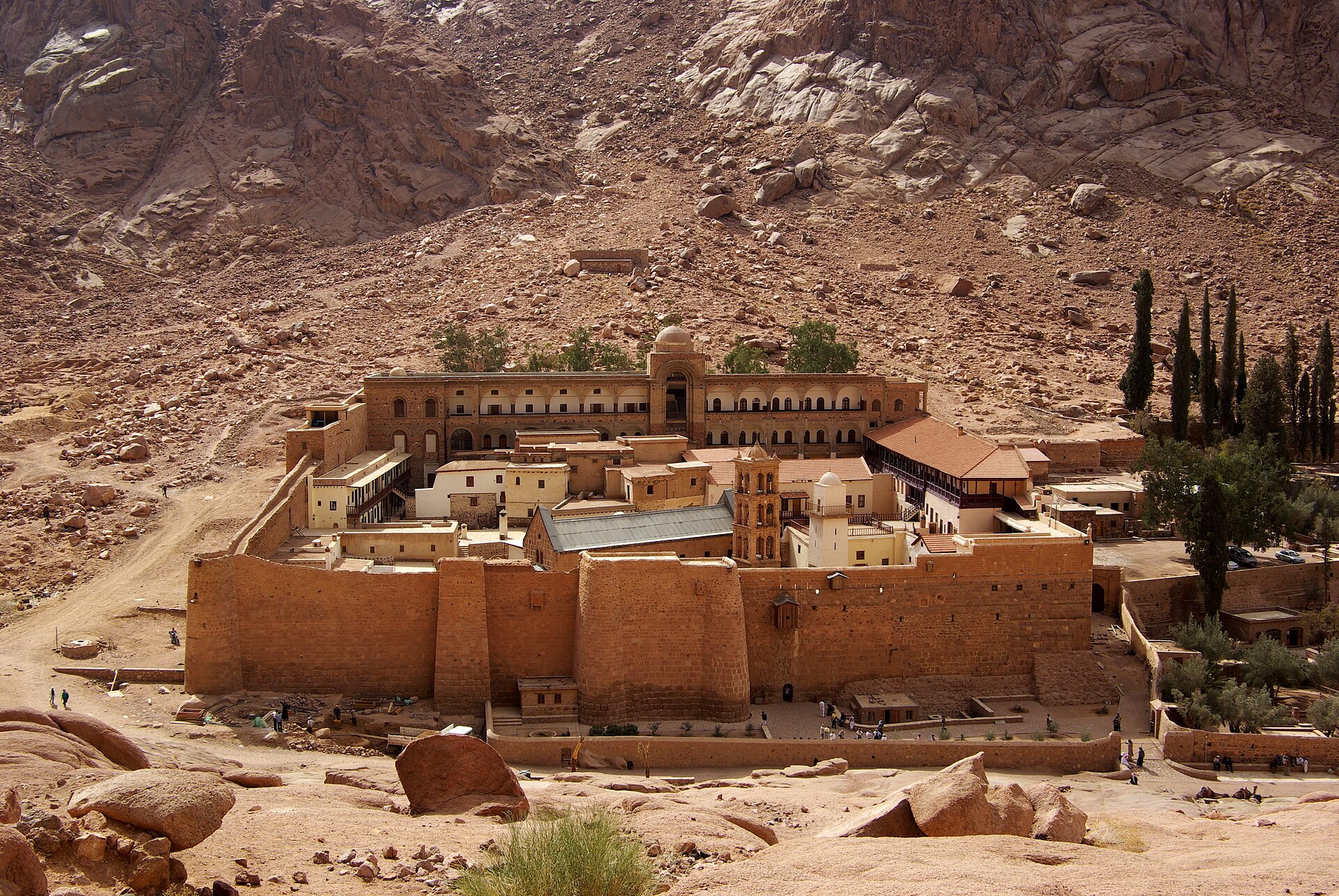
Perched at the foot of Mount Sinai, where the desert stretches endlessly under a vast, unblinking sky, Saint Catherine’s Monastery has stood for over a thousand years as a quiet witness to faith, history, and the passage of time. This is the place where, according to tradition, Moses received the Ten Commandments, where a burning bush once defied the laws of nature, and where generations of monks have kept alive the light of knowledge in one of the harshest landscapes on earth. The monastery is not just a relic of the past—it remains a living community, one of the oldest continuously functioning Christian monasteries in the world, founded in the 6th century under the rule of Emperor Justinian.
From the outside, the monastery resembles a fortress more than a place of worship. Its high walls, built from rough-hewn red granite, rise abruptly from the rocky terrain, their narrow slits for windows hinting at a history of sieges and survival. In its early centuries, the monastery was often targeted by nomadic tribes, and the monks who lived here had to defend their home as much as their faith. Yet behind these imposing walls lies a world of unexpected intimacy—a labyrinth of tiny cells, a garden where fig and olive trees grow in the shade of ancient stone, and a library that holds some of the most precious manuscripts in existence. The heart of the monastery is the Basilica of the Transfiguration, a space that feels both humble and grand. Its interior is adorned with 6th-century mosaics, an iconostasis carved from cypress wood, and frescoes that have faded but not lost their power over the centuries.
One of the monastery’s most revered sites is the Chapel of the Burning Bush, built around the very plant that, according to the Bible, burned without being consumed when God spoke to Moses. Today, the bush is small and unassuming, its gnarled branches enclosed by a silver railing, yet it remains a symbol of divine presence. Pilgrims still come to kneel before it, and the monks tend to it with care, as they have for centuries. Nearby, a well is said to have been dug by Moses himself to water the flocks of his father-in-law, Jethro. The water here is cool and clear, a rare gift in the desert, and the stories attached to it give the place a sense of continuity—of hands that have drawn from this well for thousands of years.
Beyond its spiritual significance, Saint Catherine’s is a treasure house of human history. Its library holds thousands of manuscripts in Greek, Arabic, Syriac, Coptic, and other languages, some dating back to the earliest days of Christianity. Among them is the Codex Sinaiticus, one of the oldest surviving copies of the Bible, written in the 4th century. The monastery’s collections also include icons, liturgical objects, ancient maps, and scientific texts that monks painstakingly copied and preserved through the ages. Many of these artifacts have yet to be fully studied, and scholars from around the world still travel here to uncover their secrets. The monastery is not a museum, though—it is a place where history is still being written, where the past and present coexist in the daily rhythms of monastic life.
Life here moves at the pace of the desert, unhurried and deliberate. The monks rise before dawn to pray, then spend their days tending the garden, working in the scriptorium, or maintaining the monastery’s buildings. Visitors are welcomed, but there is no rush, no sense of performance. Those who stay overnight in the monastery’s simple guesthouse often wake before sunrise to begin the climb up Mount Sinai, a two-hour journey along a winding path that cuts through the rocky landscape. By the time they reach the summit, the first light of day is just beginning to spill over the horizon, turning the desert below into a sea of gold and shadow. The view is worth the effort, but the real reward is the sense of stillness that settles over the mountain at dawn—a moment when time seems to pause.
Mount Sinai, known locally as Jabal Musa, is more than just a pilgrimage site. It is part of a protected natural reserve, where rare plants and animals have adapted to the harsh conditions of the desert. The surrounding valleys and canyons are home to Bedouin communities who have lived in these lands for generations. Historically, the Bedouin have been the monastery’s protectors, guiding pilgrims along ancient trails and maintaining a relationship with the monks that has endured for centuries. Today, many work as guides, sharing stories of the mountain’s legends and the people who have walked its paths.
A visit to Saint Catherine’s is like stepping into another era. There are no crowds here, no modern distractions—just the quiet hum of the desert, the scent of dry earth and wild herbs, and the ever-present sense of history pressing in from all sides. The air is thin and clear, hot during the day and cool at night, carrying with it the weight of countless prayers and footsteps. The monastery’s walls hold more than just relics; they hold stories of survival, devotion, and the enduring human need to seek meaning in the vastness of the world. For some, it is a place of pilgrimage. For others, it is a monument to the resilience of faith and culture. But for everyone who comes here, it offers something rare—a chance to stand in a place where the past feels very much alive.
The monastery remains an active religious community, not a tourist attraction, and visitors are asked to respect its traditions. Dress modestly, speak quietly, and remember that this is a place of worship first and foremost. Photography inside the chapels is usually not permitted, but the memories made here don’t rely on images. What lingers is the feeling of the desert wind against your skin, the sound of monks chanting at dawn, and the quiet certainty that some places are meant to be experienced, not just seen. In a world that moves too fast, Saint Catherine’s offers a reminder of what it means to slow down, to listen, and to connect with something greater than ourselves.