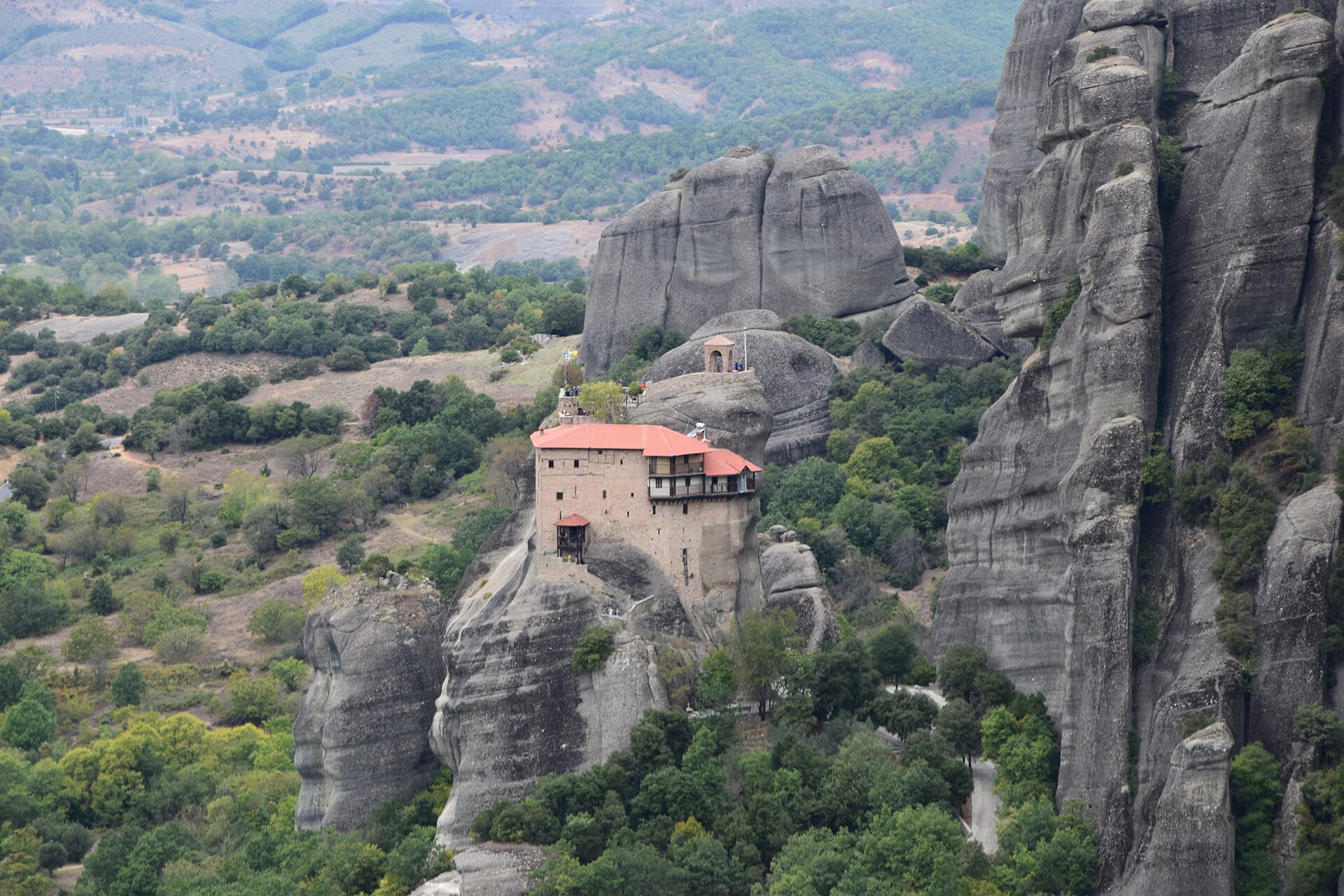
Perched on one of Meteora’s towering rock formations, the Monastery of Saint Nicholas Anapafsas feels less like a building and more like an extension of the stone itself. Its name, translating roughly to "a place of rest," hints at the quiet refuge it has offered for centuries. The monastery clings to a narrow, near-vertical pinnacle, its walls rising seamlessly from the rock as if carved by nature rather than human hands. Reaching it requires a climb up a winding path and a flight of stone steps hewn into the mountainside, a journey that takes about twenty minutes. The ascent isn’t just physical—it’s a gradual shedding of the outside world, each step drawing you closer to the stillness that defines this place.
The monastery dates back to the early 14th century, a time when Meteora’s inaccessible cliffs became a sanctuary for monks fleeing the chaos of the world below. Saint Nicholas Anapafsas was among the first monastic communities established here, though its exact origins are lost to time. By the 16th century, it had been rebuilt and expanded, yet its core architecture remained unchanged. The main church, or katholikon, is small and sturdy, with thick walls and low vaults designed to withstand the elements. Inside, the space is intimate, almost protective, with frescoes covering every surface. These were painted in the 16th century by Theophanes the Cretan, one of the most celebrated iconographers of the Byzantine world.
The frescoes here are striking not for their grandeur, but for their restraint. Unlike the more elaborate works in Meteora’s larger monasteries, these images carry a quiet intensity. The faces of saints seem to follow you, their expressions shifting subtly as you move through the church. The scene of the Last Judgment on the western wall is particularly haunting—not because of its scale, but because of its immediacy. There’s no distance between the viewer and the divine here, just a sense of inevitability. Theophanes’ work is a masterclass in late Byzantine art, blending technical precision with emotional depth. That these frescoes have survived in such good condition makes them all the more remarkable.
This was never a wealthy or populous monastery. At its peak, only a handful of monks lived here, and after the Ottoman conquest of Greece, it fell into decline. By the 19th century, it stood abandoned, its buildings slowly surrendering to time. Restoration efforts began in the mid-20th century, and today it functions as an active monastery once again, though it remains home to only a few monks. Unlike Meteora’s more famous monasteries, Saint Nicholas Anapafsas sees few visitors. There are no crowds, no tour groups, no raised voices—just the wind whispering through the rocks and the soft light filtering through narrow windows.
The architecture is simple and purposeful. The main structure is a compact cluster of rooms built from local stone, its weathered surfaces blending into the rock. The katholikon sits at the heart of the complex, surrounded by monks’ cells, a refectory, and a small library. The roofs are tiled, the windows narrow like arrow slits—a practical choice in an era when raids were a constant threat. Inside, the thick walls and low ceilings create a sense of warmth and security, even on the coldest days. The stone floors and heavy beams speak of a life built around necessity rather than comfort.
For those who visit, the monastery offers more than just a glimpse into the past. It’s a place where the line between human and nature blurs, where every stone and fresco tells a story. The library, though small, holds ancient manuscripts written by hand—some religious texts, others records of daily life. Many have been lost over the centuries, but those that remain offer a rare window into the rhythms of monastic existence. There are no grand narratives here, just the quiet accumulation of lives lived in devotion and solitude.
From the monastery’s heights, the view stretches across Meteora’s dramatic landscape. Other monasteries dot the cliffs like sentinels, while the Pineios River winds through the valley below. On clear days, the horizon seems endless, the air so crisp it feels like you could reach out and touch the distant mountains. As the sun sets, the rocks glow in shades of gold and rose, their shadows stretching long and soft across the land. In these moments, the monastery feels suspended in time, a place where the outside world’s noise fades into silence.
Visiting Saint Nicholas Anapafsas requires a certain respect for tradition. Women are asked to wear long skirts or dresses, men long pants, and all visitors must cover their shoulders. These aren’t just rules—they’re part of a centuries-old practice of reverence. There are no souvenir shops or cafes here, just a small display of icons and religious artifacts. The absence of modern distractions makes it easier to sit in the quiet, to listen to the echo of footsteps in empty halls, and to reflect on the generations of monks who once called this place home.
What makes this monastery special isn’t its size or fame, but its authenticity. It doesn’t demand attention or awe; it simply exists, as it has for centuries, a testament to human resilience and faith. Here, you can feel the weight of history in the cool stone under your hands, hear the silence that isn’t just an absence of sound but a presence of its own. It’s a place where the past isn’t just remembered—it’s still alive, breathing in the wind that sweeps across the cliffs. And perhaps that’s why it lingers in the mind long after you’ve descended the steps and returned to the world below.