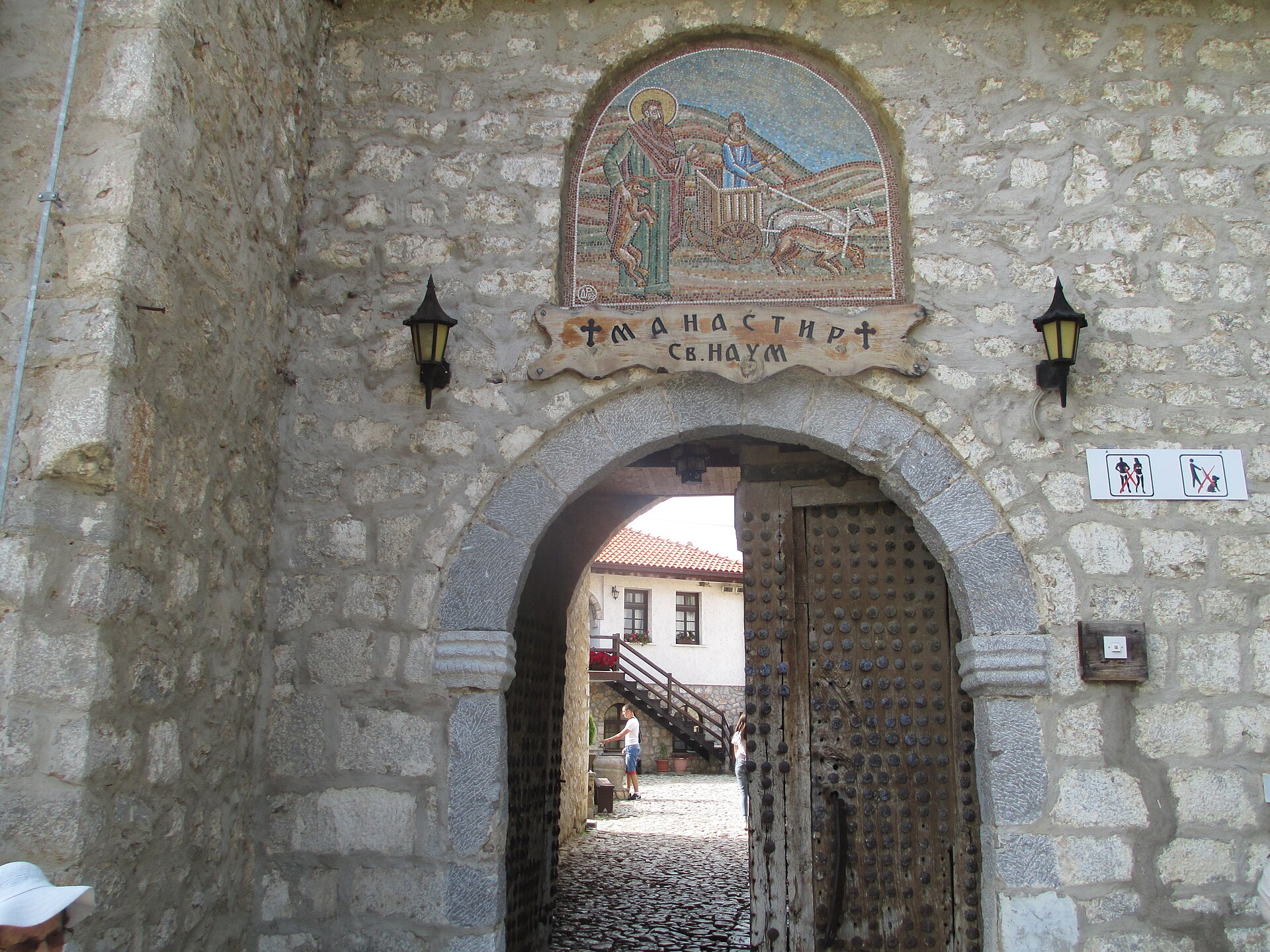
Saint Naum Monastery sits where the southern shore of Lake Ohrid softens into low hills, their slopes covered in oak and pine. The water here is quiet, lapping against the stones, and the place feels far removed from the usual tourist trails. People don’t come for grand architecture or museum displays. They come for stillness.
The road to the monastery winds through villages of stone houses and small vineyards, then follows the lake for the last few kilometers. On clear days, the water is so transparent that you can see the bottom several meters down, the sunlight catching the ripples like scattered coins. The air carries the scent of wet earth and pine, and the only sounds are the occasional call of a bird or the distant hum of a boat engine.
The monastery was founded in the late ninth century by Saint Naum of Ohrid, a disciple of Saints Cyril and Methodius. He spent his final years here, establishing a community that became a center of Slavic literacy. Naum died in 910 and was buried within the monastery walls. His relics remain in a small chapel attached to the main church, a quiet corner where visitors often pause, whether out of reverence or simple curiosity.
Over the centuries, the monastery was rebuilt several times, yet it retained its role as a spiritual and cultural heart of the region. The main church, dedicated to the Holy Archangels Michael and Gabriel, blends Byzantine influences with local building traditions. Inside, the walls are covered in frescoes from the thirteenth and fourteenth centuries—saints with solemn expressions, scenes from the life of Christ, and one of the few known portraits of Naum himself, painted during his lifetime. The light inside is dim, filtering through narrow windows to illuminate the faces of the saints in patches, as if they emerge from the shadows only when you look closely.
Beside the church, a spring bubbles up from the ground. According to legend, the water appeared after Naum prayed for it, and it has been flowing ever since. The water is always cold, even in the height of summer, and people come to fill bottles or splash their faces. A small garden surrounds the spring, with benches where you can sit and listen to the water trickling over the stones. Locals say that in the past, pilgrims traveled here from across Macedonia and beyond, drawn by the belief in the water’s healing properties.
The monastery grounds are shaded by old trees, their branches sheltering the monks’ cells, a refectory, and other outbuildings. During the socialist era, the site was repurposed as a retreat, but today it functions as an active monastery again, though only a handful of monks live here. In summer, the place hums with activity—tourists wandering the paths, families picnicking by the lake, and the occasional service in the church. Winter brings a different kind of quiet, the buildings dusted with snow, the only movement the slow drift of leaves across the empty courtyards.
Just a few kilometers away, the border with Albania cuts across the landscape. From the nearest hill, the lake stretches out until it blurs into the horizon, the water and sky merging into a single expanse of blue. On clear days, you can make out the faint outline of mountains on the Albanian side. Nearby, the cave church of Saint Stephen holds frescoes from the twelfth century, and the village of Trpejca is known for its traditional stone houses. But many visitors don’t venture far. They come to walk along the shore, listen to the water, and breathe in the scent of pine and damp earth.
The best times to visit are early morning or late evening, when the crowds thin out and the monastery settles into its own rhythm. The monks go about their routines, the spring continues its quiet murmur, and the lake reflects the changing light. It’s easy to lose track of time here, to sit on a bench and watch the shadows lengthen without thinking of anything in particular. That, perhaps, is why people keep returning—not just the faithful, but anyone in search of a place where the world feels a little slower, a little softer.