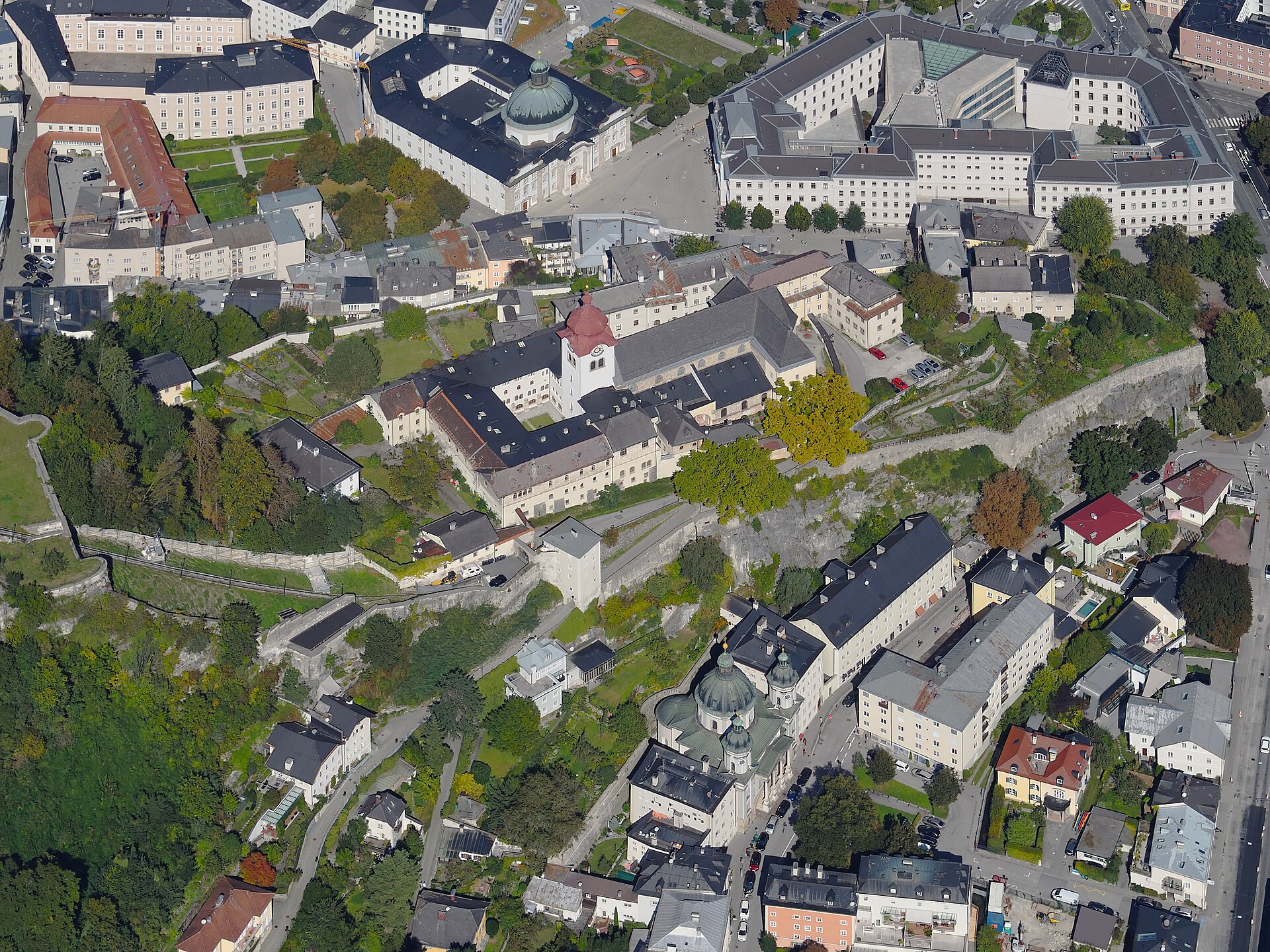
Perched on a gentle hill beneath the imposing bulk of Hohensalzburg Fortress, Nonnberg Abbey feels like a place where time has quietly settled into its own rhythm. This is not just one of Salzburg’s oldest landmarks but a living piece of history, its origins stretching back to the early 8th century. Founded in 714 by Saint Rupert, the first bishop of Salzburg, it holds the distinction of being the oldest continuously active women’s convent in the German-speaking world. For over a thousand years, its walls have witnessed the rise and fall of empires, the shifting tides of faith and culture, yet the Benedictine sisters who reside here have maintained their way of life with a steadfast devotion to the Rule of Saint Benedict.
The abbey’s architecture tells a story of endurance and adaptation. The oldest surviving structure, the Romanesque basilica, dates to the 11th century, though the complex has undergone numerous renovations over the centuries. Inside, the church strikes a balance between simplicity and grandeur—frescoes from the 12th century, an intricately carved wooden altar, and an organ that has filled the space with music for generations. The crypt, home to the relics of Saint Erentrudis, the abbey’s first abbess and Salzburg’s patron saint, offers a glimpse into early medieval artistry, with fragments of wall paintings that have survived the passage of time.
Nonnberg Abbey has long been intertwined with the city’s identity. In the Middle Ages, it served as both a spiritual sanctuary and an educational hub, where daughters of noble families received instruction in a school renowned across the region. The Baroque era brought a period of flourishing, as the abbey’s buildings were redesigned in the fashionable style of the time, and its library expanded with rare manuscripts. Yet history was not always kind—fires, wars, and the secularization of the early 19th century threatened its existence. Against the odds, the abbey endured, and today it stands much as it did in its most prosperous days.
Visiting Nonnberg is less about ticking off a tourist attraction and more about stepping into a different pace of life. While the living quarters of the sisters remain private, the public areas offer a sense of quiet reverence. The cloister, with its arched walkways, invites contemplation, and the church exudes a stillness that contrasts sharply with the bustle of Salzburg’s more crowded sights. In summer, roses bloom in the garden; in winter, snow dusts the ancient rooftops, creating a scene that feels untouched by the centuries.
Music has always been a vital part of life at Nonnberg. The abbey’s choir is celebrated beyond Austria’s borders, and their voices during services draw both pilgrims and music lovers. Concerts held within the basilica often feature medieval compositions, some written specifically for this space. Listening to Gregorian chants echo under the vaulted ceilings, it’s easy to understand why the abbey has inspired generations of musicians and artists.
Legends and history blur at Nonnberg, none more famous than the tale linking the abbey to Mozart. According to local lore, his mother, Anna Maria, was the daughter of the convent’s abbess, and the young composer may have played the abbey’s organ as a child. While historians debate the accuracy of this story, the abbey does hold a tangible connection to Mozart—manuscripts in his handwriting are preserved in its archives, and a plaque in the church commemorates his ties to the place.
Today, Nonnberg Abbey remains an active religious community and a cornerstone of Salzburg’s cultural heritage. Recognized as part of the UNESCO-listed historic center, it attracts visitors seeking more than just a glimpse of the past. Some come for spiritual reflection, others for the chance to walk in the footsteps of history. There are no grand palaces or festival crowds here, just the quiet persistence of a place that has outlasted empires and fashions, offering something increasingly rare in the modern world—a sense of timelessness.