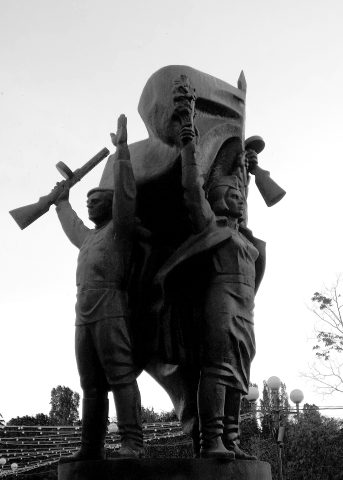
The Eternal Flame Memorial in Belgorod is one of those places where history feels tangible, not just something read about in books. Situated in the heart of the city on Sobornaya Square, it stands beside the white-stone Transfiguration Cathedral, forming a quiet but powerful presence in the daily life of the city. This isn’t just a monument tucked away in a park—it’s part of the urban fabric, a place where people naturally gather, whether for official ceremonies or personal reflection. On Victory Day, Defender of the Fatherland Day, and other significant dates, the square fills with crowds, but even on ordinary days, you’ll find visitors pausing here, laying flowers, or simply standing in silence.
The memorial’s origins trace back to the brutal fighting that took place in Belgorod during World War II. The city was occupied, liberated, and nearly destroyed in the fierce battles of 1943, particularly during the struggle for a strategically vital bridgehead. After the war, Belgorod was rebuilt, and decades later, in 1985, the memorial was unveiled to mark the 40th anniversary of Victory. Its design is straightforward yet striking: at its center burns the Eternal Flame, surrounded by granite slabs inscribed with the names of local soldiers who never returned. Encircling the flame are steles adorned with bas-reliefs depicting scenes from the war—soldiers in combat, civilians enduring hardship, and the slow, painful work of rebuilding. The images aren’t overly detailed, but they capture the essence of resilience and shared sacrifice.
The architecture of the memorial follows the restrained, symbolic style typical of Soviet-era war monuments. There’s no ornate decoration, just a deliberate focus on meaning. The flame, burning day and night, represents unbroken memory, while the engraved names ground that memory in real lives. The bas-reliefs, though stylized, tell a story of collective endurance—of a city and a country that refused to break. The materials, mostly granite and bronze, give the complex a sense of permanence, as if it has always been part of the landscape.
For Belgorod, the memorial is more than a historical marker; it’s a place where the past is actively remembered. Schoolchildren come here for lessons on courage, veterans gather to share stories, and newlyweds often visit to pay their respects before starting their own lives together. In recent years, the memorial has become part of a larger commemorative space, with additional monuments nearby honoring other figures and events in the city’s history. This creates a sense of continuity, as if the square itself is a living archive where different layers of time coexist.
The atmosphere around the Eternal Flame shifts with the seasons. In summer, the square is lively, with families strolling and children playing on the grass, while the flame flickers steadily in the background. Autumn brings a quieter mood, the golden leaves contrasting with the gray stone, and the fire standing out against the overcast sky. Winter transforms the memorial into something almost solemn—the snow softens the edges of the granite, and the flame burns brighter in the cold air. At night, the complex is illuminated, its outlines sharp against the darkness, a reminder that memory doesn’t fade with the daylight.
Despite its solemn purpose, the memorial doesn’t feel distant or imposing. It’s integrated into the city’s rhythm, surrounded by cafes, shops, and pedestrian walkways. People pass by it every day, sometimes without a second glance, but on commemorative dates, the square takes on a different character. Military songs fill the air, poems are recited, and veterans share their experiences. These moments make history feel immediate, not just a chapter in a textbook but something that still shapes the present.
What makes the Eternal Flame Memorial special is its lack of pretension. There’s no grand rhetoric here, just the quiet persistence of memory—names carved in stone, a flame that never goes out, and the occasional rustle of leaves or murmur of voices. For many in Belgorod, it’s a familiar landmark, but its meaning runs deeper than mere familiarity. It’s a place that asks you to pause, to remember, and to consider what it means to carry the past forward. In that sense, it’s not just a monument to those who were lost, but a quiet call to those who remain.