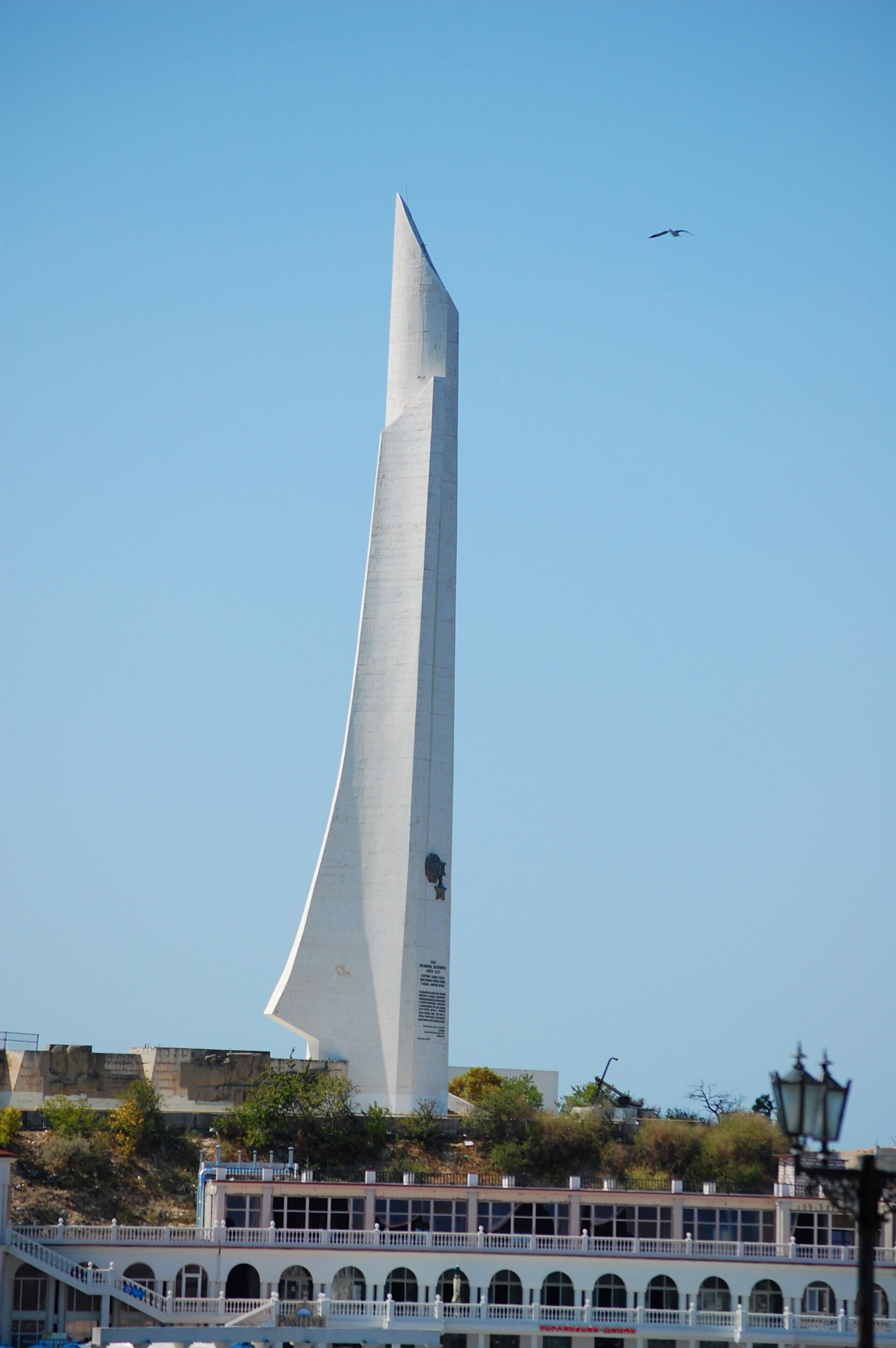
Perched on a bluff overlooking Sevastopol Bay, the *Bayonet and Sail* memorial feels like a quiet sentinel between land and sea. The location was chosen with care—this stretch of coastline has always been a vantage point, where the city’s defenders once scanned the horizon for approaching fleets. Now, instead of lookouts, the bay is framed by the monument’s two towering figures: a steel bayonet, rigid and unyielding, and a sail, its curves frozen mid-motion as if caught in an eternal gust of wind. The contrast between them isn’t just visual; it’s a conversation between the weight of war and the fleeting grace of peace.
The memorial was unveiled in 1977, a time when Sevastopol was still healing from the scars of the 20th century. The city had endured two brutal sieges—first during the Crimean War, when it held out for nearly a year against British, French, and Ottoman forces, and then in World War II, when Nazi troops surrounded it for 250 days. Those conflicts left behind more than ruins; they shaped the city’s identity. *Bayonet and Sail* doesn’t commemorate a single battle or hero. Instead, it honors the generations of sailors and soldiers who tied their fates to this harbor, whether they served on the decks of 19th-century frigates or manned anti-aircraft guns during the Soviet era.
Walking up to the monument, you notice how the ground slopes gently toward the water, as if the land itself is leaning into the sea. The bay below is never still. Ships glide in and out of the harbor, their wakes dissolving into the waves, while gulls wheel overhead. On clear days, you can see the opposite shore, where the earth still bears the faint outlines of old fortifications. The memorial doesn’t dominate the landscape so much as it anchors it, a fixed point amid the constant motion of water and sky. The designers kept the composition simple—no grand inscriptions, no dramatic poses—just the two shapes, stark against the horizon.
There’s a stillness here that’s hard to find in other parts of Sevastopol. The city is full of monuments, but many of them are loud, insistent, demanding attention. *Bayonet and Sail* is different. It doesn’t tell you what to feel. Some visitors linger for a few minutes, snapping photos before moving on. Others sit on the benches nearby, watching the light change over the water. On certain days, you might see veterans in old uniforms, their medals catching the sun as they lay flowers at the base of the monument. In the evenings, when the streetlights flicker on, the bayonet and sail cast long shadows that stretch toward the water, as if reaching back through time.
Sevastopol has always been a city of layers. Walk down any street, and you’ll pass 19th-century naval barracks next to Soviet-era apartment blocks, or a modern café tucked into the shell of a bombed-out building. The past isn’t just preserved here; it’s lived alongside the present. *Bayonet and Sail* fits into this rhythm. It doesn’t try to explain the city’s history—that’s what museums are for. Instead, it offers a space to pause, to look out at the bay and imagine the ships that have come and gone over the centuries, the men who sailed on them, and the battles fought on these shores.
The memorial’s power lies in its restraint. There are no names carved into the stone, no dramatic scenes of combat. Just the two symbols, standing side by side. The bayonet, of course, is unmistakable—a weapon, a tool of defense, a reminder of the violence that has shaped this place. The sail is more ambiguous. It could represent the Black Sea Fleet, which has called Sevastopol home for centuries, or the idea of journey, of venturing into the unknown. Together, they suggest something larger than themselves: the tension between destruction and creation, between holding the line and setting sail.
For locals, the monument is part of the fabric of the city. Some see it as a place of mourning, a spot to remember lost relatives or comrades. Others view it as a symbol of resilience, proof that Sevastopol has always found a way to endure. Tourists often come for the view—the way the bay unfolds below, the play of light on the water—but many leave with a sense of something deeper. It’s not the kind of place that leaves you with easy answers. Instead, it lingers in the mind, a quiet question about what it means to defend a place, to belong to it, to carry its history forward.
Sevastopol is a city that wears its past openly. You see it in the cannons mounted outside the naval museum, in the bullet holes still visible on some buildings, in the way older residents talk about the war as if it happened yesterday. *Bayonet and Sail* is one of those places where the past feels close enough to touch. It’s been standing here for nearly fifty years now, weathering storms and changing seasons. The metal has dulled slightly, the edges softened by time, but the monument hasn’t lost its presence. If anything, it’s become more a part of the landscape, as natural as the cliffs or the sea.
There’s no grand ceremony required to visit. You don’t need to know the details of every battle or the names of every admiral. The memorial works on a different level, one of quiet recognition. You stand there, looking out at the water, and you understand that this bay has seen empires rise and fall, that the ships in the harbor today are part of a lineage stretching back centuries. The wind carries the sound of waves, the cry of gulls, the distant hum of the city. And for a moment, it’s enough to just be there, to let the weight of the place settle over you.