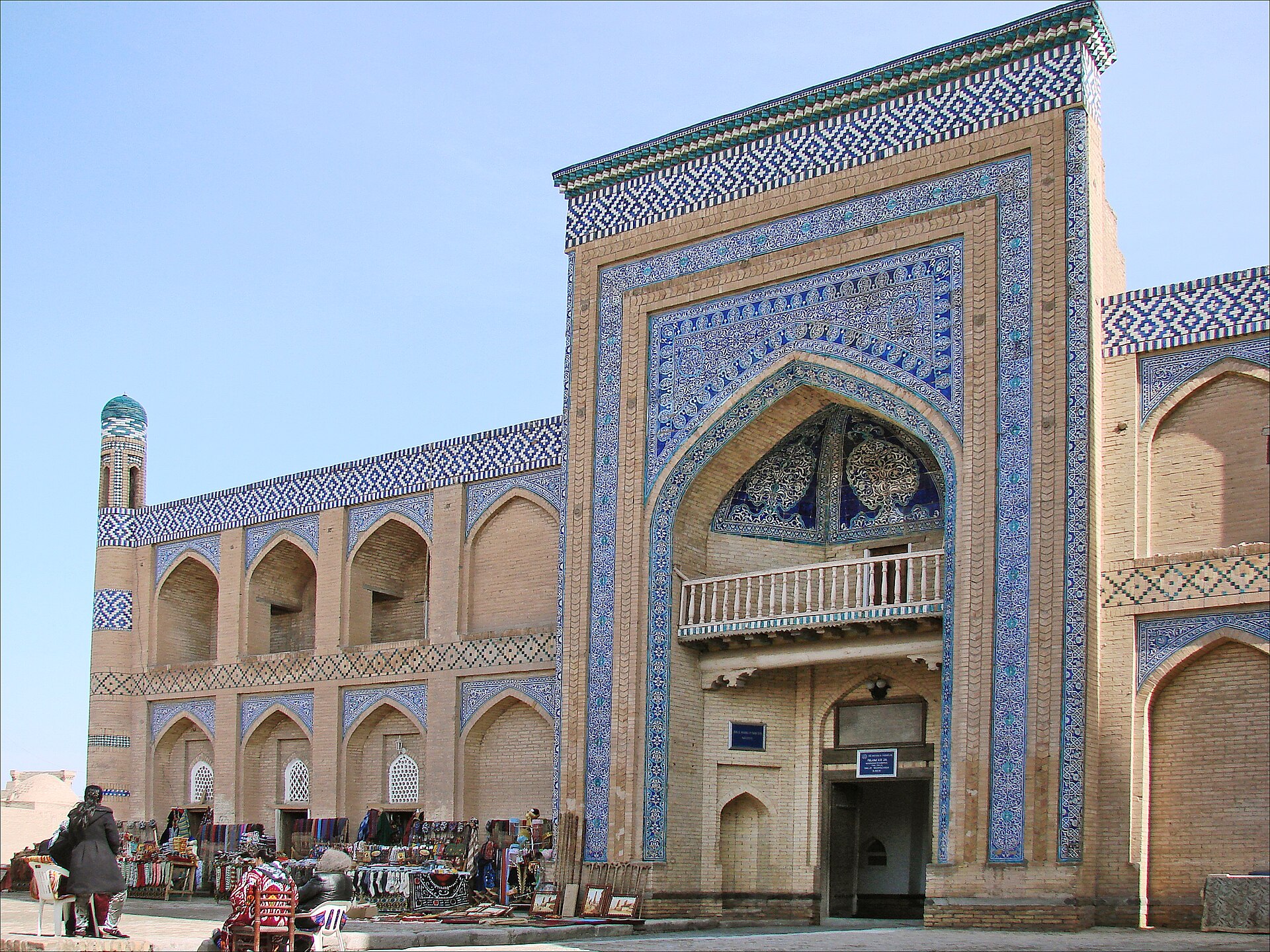
Islam-Khoja Madrasah stands as one of Khiva’s most striking landmarks, a building that feels both timeless and distinctly modern for its era. Completed in the early 20th century, it bridges the gap between the medieval traditions of Khorezm and the changing world of its time. Commissioned by Islam Khoja, a vizier and reformer, the madrasah was more than just an educational institution—it was an attempt to blend religious scholarship with the progressive ideas sweeping through Central Asia. Today, it draws visitors not only for its spiritual significance but for the way it captures the tension between old and new, a place where history feels alive rather than preserved behind glass.
The architecture of Islam-Khoja Madrasah is a study in contrasts. The façade follows the familiar patterns of Khivan design—elaborate tilework, geometric motifs, and arched portals that echo the grandeur of earlier Islamic architecture. Yet there are details that set it apart. The towering minaret, the tallest in Khiva, was a bold departure from tradition, its height making it visible for miles across the flat desert landscape. The courtyard, too, was unusually spacious, designed to accommodate not just classrooms but a library and gathering spaces. At sunset, the minaret glows in the fading light, its bricks turning gold, a beacon for travelers approaching the city.
Step into the inner courtyard, and the outside world fades away. The space is quiet, almost meditative, just as it must have been a century ago. Small cells, or *hujras*, line the perimeter—once the living quarters for students, now home to artisans practicing traditional crafts. Potters shape clay, weavers work at their looms, and woodcarvers chisel intricate patterns, their tools echoing the sounds of generations past. In the center, a shallow pool reflects the sky and the madrasah’s walls, a simple but effective way to cool the air in the summer heat. It’s easy to linger here, watching the play of light on the tiles or listening to the distant murmur of voices.
Islam Khoja didn’t just build a madrasah; he envisioned a community hub. The complex originally included a mosque, a caravanserai, and a public bath, though not all of these structures survive today. Even in its partial state, the site offers a glimpse of how ambitious the project was. The madrasah wasn’t just a school—it was a place where people gathered to trade news, negotiate deals, and socialize. The vizier understood that education and public life were intertwined, and his design reflected that belief. The remaining buildings, though fewer in number, still convey the sense of a place that was once the heart of Khiva’s daily life.
Today, Islam-Khoja Madrasah remains an active religious school, where students study theology and the Quran much as they have for generations. The curriculum has evolved, but the rhythms of life here haven’t changed entirely. Students still live in the *hujras*, participate in prayers, and engage with ancient texts. While visitors aren’t typically allowed inside the classrooms, the atmosphere of the place seeps through the walls—disciplined yet warm, a living tradition rather than a relic. The madrasah’s dual role as both a historical monument and a functioning institution makes it unique, a rare place where the past isn’t just remembered but actively lived.
The madrasah takes on a different character in the evening. As the sun sets, lanterns cast a soft glow over the courtyard, and the minaret’s shadow stretches across the walls. The crowds thin, and the quiet returns, broken only by the rustle of leaves or the distant call to prayer. Khiva is beautiful at dusk, but Islam-Khoja Madrasah feels especially magical in these hours. Time seems to slow, and for a moment, it’s possible to imagine the early 1900s, when the building was new and the ideas it represented were still taking shape. The air is cooler, the light gentler, and the sense of history more tangible.
Islam Khoja’s legacy is inseparable from the madrasah that bears his name. As a vizier, he was more than an administrator—he was a reformer who sought to modernize Khiva without erasing its identity. His efforts left a lasting mark on the city, though his own life ended tragically. Executed on the orders of the khan, he didn’t live to see the full impact of his work, but the madrasah stands as a testament to his vision. It’s a reminder that in Central Asia, as in many places, history is often shaped by individuals—people who, without holding formal power, manage to leave an indelible imprint on the world around them.
Visiting Islam-Khoja Madrasah is a reminder of how much of Central Asia’s history hinges on personal ambition and creativity. One man’s ideas could transform a city, inspire artisans to create lasting beauty, and shape the lives of generations. Islam Khoja wasn’t a ruler, yet his influence on Khiva outlasted many dynasties. The madrasah isn’t just a tourist attraction; it’s a living piece of history, proof that some ideas are stronger than time. In its walls, the past isn’t just preserved—it’s still unfolding, one student, one artisan, one visitor at a time.