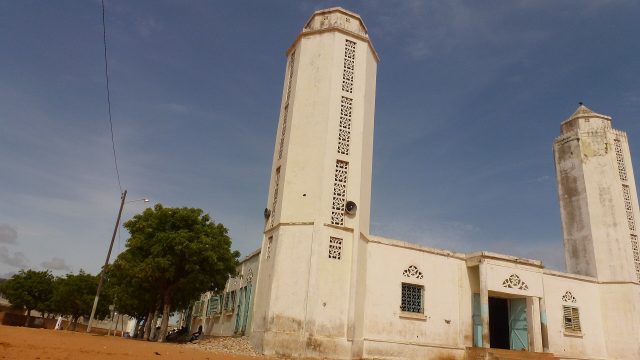
Hann Mosque sits quietly on the edges of Dakar, where the city’s restless energy begins to soften into the slower rhythms of the coastal neighborhoods. Unlike the grand mosques that dominate the capital’s center, this one is unassuming—its pale stone walls and modest minaret blending into the everyday life of Hann Bel-Air. Yet for those who live here, it holds a significance that goes beyond its size. The architecture is familiar to anyone who has seen West African Islamic places of worship: low walls, a simple courtyard, and a pointed spire that catches the light at dawn and dusk. Inside, the space is open and airy, designed not for spectacle but for reflection.
The story of the mosque is woven into the history of Hann Bel-Air itself. In the mid-20th century, this was the outskirts of Dakar, a place where laborers arrived to build the port and industrial zones that would shape the city’s growth. As the neighborhood took form, so did the need for a place of worship. What began as a small prayer house expanded over time, growing alongside the community it served. Today, it stands as a testament to the people who built it—not with wealth or grand designs, but with persistence and shared purpose.
Step inside, and the simplicity of the mosque becomes its strength. The floors are covered in woven mats, the walls bear only the faintest geometric patterns, and sunlight filters through high windows, casting gentle shadows. There are no chandeliers or gilded domes, no ornate calligraphy competing for attention. Instead, the space feels intimate, almost domestic, as if inviting visitors to pause rather than marvel. On Fridays, when the courtyard fills with worshippers, the air hums with quiet conversation and the scent of incense, a reminder that this is a place where faith is lived, not just observed.
Beyond its religious role, the mosque serves as a hub for the neighborhood. Children attend Quranic lessons in its shaded corners, elders gather to discuss community matters, and during festivals like Eid al-Fitr and Eid al-Adha, the courtyard transforms into a center of celebration. For many in Hann Bel-Air—fishermen, dockworkers, shopkeepers—this is where they come to unwind, to share news, or simply to sit in silence. Outsiders might see it as just another local mosque, but for those who call this place home, it’s a thread that connects them to something larger than themselves.
The area around the mosque offers a glimpse into Dakar’s less polished side. Hann Bel-Air is a working-class district, far from the tourist maps, where life moves at its own unhurried pace. Nearby, Hann Beach stretches along the coast, a quiet stretch of sand where locals escape the city’s heat. Unlike the crowded beaches closer to downtown, this one feels almost private, with fishing boats lined up along the shore and vendors selling fresh catch straight from the sea. The salt-tinged breeze and the sound of waves make it easy to forget you’re still in the capital.
If you visit, timing matters. Early mornings are best, when the sun is gentle and the mosque is at its most serene. The doors are open to everyone, but it’s worth remembering a few courtesies: women should cover their heads and shoulders, and men should avoid shorts. Inside, voices are kept low, and photography is best done with permission. The people here are welcoming, often happy to share stories if you show genuine interest, but it’s important to respect the space as their own.
Hann Mosque won’t appear in most travel guides, and that’s part of its charm. It’s not a monument to be admired from a distance but a living part of the neighborhood, shaped by the people who use it every day. There are no souvenir stalls or tour groups here, just the quiet rhythm of prayer and the occasional laughter of children playing in the courtyard. For those willing to look beyond the obvious, it offers something rare—a chance to see Senegal not as a postcard, but as a place where faith, community, and daily life intersect in the most ordinary and profound ways.