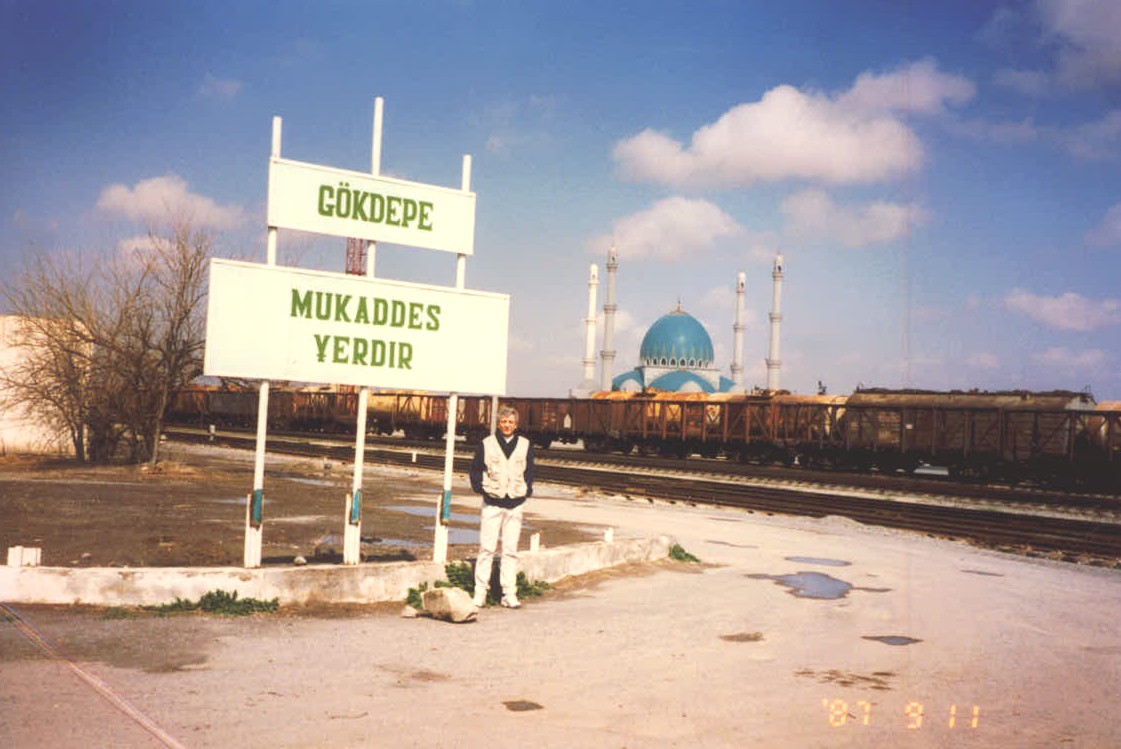
On the outskirts of the small town of Chaacha, far from the well-trodden paths of Turkmenistan’s more famous landmarks, stands the Saparmurat Hajji Mosque. Its gleaming white domes and towering minarets rise above the surrounding landscape, catching the sunlight in a way that makes the marble walls shimmer like a mirage. The mosque isn’t just an architectural monument; it’s a quiet testament to a time when Turkmenistan was redefining itself, building not only structures but also a sense of identity. Constructed in the late 1990s during the presidency of Saparmurat Niyazov, it was named in honor of his father, who perished in the devastating 1948 Ashgabat earthquake—a tragedy still etched in the nation’s memory.
The design of the mosque blends traditional Islamic elements with distinct Turkmen influences. The central dome, flanked by four smaller ones, symbolizes unity—both of faith and of the people. Inside, the space is simple yet elegant, with walls adorned by intricate Quranic calligraphy and floors covered in handwoven carpets. The mihrab, the niche pointing toward Mecca, is particularly striking, carved from smooth marble that seems to glow under the soft light filtering through the windows. Outside, a small garden with fountains offers shade from the sun, a peaceful retreat where visitors can sit and listen to the gentle sound of water.
Though not a major pilgrimage site, the mosque holds deep significance for the people of Chaacha and the surrounding villages. On Fridays, worshippers gather for communal prayers, and during religious holidays, the courtyard fills with families and friends. At other times, the mosque is quiet, its stillness broken only by the occasional footsteps of someone coming to pray or simply seeking a moment of solitude. There’s no rush here, no sense of urgency—just the unhurried rhythm of life that defines much of Turkmenistan.
The mosque’s history is closely tied to the legacy of Niyazov, who ruled the country during a period of intense nation-building. Known as Turkmenbashi, he saw religious architecture as a way to reinforce national pride, and the mosque in Chaacha was one of many built under his leadership. Yet there’s something uniquely poignant about this place. By naming it after his father, Niyazov wove personal grief into the fabric of public memory, creating a space where the past and future could coexist. The earthquake that claimed his father’s life was a turning point for Turkmenistan, and the mosque stands as a quiet reminder of resilience.
Unlike the grand monuments of Ashgabat, the Saparmurat Hajji Mosque doesn’t draw crowds of tourists. That’s part of its charm. There are no guided tours here, no souvenir stalls—just the mosque itself, its white walls contrasting with the vast, open sky. For travelers who venture beyond the capital, it offers a glimpse into the everyday spirituality of the region, where faith and daily life intertwine naturally. It’s a place where history isn’t just preserved in stone but lived, day by day, by the people who call this corner of Turkmenistan home.
The mosque is also a striking presence against the backdrop of the Karakum Desert, which begins almost at its doorstep. The shifting sands of the desert, stretching endlessly toward the horizon, make the mosque’s solidity all the more remarkable. In the scorching summer months, the heat rises in waves from the dunes, and the mosque’s white marble seems to float above the earth. In winter, the air is cooler, but the sun still warms the stone, casting long shadows across the courtyard. Sitting on one of the benches, watching the minarets reach toward the sky, it’s easy to forget the harshness of the desert just beyond the walls.
Over the years, the mosque has witnessed change—political shifts, economic challenges, and the slow evolution of Turkmen society. Yet it remains a place of solace, a constant in a landscape that is otherwise in flux. Perhaps that’s why it feels so at home here, nestled between the desert and the town. It wasn’t built to impress or to stand as a monument to power, but to serve a purpose—to offer a space for reflection, for prayer, for quiet moments of connection. In that sense, it’s more than just a building; it’s a living part of the community, shaped by the people who visit it and, in turn, shaping their lives.
For those who take the time to visit, the mosque offers a different kind of experience—one that’s less about sightseeing and more about understanding. There’s no need to rush, no scripted narrative to follow. Instead, there’s the chance to sit in the garden, watch the light play across the marble, and listen to the distant sounds of the town. It’s a reminder that some of the most meaningful places aren’t the ones that make it into guidebooks, but the ones that quietly endure, holding within their walls the stories of those who pass through.