Nicosia’s Ömeriye Mosque stands as a quiet witness to the city’s layered past, where Ottoman grandeur meets the remnants of medieval Cyprus. Built in the 16th century on the site of a former Augustinian monastery, the mosque carries the name of Caliph Omar, a figure revered in Islamic tradition. The original monastery, dedicated to Saint Mary, had been a place of worship for centuries before the Ottoman conquest, and its stones were repurposed to create something new—yet traces of its earlier life linger in the architecture. The thick walls, arched windows, and sturdy buttresses still hint at the Gothic style of the 14th century, even as the minaret and prayer hall mark the building’s transformation into a Muslim place of worship.
The mosque’s courtyard is one of its most striking features, a peaceful space where the weight of history feels almost tangible. The old fountain at its center, though no longer in use, was once a place for ritual ablutions, its worn stone surface smoothed by generations of hands. Around it, the courtyard is framed by a low colonnade, its arches supported by slender columns that seem almost too delicate for the weight of time. The play of light and shadow here changes with the hours, casting shifting patterns across the flagstones, and on quiet afternoons, the only sounds are the rustle of leaves from the surrounding trees and the occasional call to prayer drifting from the minaret.
Inside, the prayer hall is simple but imposing, its high ceiling supported by thick stone pillars that divide the space into a series of vaulted bays. The mihrab, the niche indicating the direction of Mecca, is modestly decorated, its lines clean and uncluttered. The walls, once adorned with frescoes from the monastery’s Christian era, were whitewashed during the Ottoman period, though faint traces of color can still be glimpsed in the right light. The wooden minbar, from which the imam delivers sermons, is one of the few decorative elements, its carvings subtle but precise. The overall effect is one of restraint, a space designed for reflection rather than spectacle.
What makes Ömeriye Mosque particularly interesting is how it embodies Nicosia’s role as a crossroads of cultures. The city has been ruled by Byzantines, Lusignans, Venetians, Ottomans, and British, each leaving their mark on its streets and buildings. The mosque itself sits in the heart of the old city, within the Venetian walls that once defined Nicosia’s boundaries. These walls, built in the 16th century to defend against Ottoman invasion, now encircle a labyrinth of narrow streets where Ottoman-era houses stand beside medieval churches and neoclassical facades. The mosque’s location, just a short walk from the bustling Ledra Street crossing into the northern part of the city, places it at the center of this historical tapestry.
For visitors, the mosque offers more than just a glimpse into Islamic architecture—it’s a place where the past feels immediate. Unlike grander monuments, Ömeriye doesn’t overwhelm with scale or ornamentation. Instead, it invites a slower kind of observation, the kind that comes from sitting on one of the benches in the courtyard or running a hand along the cool stone of the walls. The building has seen centuries of change, from the fall of the Lusignan Kingdom to the division of Nicosia in 1974, yet it remains a functioning place of worship, its doors open to those who wish to enter.
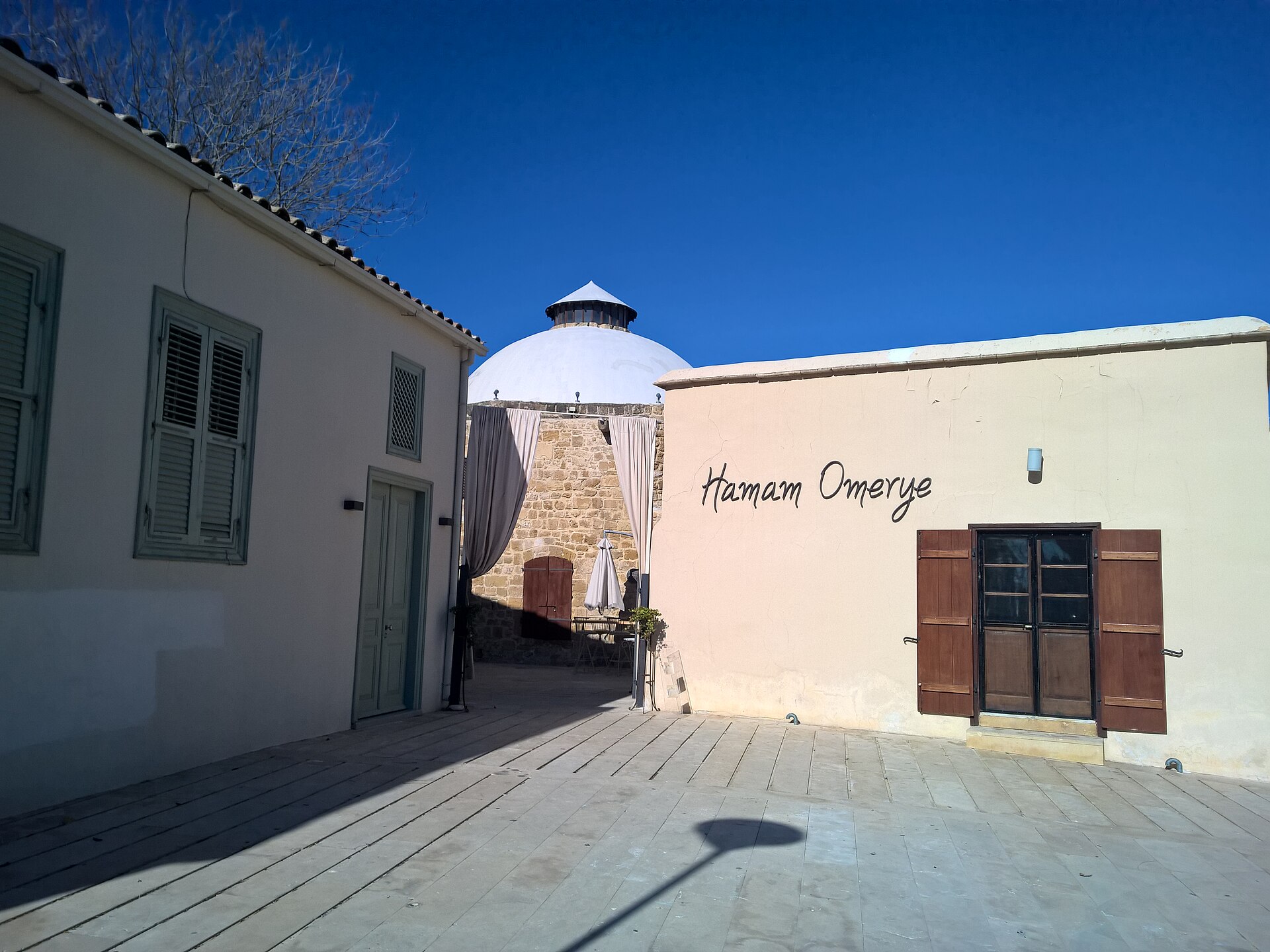
The surrounding neighborhood, known as the Ömeriye Quarter, adds to the mosque’s character. Here, the streets are quieter than in the commercial heart of the city, lined with low-rise buildings that have seen better days but retain a certain charm. A few small cafes and workshops occupy the ground floors, their presence a reminder that life in Nicosia has always been lived in the spaces between history’s grand narratives. Nearby, the old bathhouse, Hamam Ömeriye, offers another glimpse into Ottoman-era daily life, its domed roof and steam rooms still in use after centuries.
One of the most poignant aspects of Ömeriye Mosque is how it reflects the complexities of Cyprus itself. The island’s history is one of coexistence and conflict, of empires rising and falling, and the mosque stands as a symbol of that duality. It was built on the ruins of a Christian monastery, yet today, it serves a Muslim community in a city that remains divided. The Green Line, the buffer zone that splits Nicosia into Greek and Turkish Cypriot halves, runs just a few hundred meters away, a stark reminder of the island’s unresolved tensions. Yet within the mosque’s walls, there is a sense of continuity, a place where the past is not erased but acknowledged.
For those who take the time to visit, Ömeriye Mosque offers a moment of stillness in a city that has seen so much upheaval. It’s not a place that demands attention in the way that grand cathedrals or ancient ruins might, but that’s part of its appeal. Here, history is not performed for tourists; it simply exists, in the worn steps of the courtyard, the quiet hum of the prayer hall, and the way the light falls through the arched windows. It’s a building that has adapted to change without losing its essence, and in doing so, it tells a story that is as much about Cyprus as it is about itself.