Juma Mosque in Bustan is one of those places that doesn’t reveal itself at first glance but lingers in the mind long after you’ve left. Tucked away in a quiet town far from the usual tourist trails, it stands as a quiet witness to the slow, unhurried rhythm of life here, where past and present blend so seamlessly that it’s hard to tell where one ends and the other begins. Bustan itself isn’t the kind of place that makes it onto must-see lists—no grand madrasas like Samarkand, no bustling bazaars like Tashkent. Yet that very unassuming quality is what makes it special, just as the mosque, despite its outward simplicity, holds within it a piece of the region’s history.
Juma Mosque, or Friday Mosque, has always been more than just a place of worship. In Uzbekistan, these mosques traditionally served as the heart of community life, where people gathered not only for prayer but also to catch up on news, settle disputes, or simply escape the midday heat in the shade of its walls. In Bustan, it still plays that role today, though its appearance and interior have changed over the centuries. The building may not be grand, but its purpose has remained the same—a gathering place for the town’s residents, a space where faith and daily life intersect.
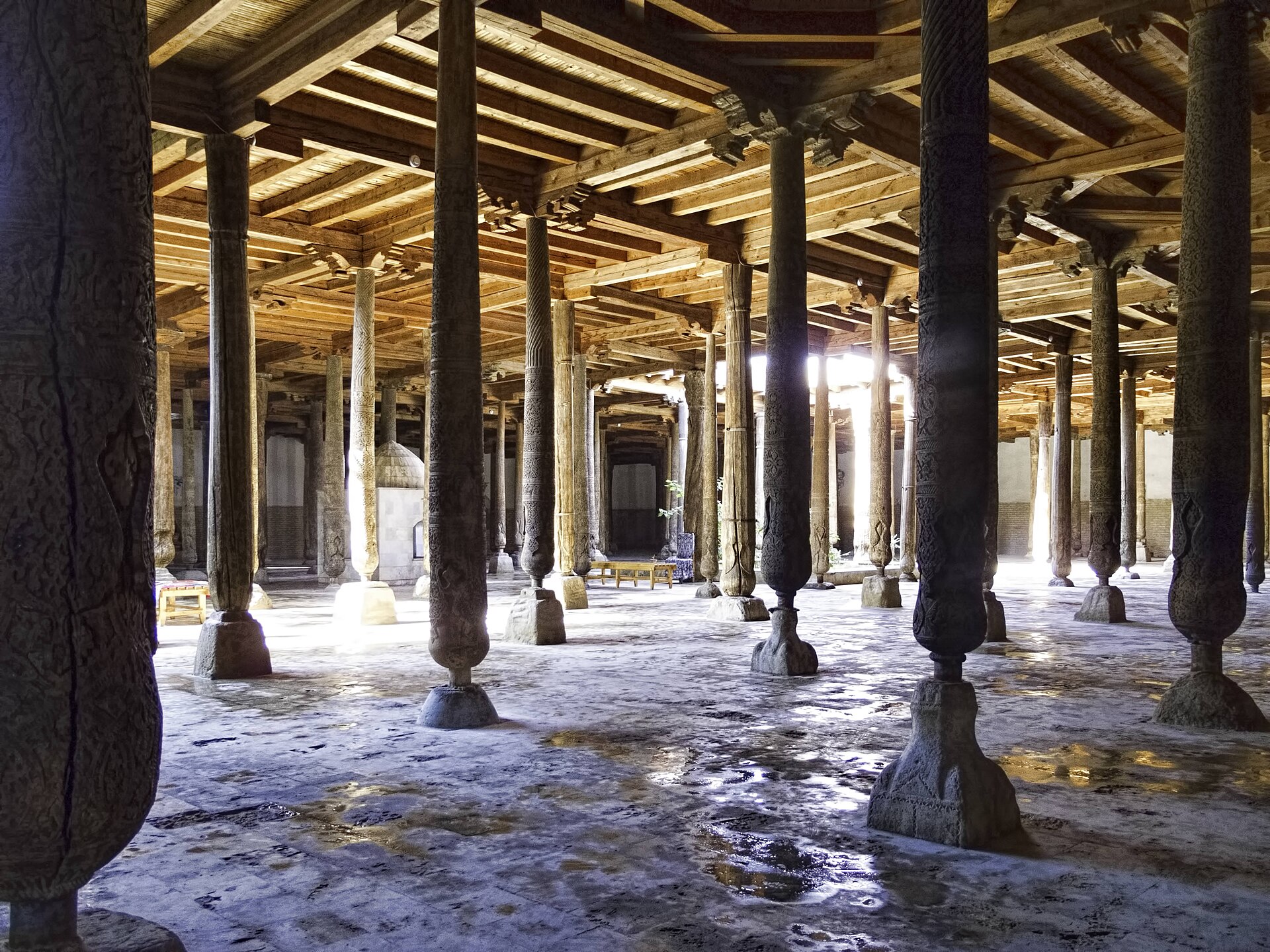
The architecture is typical of Central Asian mosques, yet it has its own distinct character. The structure is low and unassuming, with a flat roof supported by thick wooden columns. These columns are the mosque’s most striking feature, not just for their structural role but for the intricate carvings that adorn them. Some date back to the mosque’s earliest days, their patterns—a mix of floral and geometric designs—telling a story etched in wood. The walls, made of sun-dried brick, are a testament to the materials used for centuries in this region. They may not last forever, but they’re perfectly suited to the climate, blending seamlessly with the landscape.
Inside, the mosque feels spacious and airy, with high ceilings that create a sense of openness. The mihrab, the niche pointing toward Mecca, is simple and unadorned, reflecting the understated spirit of Islam in these parts. The floors are covered with carpets, worn thin by time and use, their faded patterns adding to the sense that this is a living space, not a museum. In one corner stands the minbar, the pulpit from which the imam delivers sermons on Fridays. It’s an unassuming piece, yet it carries the weight of tradition, a reminder of the generations who have stood before it.
The mosque’s history is intertwined with that of Bustan itself, a town that has long been a small but important stop on the trade routes between Khorezm and the lands beyond the Amu Darya. The first records of Bustan date back to the medieval period, when caravans passed through, bringing goods and ideas from distant lands. The mosque likely originated around the same time, though no one knows for certain when it was first built. Over the centuries, it has been rebuilt countless times—after earthquakes, wars, or simply because wood and clay don’t last forever. Yet each time, it was restored with care, preserving its original spirit.
Today, Juma Mosque is still a place of worship, but it’s also a bridge between the past and the present. Life moves around it in its usual rhythm: children playing in the courtyard, elders chatting on benches, vendors from the nearby market stopping by for a moment’s rest. There’s nothing extraordinary about it, and that’s precisely what makes it feel real. Tourists rarely visit, so if you find yourself in Bustan, you’ll likely have the place to yourself. That quiet solitude offers a chance to see the mosque not as a tourist attraction, but as a part of everyday life, where every stone and beam carries the memories of those who have prayed here over the centuries.
Visiting the mosque doesn’t require much preparation, but it’s worth keeping a few things in mind. Dress modestly—women should wear long sleeves and a headscarf, while men should avoid shorts and sleeveless shirts. The mosque is open to visitors outside of prayer times, though it’s best to avoid entering during services. Photography isn’t common, especially during worship, but if you ask the imam or locals for permission, they’ll likely agree. The key is to be respectful, to move quietly, and to remember that this is a place of quiet reflection, not just a photo opportunity.
Bustan and its Juma Mosque won’t dazzle you with golden domes or marble floors. There are no grand frescoes or ornate decorations like those found in more famous Uzbek mosques. But that’s part of its charm. This is a place where time feels tangible, where history isn’t locked away in a display case but lives on in the creak of old wooden doors, the whisper of prayers, and the gentle rustle of the wind. If you ever pass through this part of the country, don’t rush by. Stop for a while, step inside, and sit in the shade of the columns. You might just find something here that can’t be seen with the eyes alone.