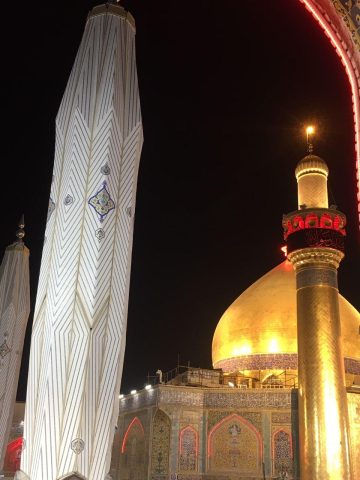
Al-Kadhimiya Mosque stands along the banks of the Tigris in Baghdad, a place where the weight of history presses against your skin. It is one of Iraq’s most sacred sites, home to the tombs of the seventh and ninth Shia imams, Musa al-Kadhim and Muhammad al-Taqi. For centuries, pilgrims have traveled here from across the Muslim world, drawn not just by devotion but by the quiet power of a place that has witnessed the rise and fall of empires, the ebb and flow of faith, and the unbroken thread of a community that has endured war, occupation, and time itself.
The mosque’s architecture tells its own story, layer upon layer of craftsmanship and belief. The golden domes, visible from afar, catch the light at dawn and dusk, turning the skyline into something almost otherworldly. Inside, the air is thick with the scent of incense and the murmur of prayers. The walls are covered in intricate tilework, patterns that shift with the light, while the ceilings shimmer with gold and deep blues. The silver lattice surrounding the imams’ tombs is so finely wrought it seems to dissolve into the air, a delicate barrier between the living and the sacred. Over the centuries, the mosque has been rebuilt and expanded, absorbing the influences of Abbasid grandeur, Persian elegance, and Ottoman solidity, each era leaving its mark without erasing what came before.
Al-Kadhimiya has always been more than a place of worship. In the medieval period, it was a center of learning, where scholars debated theology, copied manuscripts, and shaped the intellectual life of the Islamic world. The streets around the mosque buzzed with traders, pilgrims, and students, a microcosm of the broader Islamic empire. Even when Baghdad fell to invaders or crumbled under siege, the mosque remained a symbol of resilience. It was here that people came to mourn, to hope, to remember what endured when everything else seemed lost. The tombs of lesser-known scholars, poets, and saints lie scattered around the complex, their names fading but their presence still felt in the quiet corners of the courtyards.
Today, the mosque is both a spiritual anchor and a living archive. The surrounding area is dotted with madrasas, libraries, and small museums where ancient Qurans, handwritten centuries ago, sit alongside collections of coins, ceramics, and calligraphy. Some of these texts are so fragile they can only be displayed under glass, their pages whispering of a time when Baghdad was the heart of the Islamic Golden Age. During major religious festivals, like Ashura or the birthdays of the imams, the mosque becomes a sea of people—mourners beating their chests in rhythm, children clutching flags, the air thick with the scent of rosewater and sweat. For many Iraqis, Al-Kadhimiya is not just a place of pilgrimage but a cornerstone of identity, a reminder of what has survived when so much else has been lost.
Yet the mosque is no relic of the past. In recent decades, it has borne witness to some of Iraq’s darkest moments. During the Iran-Iraq War, the Gulf War, and the American invasion, the building suffered damage—shrapnel scars on the outer walls, cracked tiles, the occasional boarded-up window. Each time, the community rallied to restore it, donating money, labor, and whatever materials they could scavenge. Today, security is tight, with checkpoints and guards ensuring the safety of worshippers. Non-Muslim visitors may find some areas off-limits, but even the outer courtyards offer a sense of the mosque’s quiet power. The Tigris flows nearby, its waters carrying the same currents that have passed by these walls for over a thousand years.
What strikes visitors most is the atmosphere. There is no tourist hustle here, no vendors hawking trinkets or guides herding groups through the halls. Instead, there is a slow, deliberate rhythm—old men reciting the Quran under the shade of palm trees, women in black abayas kneeling in prayer, children playing quietly in the corners. In the evenings, when the call to prayer echoes over the rooftops, the mosque’s domes glow in the fading light, and the air hums with a kind of collective reverence. Even those who do not share the faith can feel the weight of the place, the way it holds the memories of generations in its stones.
For anyone interested in the history of Shia Islam, Al-Kadhimiya is indispensable. It is here that you can trace the evolution of a tradition—how it shaped politics, art, and daily life in the region. The mosque’s walls bear the names of scholars who shaped Islamic jurisprudence, poets who wrote verses still recited today, and ordinary people whose stories have been absorbed into the larger narrative of faith. There are no plaques or audio guides to explain it all; the history is in the worn steps, the faded inscriptions, the way the light falls through the latticework. You learn by observing, by listening to the stories of those who come here not as tourists but as pilgrims.
The neighborhood around the mosque is just as much a part of the experience. The streets are narrow and winding, lined with shops selling prayer beads, incense, and religious texts. Street vendors offer sweet tea and sticky pastries, their stalls tucked into the shadows of ancient buildings. In the evenings, families gather in small cafes, sipping bitter coffee and sharing news. The area has a lived-in feel, a place where history is not just preserved but actively used—where a 12th-century madrasa might stand next to a modern internet cafe, and where the call to prayer mingles with the sound of motorbikes and children’s laughter.
Visiting Al-Kadhimiya is not like visiting a museum. There are no neatly labeled exhibits, no prescribed route to follow. Instead, you wander, letting the space guide you—through the cool, dim halls, past the flickering candles, into the sunlit courtyards where the scent of jasmine lingers. For some, it is a deeply personal journey, a moment of connection to something larger than themselves. For others, it is a chance to see Iraq beyond the headlines, to understand the country not as a place of conflict but as a custodian of centuries of faith, art, and culture. The mosque does not demand reverence; it simply exists, a quiet testament to what endures.