The Al-Askari Mosque stands in the heart of Samarra, a city that has witnessed the rise and fall of empires, where the echoes of history still linger in the dust of its ancient streets. Though often overshadowed by more famous landmarks, this mosque carries a weight of its own—a quiet testament to the spiritual and political currents that have shaped Mesopotamia for over a thousand years. Built in the 9th century during the Abbasid Caliphate, it was once part of a grander complex that included a palace, a marketplace, and a vast library, all symbols of the golden age of Islamic civilization. Today, only fragments remain, but even in its partial ruin, the mosque offers a glimpse into an era when Samarra was the center of the Islamic world.
The architecture of Al-Askari is a study in contrasts—both austere and intricate, blending the simplicity of early Islamic design with the ambition of a dynasty that sought to leave its mark on history. The mosque’s most striking feature is its spiral minaret, known as the Malwiya, which rises like a coiled ribbon from the desert floor. Unlike the towering, straight minarets of later periods, this one spirals upward in a gentle curve, a design that was revolutionary at the time. Climbing its steps, if you’re brave enough to attempt it, rewards you with a sweeping view of the Tigris River and the vast plains beyond, a reminder of how closely the mosque was tied to the land and its people.
Inside, the mosque’s prayer hall is a space of quiet reflection, its walls adorned with geometric patterns and calligraphic inscriptions that speak of devotion and craftsmanship. The mihrab, the niche indicating the direction of Mecca, is a masterpiece of Abbasid artistry, its intricate tilework and gilded details hinting at the wealth and sophistication of the caliphate. Over the centuries, the mosque has been restored and rebuilt, each generation leaving its own imprint while trying to preserve the essence of what came before. The result is a place that feels both timeless and deeply rooted in its own history, a sanctuary where the past and present coexist.
Samarra itself is a city that has known both glory and hardship. Founded in the 9th century as the new capital of the Abbasid Caliphate, it flourished for a brief but brilliant period before being abandoned in favor of Baghdad. The ruins of its palaces and mosques, scattered along the banks of the Tigris, tell the story of a city that was once a jewel of the Islamic world, only to fade into obscurity. The Al-Askari Mosque, however, endured. It became a place of pilgrimage, not just for its religious significance, but for its role in the broader narrative of Mesopotamia—a land where empires have risen and fallen, where faith and power have intertwined for millennia.
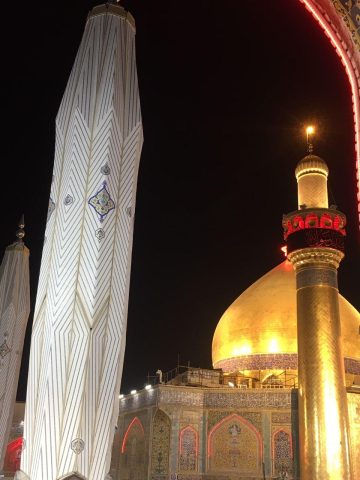
The mosque’s significance extends beyond its architectural beauty. It is one of the holiest sites in Shia Islam, believed to be the resting place of the 10th and 11th Shia Imams, Ali al-Hadi and Hasan al-Askari. For centuries, pilgrims have traveled here to pay their respects, their footsteps echoing through the halls where scholars once debated theology and rulers made decisions that shaped the fate of nations. The mosque has also been a site of conflict, its golden dome destroyed in a bombing in 2006, a stark reminder of the fragility of heritage in a region that has seen too much turmoil. Yet, even in its damaged state, the mosque stands as a symbol of resilience, a place where faith and history continue to intersect.
Visiting Al-Askari today is a journey into the layers of time. The city of Samarra, with its wide, empty streets and crumbling ruins, feels like a place suspended between past and present. The mosque itself is a microcosm of this—partially restored, partially in ruin, its beauty undiminished by the passage of centuries. The air is thick with the scent of dust and the distant murmur of the Tigris, a river that has witnessed the rise and fall of civilizations. Around the mosque, the daily life of the city goes on: vendors sell spices and textiles in the nearby markets, children play in the shadows of ancient walls, and the call to prayer rings out from minarets that have stood for over a thousand years.
What makes Al-Askari special is not just its age or its architecture, but the way it embodies the spirit of Mesopotamia. This is a land where history is not confined to museums or textbooks, but lives in the stones beneath your feet and the stories passed down through generations. The mosque is a bridge between eras—a place where the Abbasid caliphs once walked, where scholars and poets gathered, and where ordinary people have come for centuries to seek solace and connection. It is a reminder that greatness is not just measured in monuments, but in the enduring power of ideas and the communities that keep them alive.
For those who take the time to explore it, Al-Askari offers more than just a glimpse into the past. It invites you to consider the threads that connect us to history—the faith, the art, the struggles, and the triumphs that have shaped the world we live in today. Whether you come as a pilgrim, a historian, or simply a traveler curious about the stories etched into the earth, the mosque has a way of making the past feel immediate. It is a place where the weight of centuries is palpable, where the air hums with the voices of those who came before, and where the quiet dignity of the ruins speaks volumes about the enduring legacy of Mesopotamia.