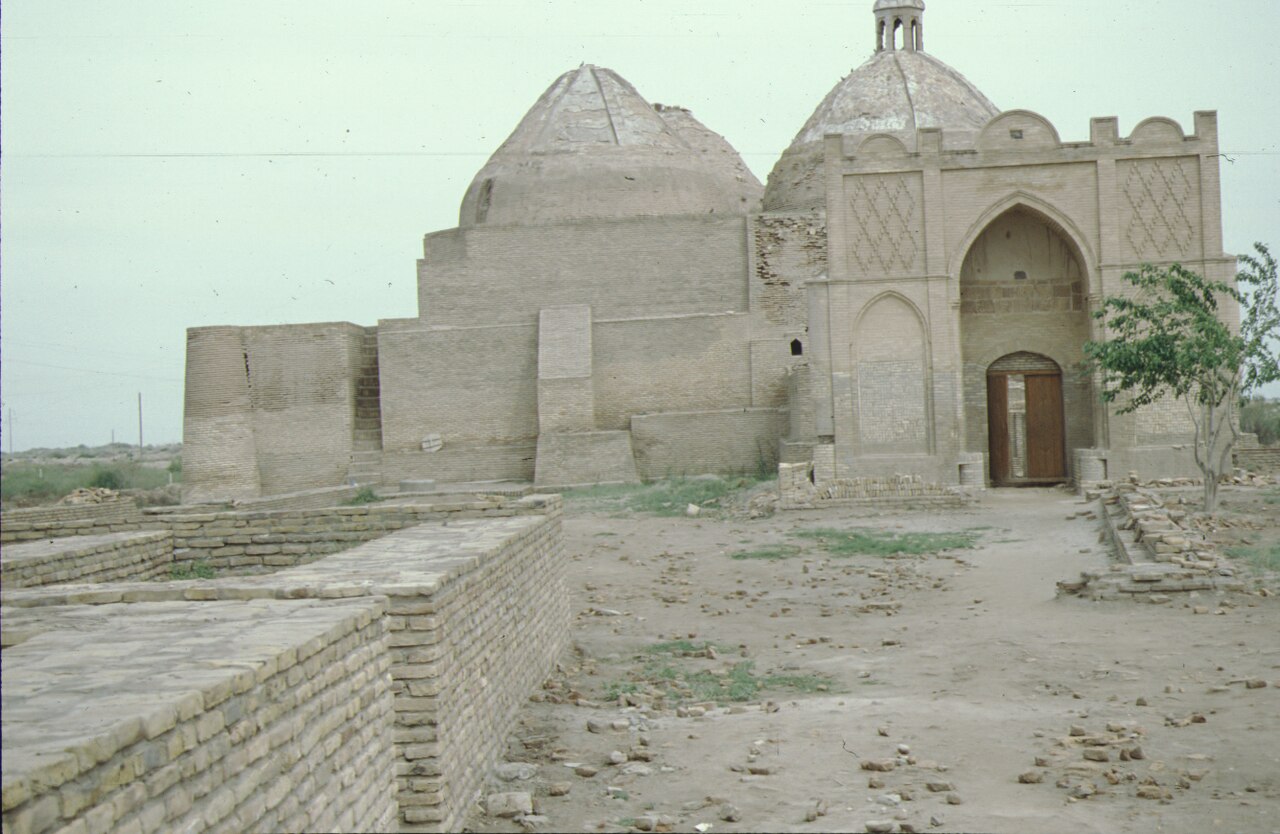
On the outskirts of Kerki, a quiet town in eastern Turkmenistan where the Amu Darya River cuts through the desert plains, stands the Astana-baba Mausoleum. It’s not a place that draws crowds, nor does it demand attention. Instead, it exists as a quiet witness to centuries of history, its walls holding the weight of time in a way that feels almost tangible. The mausoleum isn’t just an architectural relic; it’s a remnant of an era when these lands were a crossroads of the Silk Road, where Sufi teachers, wandering dervishes, and merchant caravans left their mark in stone and story.
The identity of the figure buried here remains shrouded in legend. Some say it was a Sufi saint from the 11th or 12th century, possibly Abu Jafar Ahmed, known as Astana-baba, while others link the site to Khoja Ahmed Yasawi. The details of his life are lost to time, but for the people of this region, the mausoleum has always been a place of spiritual significance—a sanctuary where the faithful have come for solace and reflection for generations. Long before the modern town of Kerki took shape, pilgrims made their way here, drawn by the quiet power of the place.
The building itself is a testament to the craftsmanship of its time. Constructed from fired brick, the mausoleum has weathered the centuries, its walls taking on a warm, golden hue under the desert sun. The facade is adorned with intricate geometric patterns and arabesques, formed from both brick and glazed tile. A carved archway, supported by slender columns, leads into a small courtyard where pilgrims once gathered before entering the main chamber. Inside, the space feels larger than it appears from the outside, the high dome creating an illusion of height as light filters through lattice windows, casting shifting patterns on the uneven walls.
Stepping inside, the air is cool and still, even on the hottest days. The scent of clay, wax, and incense lingers in the dim light, while narrow beams of sunlight pierce the gloom through the latticework. At the center of the chamber lies the tomb, draped in carved wood and fabric, surrounded by the graves of Astana-baba’s followers. Locals still visit to leave flowers and light candles, a tradition that has endured despite the passage of time.
Over the years, the mausoleum has seen periods of neglect and revival. During the Soviet era, the site fell into disrepair, but in the early 21st century, restoration efforts brought it back to life. The exterior was carefully repaired, while the interior was left largely untouched, preserving the atmosphere that has drawn visitors for centuries. Today, the complex includes a small mosque and outbuildings, though the mausoleum itself remains the focal point.
Kerki is not a town that announces itself. It’s a place where different layers of history coexist quietly—where a medieval mausoleum stands near a bustling market selling dried fruits, spices, and handwoven carpets, and where modern apartment blocks rise just beyond the old bazaar. The town doesn’t try to impress; it simply exists, much like the mausoleum itself. Here, the past isn’t something to be admired from a distance—it’s woven into the fabric of daily life.
What makes Astana-baba worth visiting isn’t grand spectacle or tourist infrastructure. There are no guided tours, no souvenir stalls, no crowds. Instead, there’s the quiet rustle of wind through the trees, the occasional murmur of voices, and the sense that time moves differently here. The mausoleum doesn’t strive to be impressive; it simply endures, a reminder that some things outlast empires, ideologies, and the relentless march of progress.
If you come, it won’t be for the usual reasons people travel. There are no postcard-perfect views or Instagram-worthy moments. What you’ll find instead is something far more subtle—a place where history isn’t just remembered, but felt. It’s the kind of destination for those who seek not just to see, but to listen—to the silence, to the stories etched into the walls, and to the quiet persistence of the past.