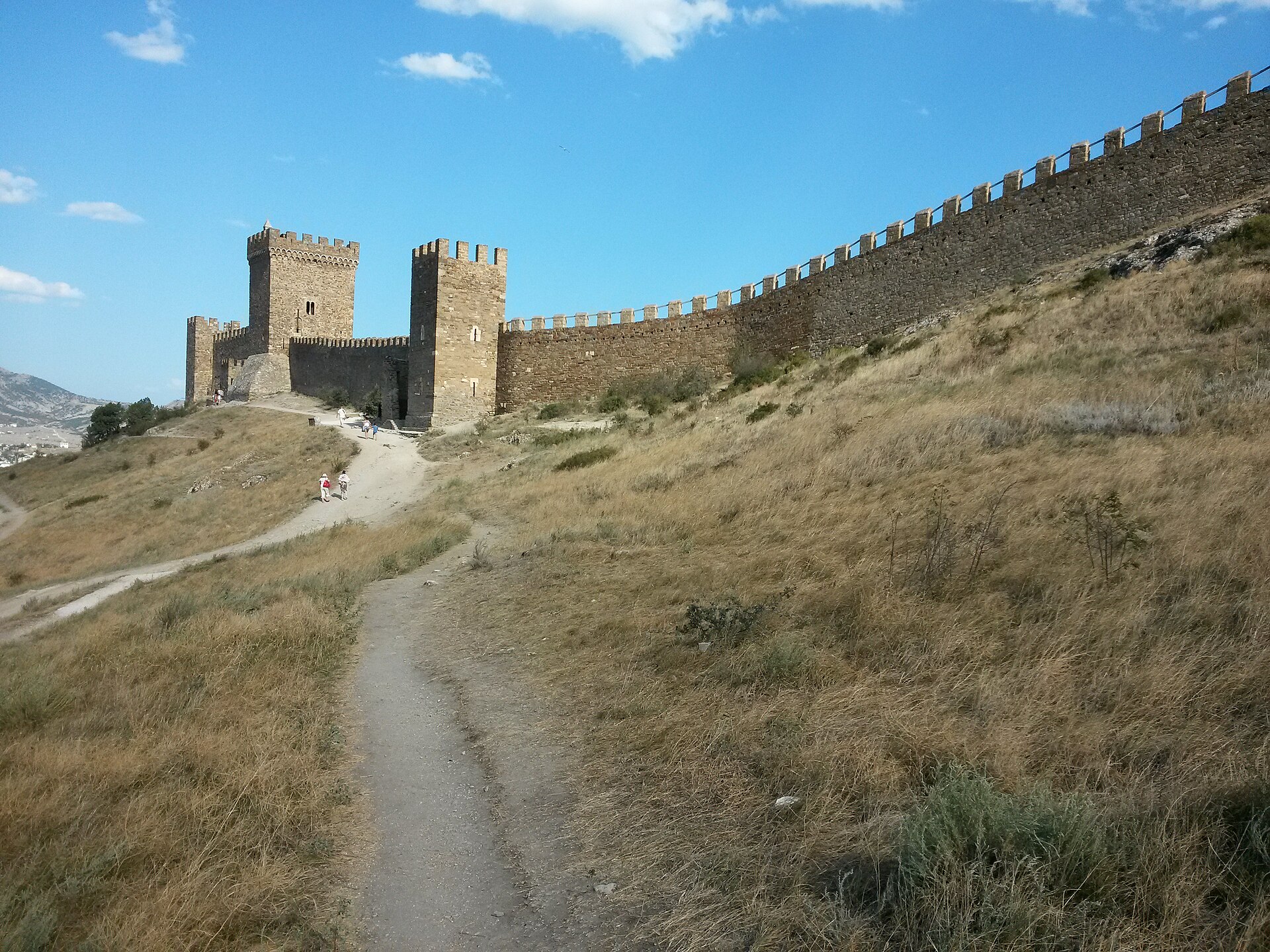
Perched on a hillside above Yalta, Massandra Fortress feels like a silent guardian of Crimea’s turbulent past. Its weathered stone walls, draped in ivy and wild grapevines, blend seamlessly with the rugged landscape, as if they’ve always been part of the mountain rather than something built by human hands. Time has softened its edges, turning what was meant to be a grand fortress into something closer to a romantic ruin. There are no crowds here, no guided tours with loudspeakers, just the quiet rustle of pine trees and the scent of salt carried on the breeze from the sea below. The view from the terrace is worth the climb—endless blue stretching to the horizon, untouched by the noise of the modern world.
The fortress was conceived in the late 19th century by Prince Semyon Vorontsov, a man with ambitious tastes and a love for European grandeur. He commissioned architect Étienne Bouchard to design a structure inspired by medieval castles, but the vision was never fully realized. Vorontsov imagined not just a defensive stronghold but a lavish residence complete with towers, courtyards, and even a private wine cellar. Work began with enthusiasm, but after the prince’s death in 1882, construction halted abruptly. What remained was a half-finished dream, left to the mercy of time and the elements.
What makes Massandra Fortress so intriguing is its architectural hybridity. From a distance, it resembles a Gothic castle, with its battlements and pointed arches, but up close, the details reveal a more eclectic influence. There are hints of Moorish design in the arched windows, and the rough-hewn stonework carries echoes of Romanesque style. The central tower, meant to be the crown of the complex, was never completed, its crumbling walls now home to moss and creeping vines. Inside, only fragments remain—broken staircases, vaulted ceilings, and empty halls where the wind whistles through the gaps. Yet even in its ruined state, the fortress has a commanding presence, especially when you stand on the upper terrace and take in the sweeping panorama of Yalta Bay.
Over the decades, the fortress has served many purposes, none of them quite fitting. During the Soviet era, it housed a sanatorium, a winery, and even a film studio. Locals still recall how its cellars once stored barrels of Massandra wine, and how scenes from historical movies were shot within its walls. But none of these uses could halt the slow decay. Today, the fortress is under the care of the Massandra Winery, and access is restricted. Visitors can only enter as part of an organized tour or with special permission, which only adds to its mystique.
There’s something undeniably atmospheric about Massandra Fortress. It’s easy to imagine the past lingering in its empty corridors—the whispers of unfinished ambitions, the shadows of workers who never saw their labor come to fruition. Local legends speak of ghostly builders still haunting the ruins or secret tunnels leading down to the sea. Whether these stories hold any truth is beside the point; the fortress itself seems to encourage them, its crumbling stones and overgrown paths inviting speculation. The silence here isn’t just the absence of noise; it’s the kind of quiet that makes you listen for echoes of the past.
For those who visit, the fortress is more than just a historical site. It’s a reminder of how quickly grand plans can unravel, how easily human ambition can be overtaken by time. The surrounding vineyards, where grapes for Crimea’s famous wines are grown, stretch out below, their rows catching the golden light of the setting sun. It’s as if the landscape itself is in no hurry to let the day end, savoring the last moments of warmth before dusk settles in.
Exploring Massandra Fortress isn’t like visiting a typical tourist attraction. There are no marked trails or informational plaques, just the freedom to wander and discover at your own pace. You can sit on a sun-warmed stone, gaze out at the sea, or trace the outlines of old carvings in the walls. The fortress doesn’t give up its secrets easily, and that’s part of its charm. The longer you stay, the more it feels like you’re uncovering something personal, something meant only for those willing to look beyond the obvious.
Today, Massandra Fortress defies easy categorization. It’s not quite a museum, not quite a ruin, and certainly not a polished tourist destination. It exists somewhere in between—a fragment of history that refuses to be neatly defined. There’s talk of restoration, of turning it into a cultural center, but for now, it remains exactly as it is: enigmatic, slightly melancholic, and utterly captivating. It’s the kind of place that stays with you long after you’ve left, a quiet testament to the beauty of imperfection.