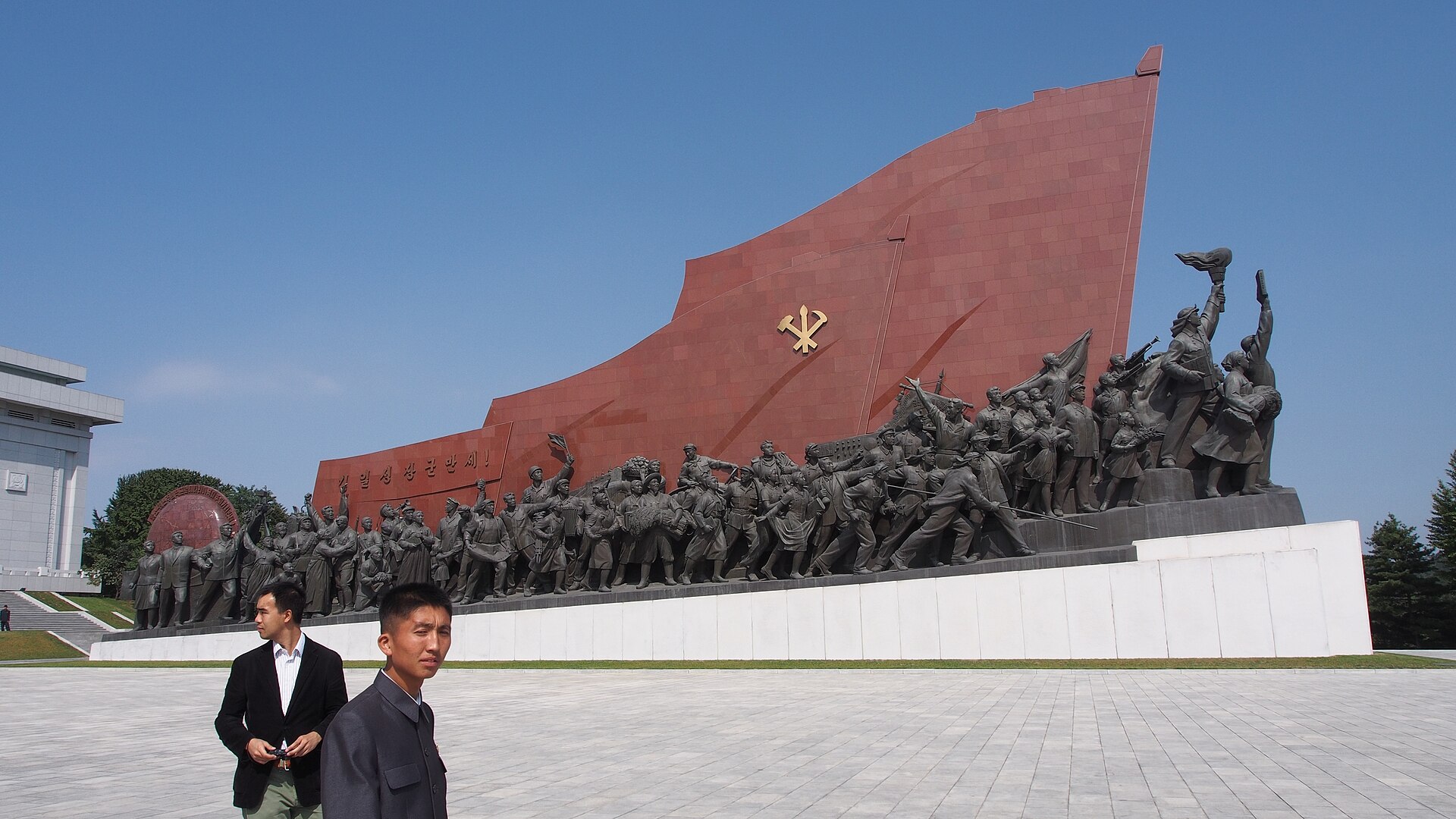
Mansu Hill rises in the center of Pyongyang, where bronze and stone hold the nation’s past. The two statues of the leaders stand on a slope, their figures visible from across the city. This is not a place for passing glances. People come to stand before them, to lay flowers, or to listen to guides recounting the country’s story.
The hill took its shape in 1972, when the first statue of Kim Il Sung appeared. Decades later, after Kim Jong Il’s death, a second figure joined it. Behind them, a curved wall carries bas-reliefs—scenes of revolution, labor, and sacrifice. The statues command the view, while the park below, with its fountains and paths, directs visitors toward the museums behind.
The statues show the leaders as they are remembered. Kim Il Sung wears his usual suit, his posture relaxed. Kim Jong Il stands beside him in a long coat, his gaze steady. Both are bronze, gilded to catch the light. At their feet, wreaths and flowers arrive daily—from delegations, school groups, and families. On holidays, the hill fills with crowds, and the air thickens with ceremony.
A mosaic of Mount Paektu stretches behind the statues, the mountain where Kim Jong Il’s birth is said to have taken place. The bas-reliefs on either side show partisan battles, factory construction, and workers raising monuments. Together, they tell a single story: one of struggle, victory, and continuity. For North Koreans, Mansu Hill is where that story becomes real.
Visitors climb the wide steps and stop at the base. Some take photographs, often with flowers or a bow. For foreigners, the gestures may seem staged, but locals perform them without hesitation. Around the monument, schoolchildren in uniforms line up, and soldiers stand at attention.
The hill is ringed by a quiet park. No cafes or souvenir stalls interrupt the space—just lawns, trees, and paths that lead nowhere in particular. From the top, Pyongyang spreads out below: the Taedong River, the Juche Tower, the Arch of Triumph. Mansu Hill remains the highest point, the one place every visitor sees first.
For those new to Pyongyang, the monument offers a starting point. Every element here has a purpose—the arrangement of the statues, the placement of the bas-reliefs, the way the light falls at dusk. Even the silence feels deliberate. You cannot walk past Mansu Hill. It forces you to stop, to look, and to decide what you make of it.
When evening comes, the lights illuminate the statues. The bronze glows, and the mosaic behind them seems to shift in the changing light. The hill becomes something else: not just a monument, but a place where the past presses close. For Pyongyang, it is the city’s anchor, the point around which everything else turns.