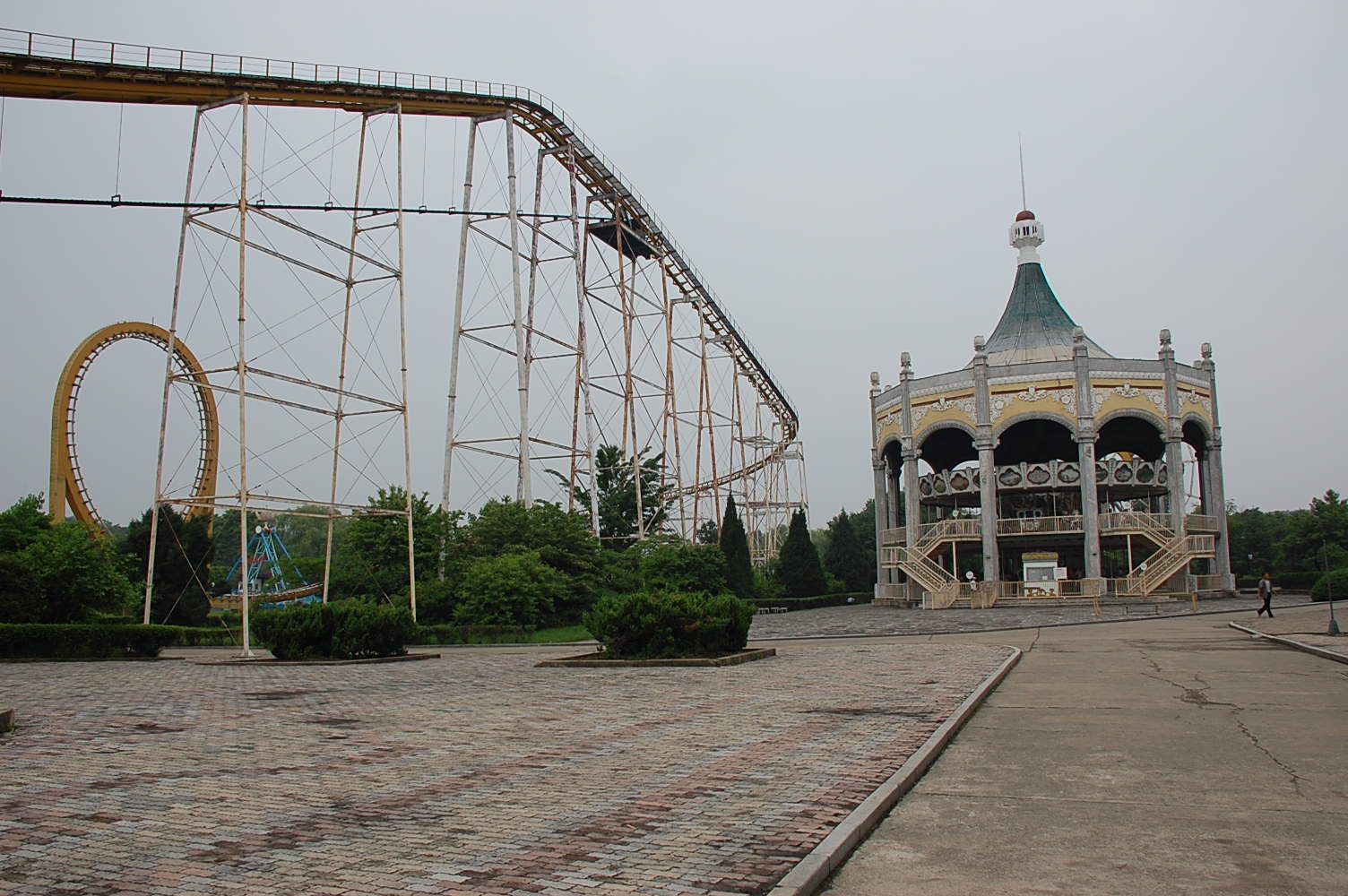
Mangyongdae Funfair sits on the outskirts of Pyongyang, a short distance from the district that shares its name—a place deeply tied to North Korea’s founding narrative. The park itself is unassuming at first glance, a collection of rides and pathways nestled among low hills and patches of greenery. Ferris wheels, roller coasters, and carousels stand in neat rows, their bright paint slightly faded under the sun. There’s nothing immediately striking about the place, nothing that would suggest it’s anything more than a modest amusement park. Yet the quiet order of it all, the way families move through the grounds in small, deliberate groups, hints at something more layered beneath the surface.
The park opened in 1982, part of a wave of construction projects timed to mark Kim Il Sung’s 70th birthday. Such anniversaries in North Korea often serve as catalysts for new public spaces, and Mangyongdae was no exception. It was built not just as a place for leisure, but as a symbol of the nation’s prosperity under its leader—a tangible sign of progress in a country where even recreation is framed within a larger ideological purpose. Over the decades, it has remained one of the few designated spaces where ordinary North Koreans can spend their free time, though access, like most things in the country, is tightly controlled.
The architecture here is functional rather than grand. There are no towering monuments or elaborate facades, just simple pavilions and the skeletal frames of rides, their metal and wood structures painted in primary colors. The paths are well-kept but unadorned, winding between attractions without fanfare. It’s a design that prioritizes utility over spectacle, and in its own way, that simplicity feels deliberate. The park doesn’t try to impress; it exists to serve a purpose, offering a brief escape from the routines of daily life.
What sets Mangyongdae apart from amusement parks elsewhere is the atmosphere. There’s no crowd noise, no blaring music, no sense of chaotic energy. Instead, the park moves at a measured pace, with visitors arriving in organized groups—schoolchildren on outings, families on weekend trips. The mood is subdued, almost solemn, as if everyone understands that this isn’t just about fun. In North Korea, even leisure is structured, and Mangyongdae reflects that. People don’t come here on a whim; they arrive as part of a planned visit, whether for a holiday or a sanctioned excursion.
The rides themselves are a mix of the familiar and the dated. There’s a Ferris wheel that offers a quiet view of the surrounding hills, a roller coaster that rattles along its tracks at a modest speed, and classic carousels spinning in slow circles. Some attractions feel like relics of an earlier era, their mechanics simple and unpolished. There are also playgrounds for younger children and small snack stalls selling basic refreshments. Everything is designed to keep visitors occupied for a few hours, though the experience is far removed from the high-tech, high-speed thrills of amusement parks in other parts of the world. This is a place built for locals, not tourists, and its rhythms reflect that.
Beyond its role as a recreational space, Mangyongdae carries a deeper significance. The district it’s named after is where Kim Il Sung is said to have been born, a fact that imbues the park with a layer of national mythology. For North Koreans, this isn’t just a place to ride bumper cars; it’s part of a larger narrative about the country’s origins and its leadership. Even if visitors come simply to enjoy the attractions, the weight of that history lingers in the background. The park exists within a landscape where every public space, no matter how ordinary, is connected to the state’s vision of itself.
In recent years, Mangyongdae has seen some updates—new rides added, older ones refurbished—but its essential character hasn’t changed. It hasn’t been transformed into a modern entertainment complex, nor does it seem to aspire to that. Instead, it remains what it has always been: a quiet, unassuming corner of Pyongyang where people can step away from their usual routines. That lack of pretension is perhaps its greatest strength. The park isn’t trying to be anything more than it is, and in a country where so much is carefully curated for external consumption, that authenticity feels rare.
For an outsider, visiting Mangyongdae can be a disorienting experience. There’s no sense of carefree abandon, no loud laughter or spontaneous energy. Instead, there’s a quiet orderliness, a feeling that everything operates within an unspoken set of rules. But that’s also what makes the park intriguing. It offers a glimpse into a side of North Korean life that’s rarely seen—a place where people gather not just for entertainment, but as part of a larger social fabric. Here, leisure and ideology intersect, and the ordinary becomes a reflection of something much bigger. In that way, Mangyongdae is more than just a funfair; it’s a small window into a world that remains largely closed to the outside.