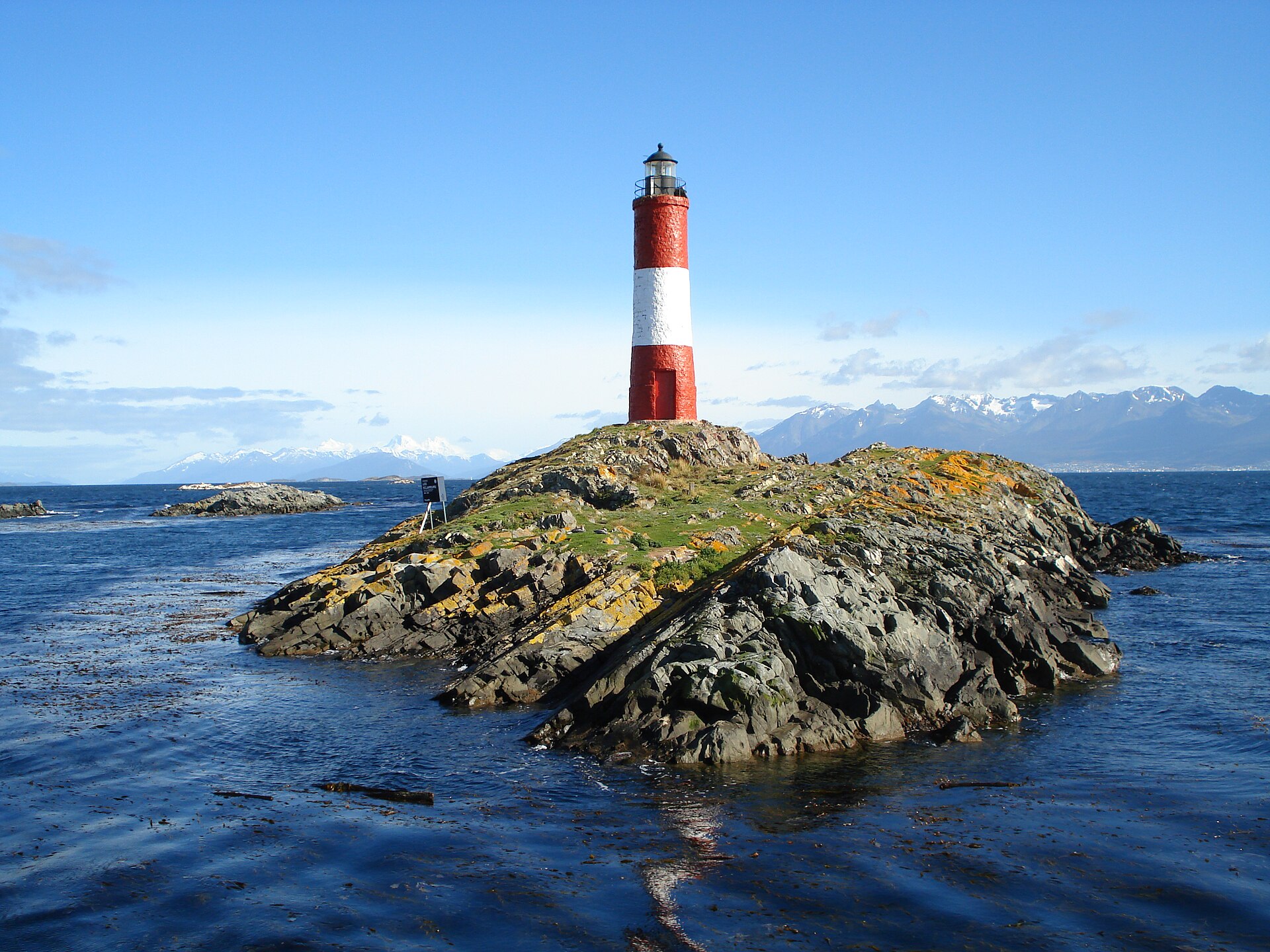
Perched on the edge of the world, where Argentina’s southernmost tip meets the restless waters of the Beagle Channel, the Les Éclaireurs Lighthouse has stood for over a century as a silent witness to the raw beauty and isolation of Tierra del Fuego. Built in the early 1900s, when Ushuaia was little more than a windswept outpost on the fringes of civilization, the lighthouse was never just a navigational aid—it was a lifeline. In an era when ships regularly fell victim to the treacherous rocks and shifting ice of these waters, its beam cut through the fog, guiding sailors away from danger. Though its practical importance has faded with modern technology, the lighthouse remains one of the most enduring symbols of the region, a quiet monument to the resilience of those who once depended on it.
The structure itself is a study in functional elegance, a testament to the engineering of its time. A modest white tower, banded in red and crowned with a lantern, it rises unassumingly from the rocky shore. There’s no ornate detailing, no grand flourishes—just sturdy brickwork and a metal frame designed to withstand the relentless winds and storms that batter this coastline. Inside, the original mechanisms that once powered the rotating light still sit in place, though they’ve long since fallen silent. A narrow spiral staircase leads to the top, where the view alone is worth the climb. The simplicity of the design only underscores its purpose: to endure, no matter what the elements threw at it.
The lighthouse occupies a stretch of land that feels suspended between two worlds. On one side lies the Beagle Channel, its dark waters stretching toward the horizon; on the other, a sheltered bay where sea lions occasionally haul themselves onto the rocks, and if you’re lucky, the distant spout of a whale might break the surface. The landscape around it is untamed—jagged cliffs draped in moss, stunted trees clinging to the thin soil, and vast, empty spaces where the wind carries the scent of salt and distant ice. It’s a place that makes the past feel tangible, where you can almost hear the echoes of the sailors and settlers who once navigated these waters with little more than hope and a compass.
Ushuaia’s history is woven into the very fabric of the lighthouse. Long before the city became a gateway for Antarctic expeditions and adventure tourism, it was a place of exile—a penal colony where Argentina sent its most dangerous criminals. For those early inhabitants, the lighthouse was one of the few constants in a landscape that must have felt like the end of the earth. Later, as the town grew, it became a fixture in the lives of fishermen, traders, and sailors, its light a reassuring presence in the long, dark winters. Though it no longer serves its original purpose, the lighthouse hasn’t lost its significance. Instead, it has become a bridge between past and present, a reminder of a time when Ushuaia was a remote and unforgiving frontier.
Visiting the lighthouse is an experience that begins long before you reach it. The journey starts on the outskirts of Ushuaia, where a narrow trail winds along the coastline, offering glimpses of the channel and the mountains beyond. The walk takes about an hour, depending on the weather, and with each step, the landscape grows wilder, the air sharper. By the time the lighthouse comes into view, it feels like you’ve arrived somewhere truly remote—a place where the rules of the modern world don’t quite apply. The best time to make the trip is during the southern summer, when the days are longer and the weather more forgiving, though even then, the wind can be fierce, a reminder that this is still a land of extremes.
Inside the lighthouse, a small museum offers a glimpse into its past. The exhibits are modest but evocative: black-and-white photographs of the keepers who once tended the light, yellowed maps of the channel, and the tools they used to maintain the beacon. The stories here are of isolation and endurance—of men who spent months at a time in this windswept outpost, ensuring the light never faltered. Their lives were shaped by the rhythms of the sea and the seasons, by the long polar nights and the sudden, violent storms. It’s hard not to feel a sense of awe for those who called this place home, even briefly.
From the top of the lighthouse, the view is nothing short of breathtaking. The Beagle Channel stretches out below, its waters shifting between deep blue and emerald green depending on the light. In the distance, the jagged outlines of islands rise from the sea, and on clear days, you can even make out the faint silhouette of Chilean territory. The horizon feels endless here, a vast expanse where sky and water blur into one. It’s a place that invites reflection, where you can’t help but wonder about the countless ships that have passed this way over the decades, about the lives that intersected with these waters. The lighthouse isn’t just a relic of the past; it’s a vantage point from which to consider the vastness of the world and the small, stubborn human presence within it.
Though the lighthouse no longer operates as it once did, its light is still kindled on special occasions—during the annual Lighthouse Day celebrations or local festivals, when the town gathers to honor its maritime heritage. For visitors, it’s one of Ushuaia’s most iconic sights, a must-see stop on any itinerary. But for those who live here, the lighthouse means something deeper. It’s a symbol of survival, a testament to the idea that even in the harshest environments, there is light to be found. Perhaps that’s why it continues to draw people in, long after its practical purpose has faded. In a world that moves faster every day, the Les Éclaireurs Lighthouse stands as a quiet reminder of the enduring power of place—and the stories that linger in the wind.