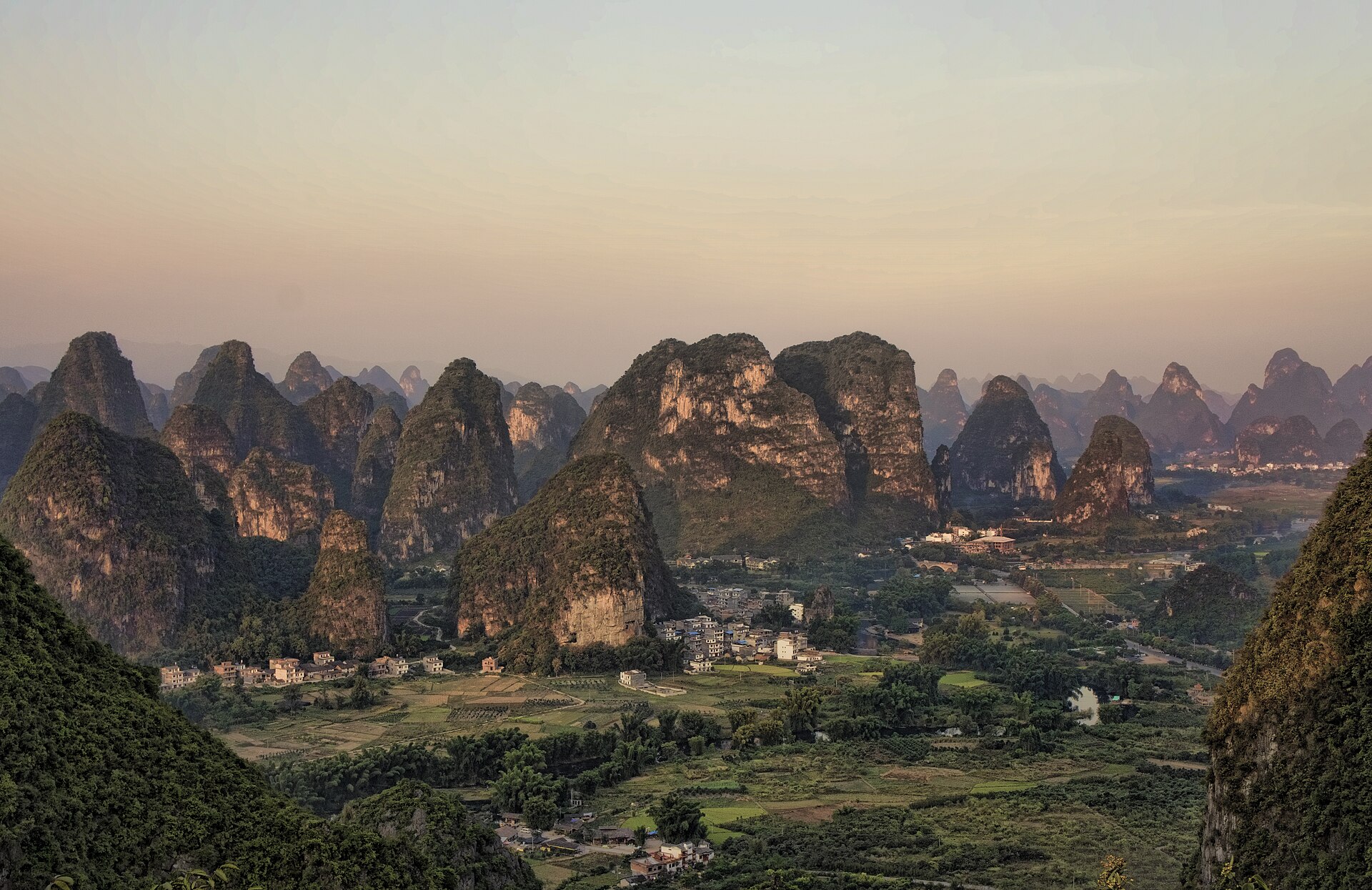
Moon Hill rises above Guilin like a quiet promise, its curved silhouette cutting into the sky with the effortless grace of something drawn rather than carved by nature. The name fits perfectly—its arch, worn smooth by time and weather, does resemble a crescent moon, though one that has settled permanently into the earth. It’s not the tallest of Guilin’s karst peaks, nor the most dramatic, but its shape is unmistakable, a gentle giant among sharper, more angular neighbors. From a distance, the hill appears almost weightless, its slopes draped in greenery that softens the stone beneath. Up close, the rock reveals itself as porous and ancient, its surface etched with the slow work of wind and rain. The southern face drops away in a sheer cliff, a stark contrast to the hill’s otherwise rounded contours, as if nature had paused mid-sculpture, undecided whether to smooth it further or leave it raw.
The hill has been a silent witness to centuries of human longing and reflection. During the Tang Dynasty, when Guilin was a remote outpost on the empire’s southern frontier, exiled officials and wandering poets sought solace in its shadow. To them, the landscape was more than scenery—it was a mirror for their own displacement, a place where the vastness of nature could dwarf even the weight of imperial displeasure. Moon Hill became a symbol of resilience, a reminder that beauty persists even in hardship. Later, under the Song, Buddhist monks carved shrines into its caves, leaving behind statues of bodhisattvas that still gaze out from the rock with serene, weathered faces. Some of these figures have survived, their features softened by time, their presence a quiet rebuke to the idea that anything here is permanent.
The architecture of Moon Hill is subtle, almost apologetic in its restraint. The most notable structure is the Moon Pavilion, a small wooden building perched at the summit, its curved roof echoing the hill’s own shape. It’s not grand—just a place to sit, catch your breath, and look out over the Li River as it winds through the karst peaks. The pavilion has been rebuilt over the centuries, but its purpose has never changed: to offer a moment of stillness, a cup of tea, a view of the sunset painting the limestone in gold and rose. Nearby, a stone stele bears an inscription by a Ming Dynasty calligrapher, its characters praising the landscape in a script that feels as fluid as the river below. The words are less about the place itself than about the people who have stood here, seeing in these rocks something that transcends their physical form.
The caves of Moon Hill are another layer of its story. The largest, Dragon Shadow Cave, tunnels deep into the hillside, its cool, damp interior a relief from the southern heat. The walls glisten with moisture, and stalactites hang like forgotten chandeliers, their shapes shifting in the dim light. Local legends say the cave was once home to a dragon, its breath lingering in the damp air, its presence still felt in the way the shadows move. In earlier times, these caves were refuges for hermits and monks, places to escape the noise of the world. Later, they became shelters during wars, their narrow passages hiding those who had nowhere else to go. Today, the remnants of old altars and faded murals cling to the walls, their details blurred by time. Some have been restored, but others remain as they were—fragile, half-erased, their meaning left to the imagination.
Climbing Moon Hill is not a test of endurance, but it’s not a casual stroll either. The paths wind upward in lazy switchbacks, then suddenly steepen, forcing you to grip the rock with your hands. Stone steps, worn smooth by generations of footsteps, lead through patches of shade and sunlight, each turn revealing a new angle on the landscape. The effort is worth it. From the top, the view stretches in every direction—the Li River curling like a ribbon through the karst, the distant peaks floating in haze, the city of Guilin sprawling at the hill’s feet. The best times to come are early morning, when mist still clings to the valleys and the rocks seem to hover above the earth, or late afternoon, when the setting sun turns the limestone into something molten. Locals often bring thermoses of tea and spend hours sitting on the rocks, watching the light shift across the hills.
Moon Hill is more than a landmark; it’s a thread woven into the fabric of Guilin’s identity. You’ll find its likeness on scroll paintings, in the names of local dishes, even in the way people describe the city’s character. For centuries, it has embodied the Chinese ideal of harmony between humans and nature—a place where the man-made and the wild coexist without conflict. Yet it’s not a museum piece. Pilgrims still leave offerings at its shrines, artists set up easels along the paths, and visitors press coins into the rock for luck. The hill absorbs these small acts without fanfare, its presence as constant as the river below. That’s part of its magic: it doesn’t demand attention, but it rewards those who give it.
The seasons change Moon Hill in ways that feel almost personal. In winter, the wind strips the trees bare, and the rocks take on a crystalline sheen in the cold mornings, as if dusted with sugar. The paths are quiet then, the only sounds the crunch of dry leaves underfoot and the occasional cry of a bird. Summer brings a different kind of life—wildflowers bloom in the cracks of the stone, and the caves offer respite from the heat. Autumn is the clearest season, the air so sharp it seems to magnify the distance, making the farthest peaks feel close enough to touch. Each time of year reveals something new, which is why people return. The hill doesn’t change, but the way you see it does.
What’s striking about Moon Hill is how little it has been turned into a spectacle. There are no souvenir stalls at the base, no loudspeakers, no crowds jostling for the best photo. It remains a place of quiet, where the only sounds are the rustle of leaves and the distant murmur of the river. Part of that is practical—it’s a bit off the main tourist routes—but it also feels intentional, as if the hill’s beauty can only be appreciated in stillness. It doesn’t offer instant gratification. There’s no grand reveal, no single moment that sums it up. Instead, it unfolds slowly, in the way the light moves across the rocks, in the way the wind carries the scent of damp earth and pine. You have to meet it on its own terms, and if you do, it leaves you with something harder to define than a memory—a sense of having touched something enduring, something that was here long before you and will remain long after.