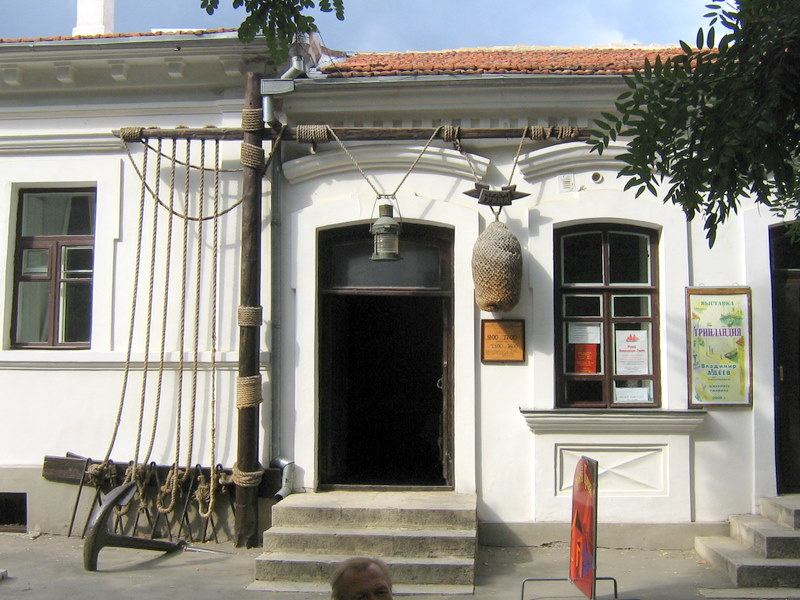
Alexander Grin never became a household name in his lifetime. Feodosia remembers him as a man who once walked its streets, rented a room, and wrote stories that would later captivate generations. The museum dedicated to him occupies a modest house on a quiet side street. The place feels less like a formal memorial and more like a preserved fragment of everyday life.
The house is a typical example of late 19th-century Feodosia architecture: low, sturdy, with thick walls and wooden shutters. Inside, the rooms remain as they were when Grin lived here in the 1920s. The furnishings are simple—wooden furniture, books, photographs, and personal belongings. An open notebook lies on the desk, an old coat hangs on a hook, and a walking stick leans in the corner. The effect is uncanny.
Grin spent years in Feodosia. Here, he wrote some of his most enduring works. The city, where the sea meets the land under the vast Crimean sky, lent his fantastical worlds authenticity. The old port, the sailing ships, the narrow streets—all became backdrops for his tales. The museum shows how reality and imagination intertwined in his work. Among the manuscripts and first editions, you’ll find objects that sparked his creativity: antique maps, maritime compasses, models of sailing vessels.
The recreated study is one of the most striking spaces. The room remains as it was—a writing desk with an inkwell, a high-backed chair, a shelf of books. A portrait of Grin, painted by a friend, hangs on the wall. In the evenings, when the kerosene lamp flickered, this is where he sat, crafting the characters and worlds that would later become part of Russian literature.
It’s easy to imagine him here.
The museum is small. Visitors often remark that it doesn’t feel like a traditional museum. The guides explain how Feodosia seeped into his writing. The local lighthouse might have inspired a story. The sound of waves could have reminded him of distant seas. These details make the place feel alive.
Grin wasn’t born in Feodosia, but the city became his home. After years of wandering, he found peace here. The museum holds documents tracing his life in the city—letters, photographs, official papers. They paint a picture of a man whose work would later find a lasting audience. Grin resisted being labeled a fantasy writer. He believed he was writing about real emotions and dreams.
Today, the museum is a window into old Feodosia. The city was once a port, full of trade. Now, it lives a quieter existence, but traces of its past remain. Walking the streets around the museum, you see the same houses Grin saw, the same views of the sea. That’s the magic of the place—it lets you step into the world that shaped him. The connection between literature and reality feels tangible.
A visit to the museum doesn’t take long. There are no crowds, no rush. Just silence, books, and the distant sound of the sea. Perhaps that’s why people return. It’s not about seeing everything. It’s about stepping into a moment that still feels alive. Here, the spirit of Alexander Grin isn’t just remembered—it’s present.