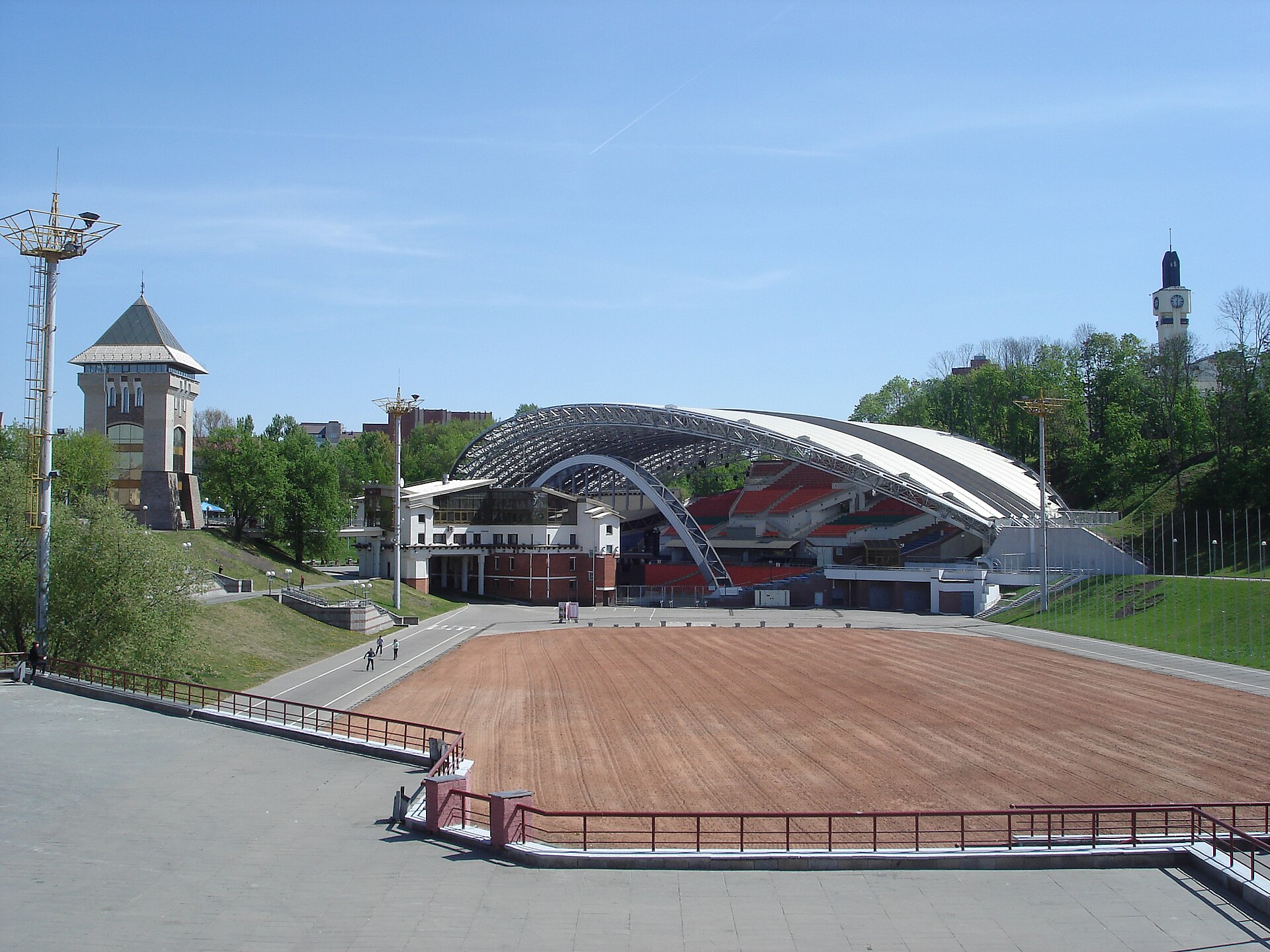
Vitebsk’s Summer Amphitheatre is one of those places where the past and present coexist without much fuss, as if time itself decided to take a pause. Built in the 1980s, it was meant to be a grand stage for the Slavianski Bazaar, an international arts festival that has since become a cornerstone of Belarusian cultural life. The amphitheatre sits on the banks of the Western Dvina River, a spot that has always been central to the city’s identity. The river, wide and unhurried here, has witnessed centuries of trade, war, and quiet everyday life, and the amphitheatre seems to have absorbed some of that unassuming resilience.
The design of the place is straightforward, almost utilitarian, yet there’s a certain elegance in its simplicity. The open-air stage is framed by a semicircular arrangement of concrete steps, rising gently like the tiers of an ancient Greek theatre. There’s no ornate decoration, no attempt to mimic classical grandeur—just raw, functional architecture that serves its purpose well. The materials are honest: concrete, steel, and wood, weathered by decades of use but still holding strong. It’s the kind of place that doesn’t try to impress with flashy details but earns respect through its reliability.
What makes the Summer Amphitheatre special isn’t just its structure but the role it plays in the city’s life. For most of the year, it’s a quiet spot where locals come to walk along the river, sit on the steps, or watch the sunset. The atmosphere is unpretentious, almost provincial in the best sense of the word. There’s no tourist rush, no overpriced cafes, just a sense of belonging to a place that has seen generations come and go. But when the Slavianski Bazaar rolls around in July, the amphitheatre transforms. The steps fill with people, the air hums with music, and for a few days, Vitebsk becomes the center of something much larger than itself.
The festival itself is a curious mix of tradition and modernity. It started in the late Soviet era as a way to celebrate Slavic culture, but over the years, it has grown into an event that draws performers from across Eastern Europe and beyond. The amphitheatre’s stage has hosted everything from folk ensembles to pop stars, from classical orchestras to experimental theatre. There’s no strict genre or style, just a sense that anything can happen here. The festival isn’t about polished perfection; it’s about raw energy, about the kind of performances that leave you with a feeling rather than a critique.
Beyond the festival, the amphitheatre has become a symbol of Vitebsk’s cultural resilience. The city has a long history of artistic significance—Marc Chagall was born here, after all—but it’s not a place that wears its heritage on its sleeve. The amphitheatre reflects that quiet confidence. It doesn’t need to shout about its importance because it’s simply there, a part of the city’s rhythm. In winter, when the river freezes and the steps are covered in snow, it feels almost forgotten, a relic of another season. But come spring, the first warm days bring people back, and the cycle begins again.
The location along the river adds another layer to the place. The Western Dvina has always been a lifeline for Vitebsk, connecting it to the Baltic and beyond. In the past, it was a trade route; today, it’s a backdrop for leisurely strolls and summer concerts. The amphitheatre’s position on the bank means that performances often have the river as a natural stage set, its waters reflecting the lights and sounds of the evening. There’s something almost poetic about watching a concert with the river flowing by, as if the music is being carried downstream to some unseen audience.
For visitors, the Summer Amphitheatre offers a glimpse into the everyday life of Vitebsk. It’s not a place you’d necessarily plan a trip around, but if you find yourself in the city, it’s worth stopping by. Walk along the riverbank, sit on the steps, and watch how the light changes over the water. If you’re lucky enough to be there during the festival, you’ll see the amphitheatre at its liveliest, but even on an ordinary day, it has a quiet charm. It’s the kind of place that doesn’t demand attention but rewards those who take the time to notice it.
In many ways, the amphitheatre is a microcosm of Vitebsk itself: unassuming, enduring, and deeply rooted in its surroundings. It doesn’t try to be anything other than what it is—a stage for life, in all its messy, beautiful, unpredictable forms. Whether it’s hosting a world-famous performer or a group of local children running up and down the steps, it remains a place where the ordinary and the extraordinary coexist without fuss. And perhaps that’s the real magic of it.