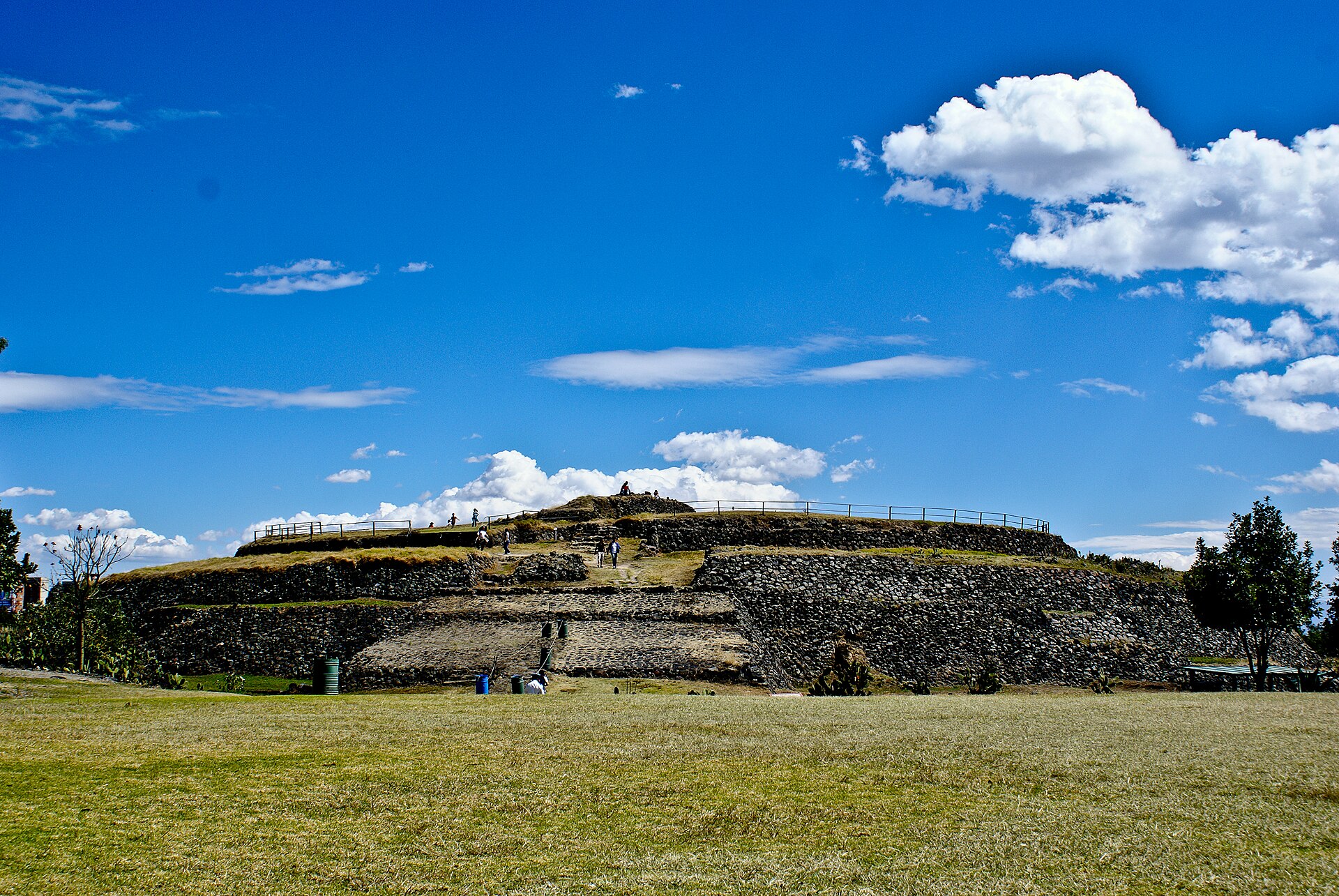
Cuicuilco is one of those places that quietly challenges what we think we know about ancient civilizations. Long before the rise of empires we recognize today, people here were building cities in the Valley of Mexico, leaving behind traces of a society that thrived over two thousand years ago. Located on the southern edge of Mexico City, this archaeological site holds the remains of one of the region’s earliest settlements, dating back to around 800 BCE. What you see now are the ruins of a pyramid, half-buried in a landscape shaped by catastrophe—the lava fields that surround it are the legacy of the Xitle volcano’s eruption around 100 BCE. That event didn’t just reshape the land; it likely marked the beginning of the end for Cuicuilco, though historians still debate exactly how and why the city faded from history.
The most striking feature of Cuicuilco is its pyramid, unlike any other in Mesoamerica. While later civilizations like the Maya and Aztecs built towering, stepped structures, this one is round—a massive, gently sloping mound of stone and clay, nearly 130 meters across and 20 meters high. Its design suggests it wasn’t just a temple but possibly an astronomical observatory, aligned with the sun’s position during solstices. Around it lie the remnants of residential areas, smaller temples, and plazas, offering a glimpse of what the city might have looked like at its peak. Unlike later urban centers, Cuicuilco left no written records, so what we know comes almost entirely from the ground beneath our feet.
Cuicuilco is often called a precursor to Teotihuacan, the sprawling metropolis that would later dominate the valley. Though centuries separated the two, many researchers see Cuicuilco as an early experiment in urban life. Here, a complex society took shape, with specialized crafts, agriculture, and trade networks. The city was part of a broader cultural landscape tied to fire and fertility rituals, reflected in its architecture and ceremonies. Yet unlike its successors, Cuicuilco remains enigmatic, its story pieced together from fragments rather than grand inscriptions or codices.
Visiting Cuicuilco is as much about the land as it is about the ruins. The lava fields, now softened by time and sparse vegetation, are a stark reminder of the eruption that buried the city. Black basalt stretches across the ground, punctuated by cacti and low shrubs, creating a landscape that feels both desolate and strangely alive. Locals sometimes call this the "black city," a name that captures the eerie beauty of the place. Walking through the site, it’s hard not to imagine the force of the eruption or the way it must have upended life here, forcing people to abandon a city that never recovered.
For all its historical importance, Cuicuilco remains overshadowed by more famous sites like Teotihuacan or Chichen Itza. There are no towering pyramids or vivid murals here, no grand narratives carved in stone. But that’s part of its appeal. Without crowds of tourists, you can wander the ruins in quiet reflection, wondering about the people who once lived here. Archaeologists still work at the site, uncovering new details each season, slowly filling in the gaps of a story that’s still being told. It’s a place that draws not just scholars but anyone who prefers history without the spectacle—just the weight of time and the silence of the past.
Modern Mexico City has crept up to the edges of Cuicuilco, surrounding the ruins with neighborhoods, shopping centers, and highways. The contrast is jarring—ancient stones framed by power lines and apartment buildings, a reminder of how the present constantly encroaches on the past. Yet the site itself retains a sense of isolation, especially on weekdays when few visitors come. A small on-site museum offers some context, though it’s modest compared to the grand exhibits in the city’s larger institutions. Still, it’s enough to help visitors connect the dots between the ruins and the lives they once sheltered.
Cuicuilco isn’t a place of gold or grand monuments, but it offers something rarer: a sense of continuity. Here, you can stand on the same ground where people once gathered for rituals, where they watched the sky for signs, where they faced a disaster that changed everything. The lack of written records makes it feel more human, somehow—less like a textbook chapter and more like a story still unfolding. The lava fields, the pyramid, the quiet hum of the city in the distance—all of it serves as a reminder that history isn’t just something that happened. It’s something that’s still happening, layer by layer.
Beyond the archaeology, Cuicuilco is woven into local myths and legends. Some say the spirits of its ancient inhabitants still linger in the lava fields. Others believe the pyramid holds a special energy, a remnant of the rituals performed here centuries ago. Science and folklore coexist in this place, creating an atmosphere that’s equal parts tangible and mysterious. Whether you come for the history or the quiet, Cuicuilco leaves you with the feeling that the past isn’t as distant as it seems. It’s right beneath your feet, waiting to be noticed.