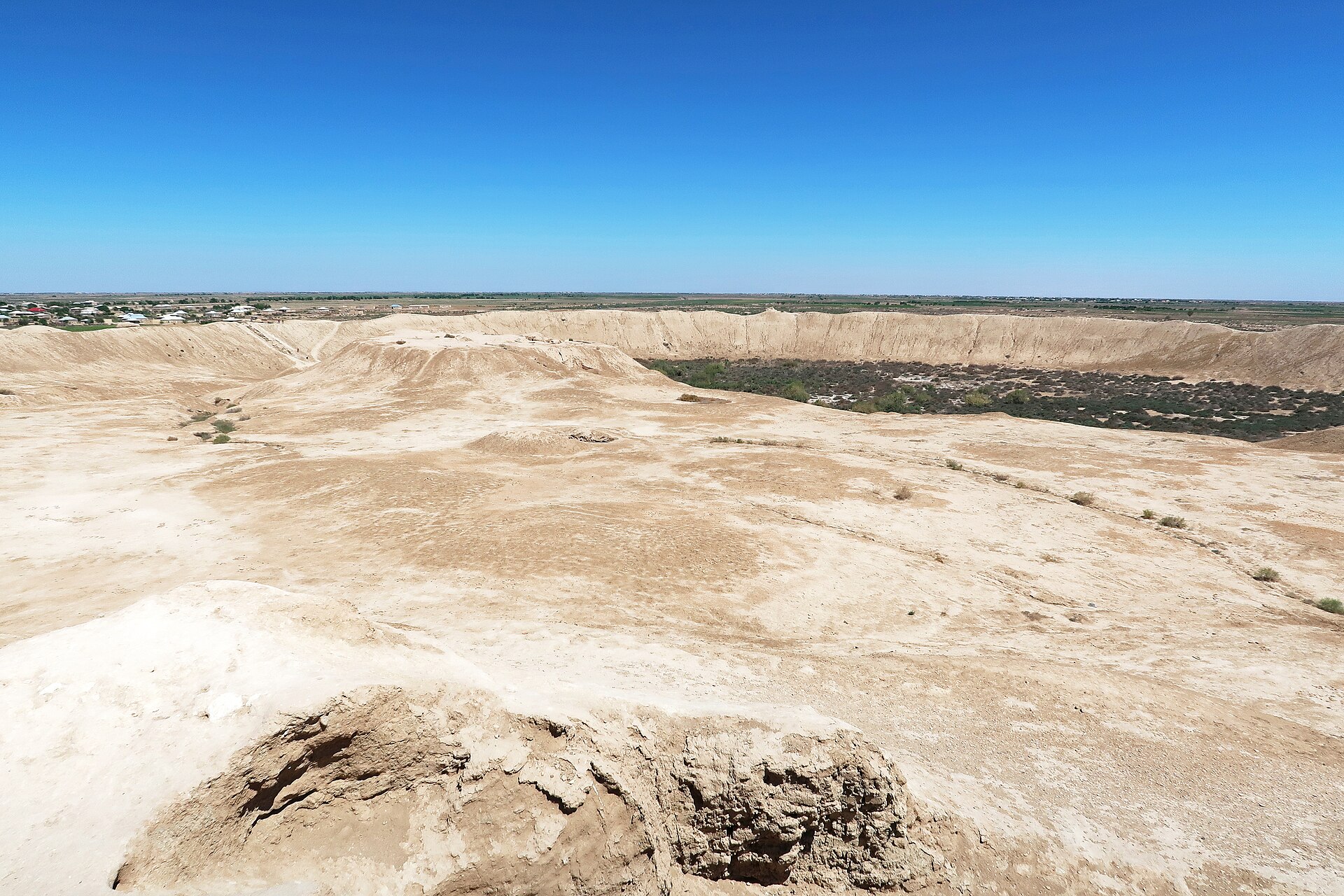
Ancient Merv is one of those places that feels suspended in time, its former glory lingering in the dust and silence. Once a thriving hub on the Silk Road, it was where caravans from China, India, Persia, and the Mediterranean converged, exchanging not just goods but ideas, languages, and cultures. Today, little remains of its grandeur except for scattered ruins, yet even these fragments tell a story of conquest, prosperity, and eventual decline. Among them, the fortress of Gyaur Kala stands out—a silent witness to centuries of history etched into its crumbling walls.
Gyaur Kala, meaning "Fortress of the Infidels," was built during the Parthian era, around the 3rd century BCE, when Merv was part of the Parthian Empire. Positioned on the empire’s eastern frontier, it served as a key defensive stronghold, guarding against nomadic raids and rival armies. Over time, as Merv changed hands—first under the Sassanids, then the Arabs—the fortress retained its strategic importance. It became part of a larger fortified complex, its walls constructed from sun-dried mud bricks, a common building material in this arid region where clay and straw were the only resources at hand.
The architecture of Gyaur Kala reflects the typical design of ancient Central Asian fortresses. Its massive walls, once reaching up to ten meters in height, enclosed an area of roughly thirty hectares. Inside, the fortress housed residential quarters, workshops, storage facilities, and likely administrative buildings. Several gates allowed the passage of caravans and troops, while later, as Merv became a center of Islamic learning, mosques and madrasas were added—though only fragments of their foundations remain today. The walls are now heavily eroded, but their outlines still rise from the desert, a skeletal reminder of what once was.
Gyaur Kala’s history is intertwined with Merv’s own turbulent past. In the 11th century, when Merv became the capital of the Seljuk Empire, the fortress continued to serve as a military outpost. But its fate was sealed in the 13th century when the Mongols swept through the region. Their invasion left Merv in ruins, and Gyaur Kala, like much of the city, was reduced to rubble. Though Merv was later partially rebuilt, it never regained its former prominence. The fortress, now a shadow of its past, stands as a quiet testament to the devastation wrought by war and time.
Walking through the remains of Gyaur Kala, it’s easy to imagine the life that once pulsed within its walls. The echoes of bustling bazaars, the clink of coins in merchants’ hands, the hum of artisans at work—all seem to linger in the air. The desert wind carries a sense of timelessness, as if the past is still present in the crumbling bricks. The ruins are especially striking at sunset, when the fading light bathes the stones in gold, accentuating their age and the weight of history they carry.
Though little of the fortress remains, its significance is undeniable. Gyaur Kala is more than just a collection of ruins; it’s a piece of Turkmenistan’s cultural heritage, a link to the civilizations that shaped the region. The layers of history here reveal how architectural styles evolved, how building techniques advanced, and how the unique culture of Central Asia took shape over centuries. For historians and archaeologists, the site remains a valuable subject of study, while for travelers, it offers a rare chance to step into the past.
Visiting Gyaur Kala is an opportunity to see Merv as it once was—a city once called the "Queen of the World," now reduced to a quiet expanse of ruins. The fortress, surrounded by endless desert, serves as a reminder of how even the mightiest empires fade, leaving behind only memories. There’s a certain magic in places like this, where the passage of time feels tangible, and the fragility of human civilization becomes impossible to ignore. It’s a place that doesn’t just tell history—it makes you feel it.