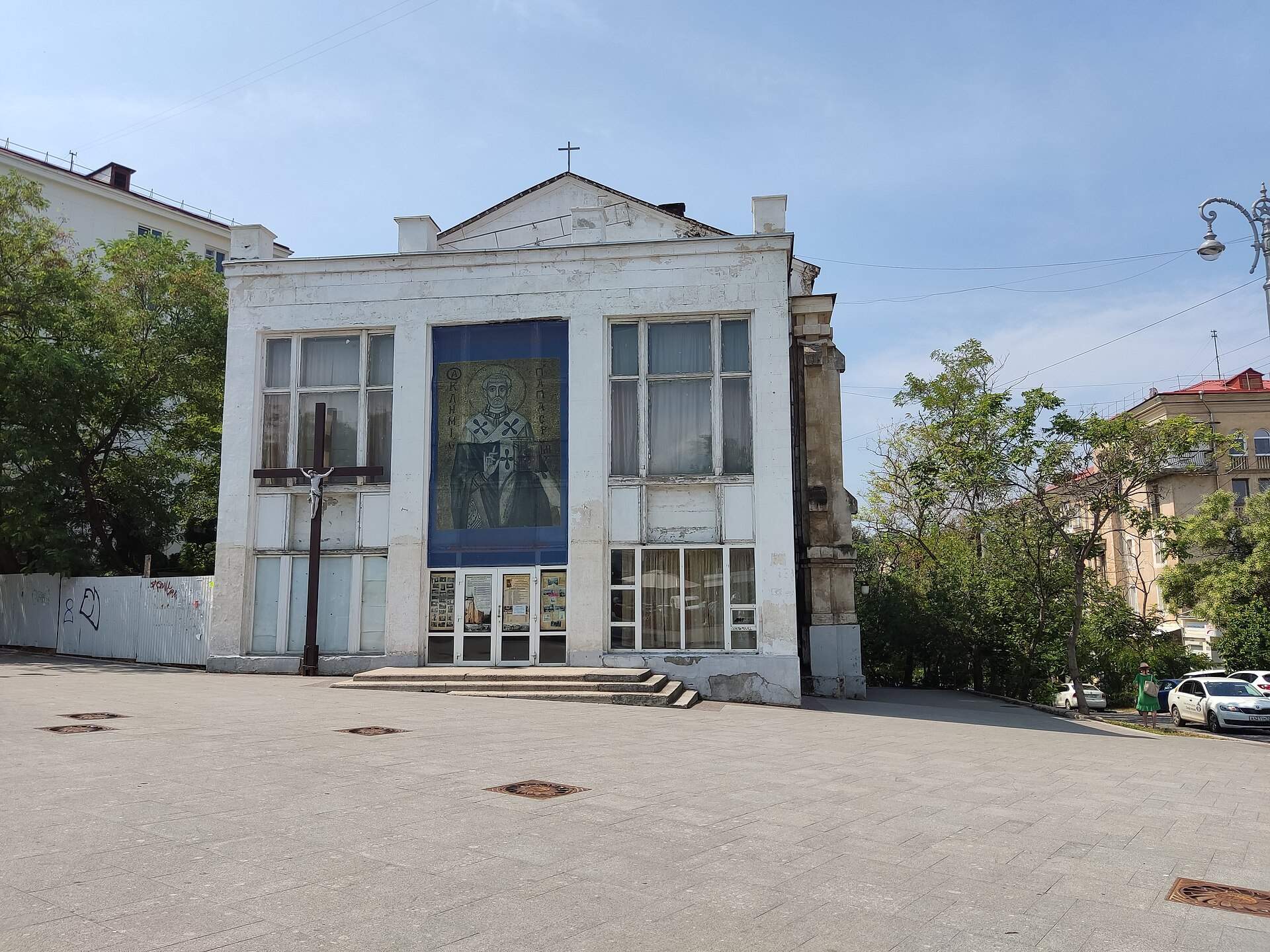
St. Clement’s Church in Sevastopol is one of those rare places that quietly carries the weight of history without demanding attention. Tucked away on a side street near the city center, it stands as a reminder of a time when Sevastopol was more than just a naval stronghold—when it was a crossroads of cultures, where merchants, sailors, and engineers from across Europe made their lives alongside local residents. The church is dedicated to St. Clement of Rome, a figure whose connection to Crimea runs deep. According to tradition, he was martyred near Chersonesus, the ancient Greek settlement just outside modern Sevastopol, and his legacy lingers in the region’s layered past.
The building itself is a contrast to the Orthodox churches that dominate Sevastopol’s skyline. Designed in the late 19th century, it follows the neo-Gothic style, with pointed arches, slender windows, and buttresses. The exterior is unassuming, yet the proportions feel balanced. Inside, the space opens up in a way that belies its small size. Light filters through the stained glass, casting soft hues across the walls, while the acoustics make even a whisper carry. The interior has been preserved, with wooden pews, a carved altar, and an organ that fills the space with music during services or concerts.
St. Clement’s was built in 1896. The Catholic community that funded its construction included Italian and Polish merchants, French engineers, German doctors, and local converts. For them, the church was a place of worship and a connection to home in a city that was both familiar and foreign. After the revolution, it was closed and repurposed as a warehouse, then a gymnasium. In the 1990s, the building was returned to the Catholic community, and restoration began—repairing the facade, recreating lost details, and reviving the interior. Today, it functions as a church, with regular services and organ music on Sundays.
What makes St. Clement’s stand out is how it fits into Sevastopol. It doesn’t tower over the city; it blends into the streetscape, surrounded by old apartment buildings with wrought-iron balconies and narrow lanes leading to the harbor. The sound of the sea is never far away. On warm days, the small square in front of the church fills with people—tourists, locals, or visitors pausing to take in the quiet atmosphere. The church doesn’t draw crowds, but those who come often linger, as if the place slows time.
The church has seen Sevastopol change—from an imperial port to a Soviet naval base, from a closed city to one that welcomes visitors. Yet through it all, St. Clement’s has endured. It’s a place where the past is present in the worn wooden pews, the scent of incense, and the way light falls through the windows in the late afternoon.
On a quiet weekday, the church offers stillness. Without the noise of tourists or daily life, you can imagine the footsteps of parishioners from a century ago, the murmur of prayers, the sound of the organ under the vaulted ceiling. The building doesn’t need to shout its history—it tells it in the details that have survived wars, neglect, and restoration. In the evening, when streetlights flicker on, its silhouette against the dark sky feels like a quiet presence: some places don’t just stand in a city; they hold its memories and stories.