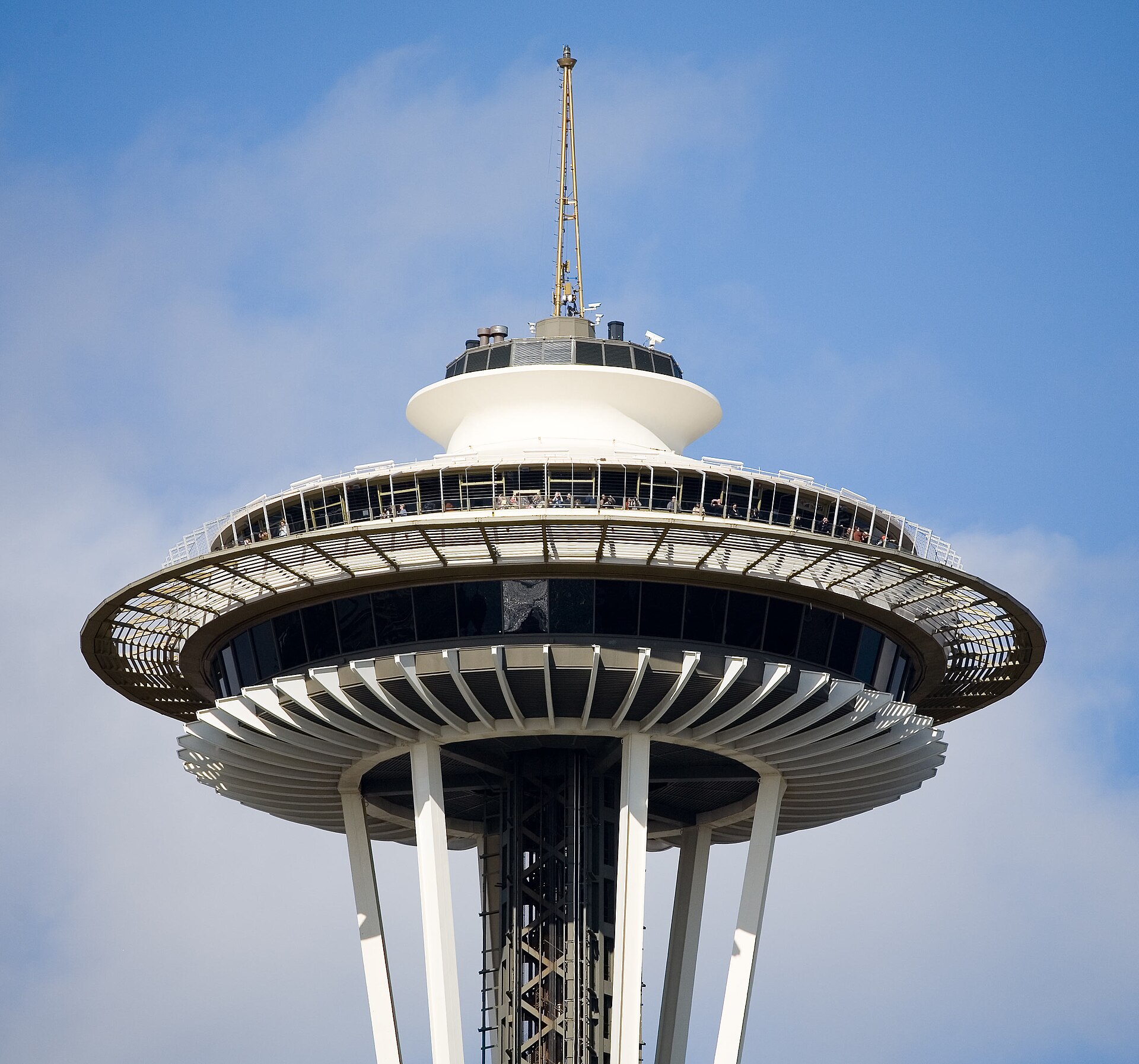
Seattle’s Space Needle isn’t just a landmark—it’s a piece of the city’s soul, suspended between the optimism of the past and the reality of the present. Built for the 1962 World’s Fair, it was a bold statement of faith in progress, a time when the space race was in full swing and America wanted to prove it was leading the charge into the future. The fair, called Century 21 Exposition, was meant to showcase what life might look like a hundred years later, and the Space Needle became its most enduring symbol. Back then, Seattle wasn’t the first city that came to mind when people thought of innovation, but the fair changed that, putting it on the map as a place where the future was being imagined in real time.
Standing at 605 feet, the Space Needle was an engineering marvel when it was built, and it still turns heads today. Its design—a flying saucer perched on a slender stem—was meant to evoke the space age, a vision of what tomorrow might look like. The observation deck sits at 520 feet, offering a sweeping view of the city and beyond. On clear days, you can see the snow-capped peaks of the Cascade Mountains, the deep blue waters of Puget Sound, and even the distant, towering presence of Mount Rainier. The structure was built to withstand winds of up to 200 miles per hour and earthquakes as strong as 9.1 on the Richter scale, a testament to the confidence of its designers. The foundation alone weighs as much as the tower itself, a clever solution to keep it stable in a region prone to seismic activity.
Getting to the top is part of the experience. The elevator ride takes just 41 seconds, but the retro-futuristic design of the cabin makes it feel like a journey through time. Once you step out onto the observation deck, the city unfolds beneath you. The floor-to-ceiling windows frame Seattle like a living postcard, shifting with the light and weather. At night, the view transforms—the city lights blur into a shimmering grid, and the Space Needle itself becomes part of the spectacle, bathed in changing colors that reflect off its sleek surface.
The Space Needle wasn’t just meant to be looked at; it was designed to be experienced. The rotating restaurant, SkyCity, sits just below the observation deck, offering a slow, 360-degree tour of the city while you eat. It takes about 47 minutes for the floor to make a full rotation, giving diners a chance to see Seattle from every angle without ever leaving their seats. The food isn’t cheap, but the experience is worth it—the soft hum of the mechanism, the panoramic windows, the way the city seems to drift by like a dream. It’s easy to see why this place has been a Seattle staple for over sixty years.
Over time, the Space Needle has become more than just a tourist attraction; it’s woven into the fabric of the city. It appears in movies, TV shows, and music videos, often as a shorthand for the future or a nod to the nostalgia of what the future once promised. In 1999, it was designated a historic landmark, and in 2018, it underwent a major renovation to preserve its original look while updating its systems. Now, visitors can explore interactive exhibits about the World’s Fair and the tower’s history, or pick up a souvenir that captures a piece of that mid-century optimism.
For locals, the Space Needle is more than just a landmark—it’s a familiar presence, a constant in a city that’s always changing. On clear days, you can see it from almost anywhere in Seattle, a reminder that this city has always looked forward, even when the rest of the world wasn’t paying attention. It’s not just about the rain or the grunge scene; it’s about the idea that Seattle has always been a place where the next big thing could happen. Even long-time residents still pause to admire it, whether as a symbol of progress or a reminder of how close the future once felt.
The area around the Space Needle is just as much a part of its story. The surrounding park hosts festivals, concerts, and community events year-round. In the summer, people spread out blankets for picnics; in the winter, the space fills with holiday markets and lights. The tower itself often becomes part of the celebration—fireworks on the Fourth of July, a dazzling light show on New Year’s Eve. It’s as if the Space Needle pulses with the life of the city, adapting to each season while remaining a constant presence.
Visiting the Space Needle isn’t just about seeing Seattle from above; it’s about stepping into a moment when the world believed anything was possible. The architecture, the details, the very air inside the tower carry that sense of boundless optimism. Even if you’re not usually drawn to futuristic structures, it’s hard not to be moved by how seamlessly this tower fits into the city’s landscape. It doesn’t just stand on the ground—it feels like it’s hovering above it, a reminder that sometimes, dreams really do take flight.