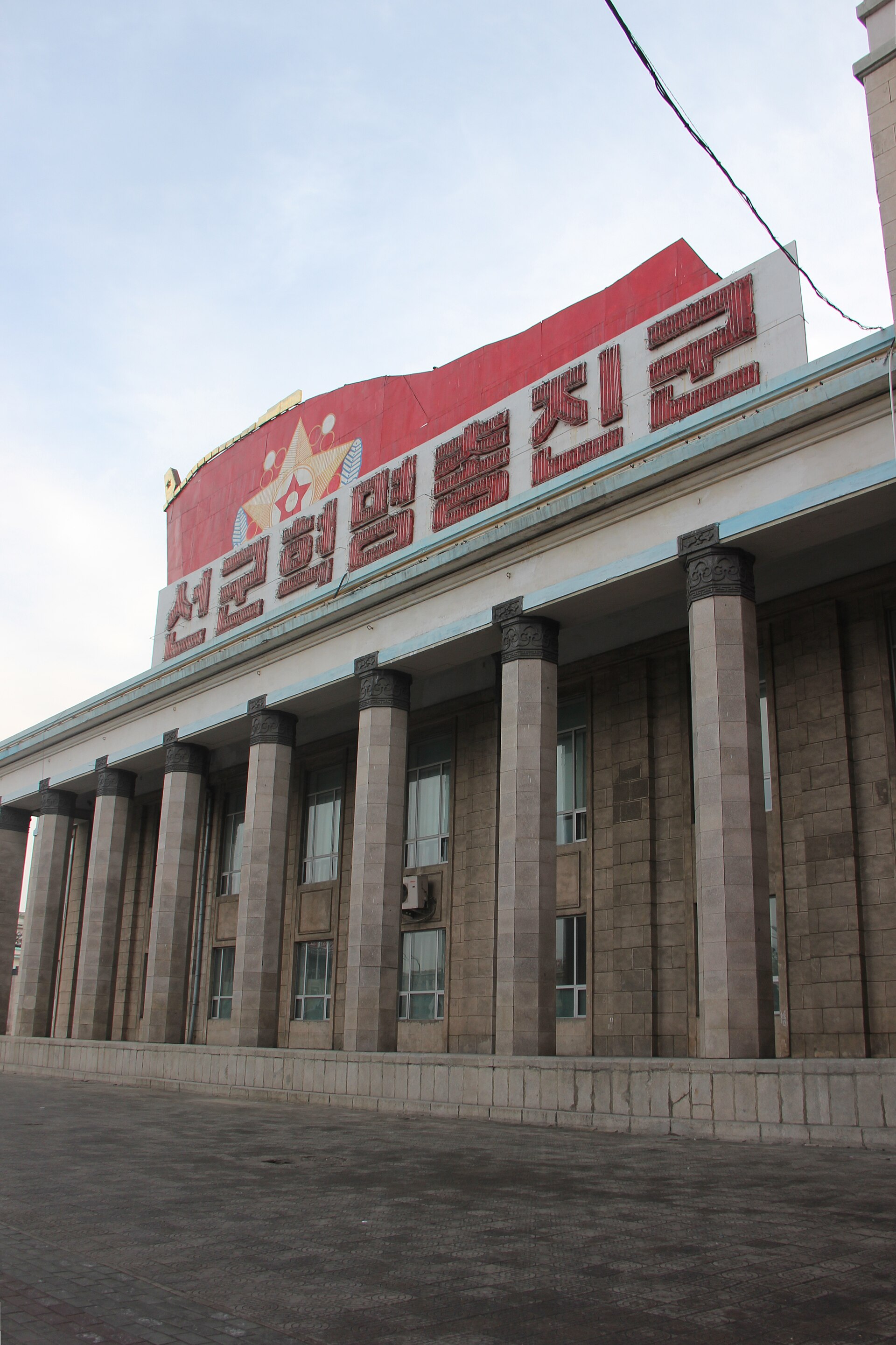
The Korean Art Gallery in Pyongyang stands as a quiet monument to the country’s official culture, where painting, sculpture, and graphic art serve not just as decoration but as a carefully constructed narrative. Located in the heart of the city, near the grand squares and government buildings, it occupies a space that feels both central and ceremonial. The building itself is imposing, with broad staircases and columns that echo the Soviet architectural style of the mid-20th century. Inside, the high ceilings and spacious halls create an atmosphere of solemnity, where art is displayed with deliberate precision—no clutter, no distractions, just the work itself, bathed in even, unobtrusive light.
The collection here is rooted in the decades following the Korean War, a time when the country was shaping its own artistic identity. The paintings and sculptures on display reflect the state’s priorities: the glorification of labor, the heroism of the military, and the reverence for its leaders. Portraits of Kim Il Sung and Kim Jong Il appear frequently, rendered in a style that blends realism with idealization. Historical scenes—struggles against Japanese colonial rule, the rebuilding of a war-torn nation—are presented not as mere events but as foundational myths, reinforcing a sense of collective memory. There is little room for ambiguity; every piece serves a purpose, whether to inspire, educate, or unify.
Sculpture plays a significant role in the gallery, often taking on a monumental quality. Figures of workers, farmers, and soldiers are cast in bronze or carved from plaster, their poses rigid yet dynamic, embodying both strength and discipline. Many of these works were originally created for public spaces—parks, squares, government buildings—before being relocated to the gallery. This gives them an added layer of meaning; they are not just art but artifacts of a larger story, one that ties individual effort to the progress of the nation. The craftsmanship is undeniable, even if the subject matter is predictable.
A separate section of the gallery is dedicated to traditional Korean art, particularly *chosonhwa*, a style of ink painting on paper or silk. Here, the mood shifts slightly. The works—depictions of mountains, rivers, birds, and flowers—feel more intimate, closer to the classical traditions of East Asian art. Yet even in these pieces, symbolism lingers. Pine trees and cranes, recurring motifs, are not just decorative elements but representations of endurance and longevity, values that align with the state’s broader messaging. It’s a reminder that even in spaces where tradition is preserved, the boundaries are carefully defined.
For locals, the gallery is more than a museum; it’s a place of education and patriotic reinforcement. School groups and students often visit for lectures, artist talks, and workshops, where the focus is as much on ideology as it is on technique. Foreign visitors, meanwhile, may find the experience jarring at first. There is no abstraction, no avant-garde experimentation, no art for art’s sake. Instead, every piece reinforces a singular vision—one of unity, sacrifice, and national pride. It’s a stark contrast to the museums of the West, where individual expression often takes precedence over collective values.
That said, the gallery isn’t entirely devoid of subtlety. Some of the landscapes, with their delicate brushwork and nuanced use of light, reveal a quiet mastery that transcends propaganda. Certain portraits, too, capture fleeting moments of human emotion, hinting at the skill of the artists behind them. These exceptions don’t undermine the gallery’s purpose, but they do suggest that even within rigid constraints, art can still breathe. It’s in these small details that the gallery becomes more than just a showcase of state-approved imagery—it becomes a record of a time, a place, and the people who shaped it.
Visiting the Korean Art Gallery offers a glimpse into how art functions in a society where creativity is tightly controlled. There are no surprises here, no rebellious statements or radical departures from the norm. Instead, there is order, clarity, and a sense of shared purpose. For those accustomed to the chaos of contemporary art, it may feel restrictive, even sterile. But for others, it’s a fascinating study in how aesthetics and ideology can merge, how beauty can be harnessed to serve a larger cause. The gallery doesn’t just display art—it tells a story, one that has been carefully curated to shape how North Koreans see themselves and their history.
In the end, the Korean Art Gallery is less about individual artists and more about the collective voice of a nation. It’s a place where art is not just admired but understood as a tool, a mirror, and a means of reinforcement. Whether that makes it propaganda or simply a different kind of cultural expression depends on perspective. But what’s undeniable is its role in preserving a particular vision of North Korea—one that is both aspirational and unyielding. For those willing to look beyond the surface, the gallery offers more than just a lesson in politics; it offers a window into the soul of a country that remains, in many ways, an enigma.