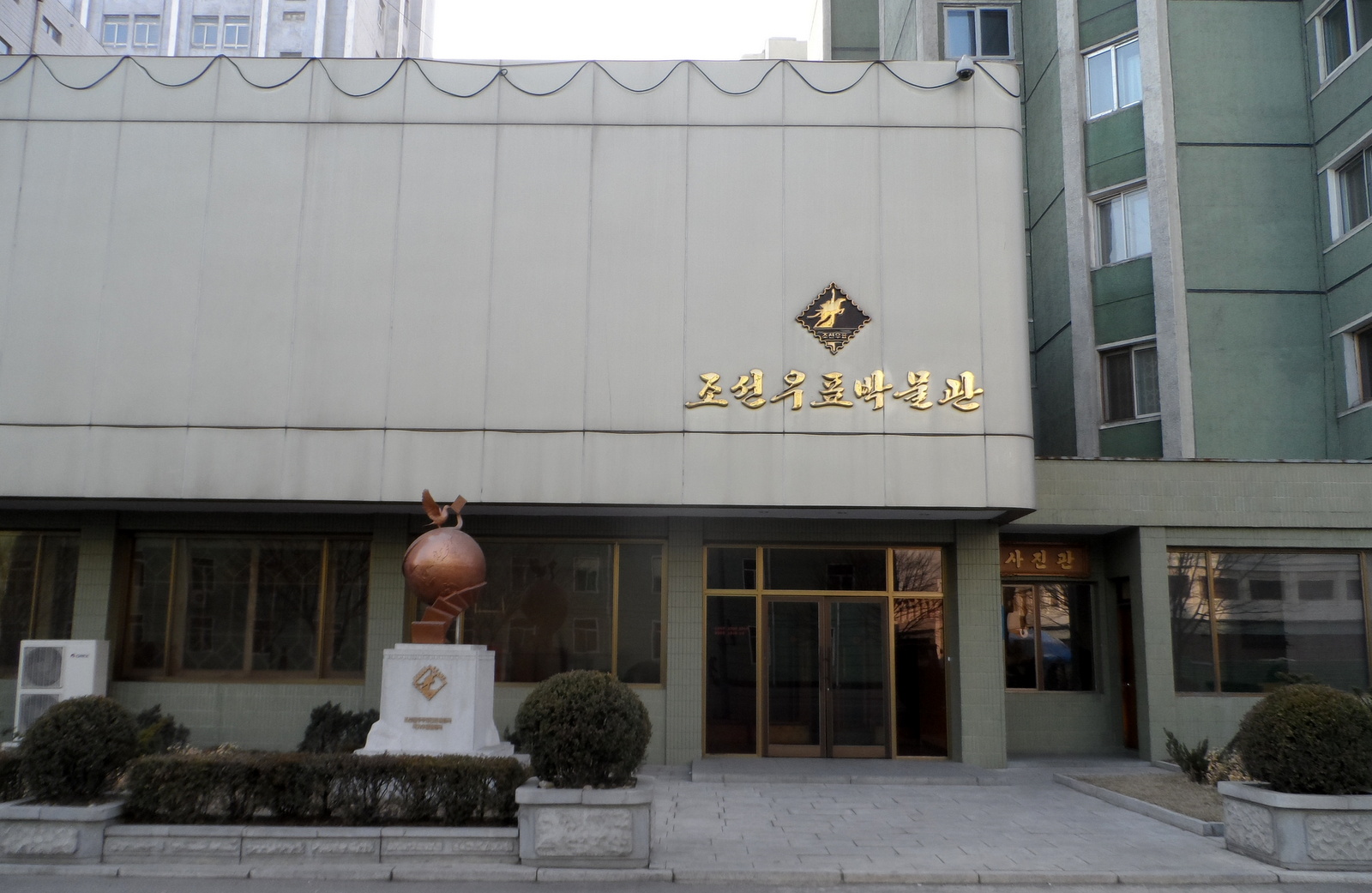
The Korea Stamp Museum in Pyongyang is one of those quiet, unassuming places that reveal more about a country than its grand monuments ever could. Tucked away in a modest part of the capital, the building itself is unremarkable at first glance—clean lines, a restrained facade, the kind of architecture that doesn’t demand attention but quietly insists on respect. Inside, though, the space unfolds like a carefully curated time capsule, where every stamp is more than just ink on paper; it’s a fragment of North Korea’s self-narrative, a miniature window into how the country sees itself and wants to be seen.
The collection spans over a century, beginning with the earliest issues from the Japanese colonial period and stretching to the present day. What strikes you first is how deliberately these stamps have been designed to tell a story—one of resilience, progress, and unwavering loyalty. Portraits of Kim Il Sung and Kim Jong Il appear frequently, often framed by symbols of the Workers’ Party or scenes of industrial and agricultural triumph. There are stamps commemorating national holidays, missile launches, and anniversaries of revolutionary milestones, each one reinforcing the official version of history. But it’s not just about propaganda. Some of the older issues, particularly those from the Korean War era, show a different side—images of soldiers in battle alongside calls for peace, a reminder that even in a country as isolated as North Korea, stamps have long served as a bridge, however fragile, to the outside world.
The museum’s layout is simple, almost austere. The lighting is soft, the display cases arranged to encourage slow, deliberate observation. There’s no rush here, no crowds jostling for a better view. Instead, the atmosphere is one of quiet reverence, as if the stamps themselves command a certain solemnity. For philatelists, this place is a treasure trove. Many of the stamps on display are rare, some printed in such limited quantities that they never left the country. There are issues that circulated only within North Korea, their designs reflecting internal priorities rather than international appeal. Temporary exhibitions occasionally highlight specific themes or anniversaries, though details about these are rarely publicized beyond Pyongyang’s borders.
What makes the museum unusual is how little it resembles the more overtly political sites in the city. There are no towering statues or grandiose murals here, no overt declarations of ideology. Instead, the focus is on the stamps themselves—their artistry, their precision, the way they distill complex ideas into something small enough to hold in your hand. For visitors, this can feel like a rare moment of subtlety in a country where symbolism is often anything but. The museum doesn’t try to impress with scale or spectacle; its power lies in its restraint.
For most North Koreans, stamp collecting is a niche interest rather than a widespread pastime. Yet for those who do engage with it, the museum serves as a gathering place, a hub where enthusiasts can trade stories about rare finds or debate the finer points of a particular series. In that sense, it’s more than just a repository of history; it’s a social space, one of the few where people can connect over a shared passion without the weight of official narratives pressing down too heavily. The staff, too, seem to take a quiet pride in their work, guiding visitors through the collection with a mix of professionalism and genuine enthusiasm.
The role of stamps in North Korean culture goes beyond mere postage. They are tools of propaganda, yes, but also of education and diplomacy. Through them, the country projects its identity—its achievements, its values, its vision of the future. A stamp celebrating a satellite launch isn’t just a commemorative item; it’s a statement of technological prowess. A series depicting children in school isn’t just a pretty picture; it’s a declaration of the state’s commitment to education. In this way, the museum becomes something like an archive of national identity, where each stamp is a carefully crafted message, intended for both domestic and foreign audiences.
Visiting the museum leaves you with a curious sense of duality. On one hand, there’s an undeniable appreciation for the craftsmanship and thought that goes into each design. The precision of the printing, the attention to detail, the way even the smallest elements are imbued with meaning—it’s hard not to admire the skill behind it. On the other hand, there’s the awareness that every stamp, every image, every word is part of a larger narrative, one that is meticulously controlled. For travelers who come to North Korea seeking more than just the usual political landmarks, the museum offers a different kind of insight. It’s not the kind of place that dazzles with spectacle, but it lingers in the mind precisely because of its quiet intensity.
In the end, the Korea Stamp Museum is a reminder of how much can be conveyed in something as small as a postage stamp. It’s a place where history, art, and ideology intersect, where the personal and the political blur in unexpected ways. For those willing to look beyond the surface, it offers a glimpse into how North Korea constructs its own story—one tiny, colorful piece at a time.