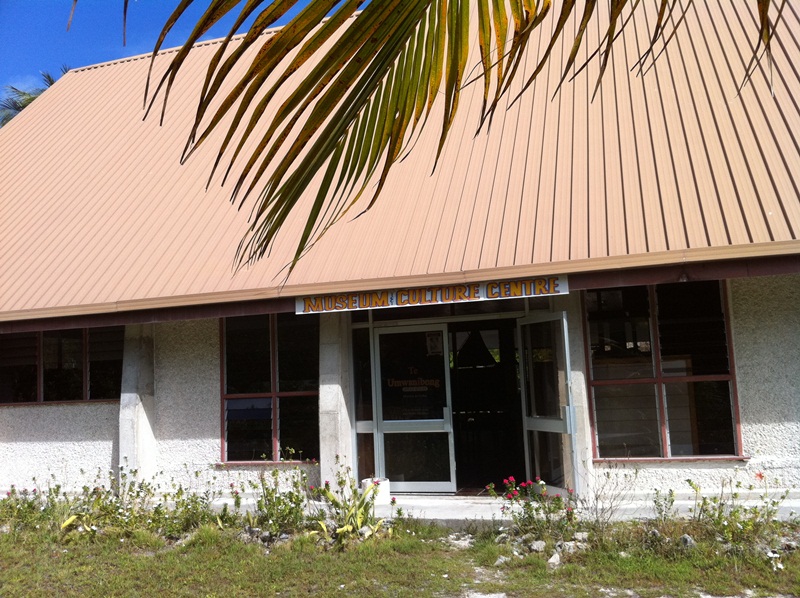
South Tarawa is the kind of place where the ocean feels closer than the next island over, where the horizon stretches so far it seems to curve with the earth itself. Here, on a slender strip of land barely rising above the waves, the Kiribati National Cultural Centre and Museum stands as a quiet guardian of a culture shaped by the sea. It isn’t a grand building with marble floors or climate-controlled galleries. Instead, it’s a place where history isn’t just displayed—it’s lived, shared, and passed down in the way people move through its spaces, the way stories linger in the air long after they’ve been told.
The building itself is a testament to the resourcefulness of Kiribati’s people. Constructed from local materials—driftwood, pandanus leaves, and coconut fiber—it blends seamlessly into the landscape, as if it grew from the sand rather than being built upon it. The roof, curved like the hull of an upturned canoe, pays homage to the seafaring traditions that have defined life here for centuries. Inside, the light filters through gaps in the walls, casting shifting patterns on the floor, while the sound of voices and occasional laughter fills the air. There’s no hushed reverence here, no sense of artifacts being locked away behind glass. The museum feels more like a living room for the community, a place where the past and present coexist without pretense.
The exhibits trace the arc of Kiribati’s history, from the tools and crafts of its earliest inhabitants to the modern challenges of a nation scattered across the Pacific. You’ll find fishing hooks carved from bone, intricately woven baskets that once held the day’s catch, and ornaments fashioned from shells and teeth—objects that tell of a life intimately connected to the ocean. But the most striking displays are those dedicated to navigation. Models of outrigger canoes, star charts drawn on bark, and tools used to read the currents and winds reveal a deep understanding of the sea. For generations, Kiribati’s navigators were among the most skilled in the Pacific, able to cross vast distances using only the stars, the swell of the waves, and the flight of birds as guides. The museum preserves this knowledge not as a relic, but as a reminder of what it means to truly know a place.
One section of the museum is devoted to the 20th century, a period of upheaval that reshaped the islands forever. Photographs and documents chronicle Kiribati’s journey from a British colony to an independent nation in 1979, but the most haunting exhibits are those that deal with World War II. When Japanese and American forces clashed on these shores, the war left behind more than just rusted tanks and crumbling bunkers—it left scars on the land and its people. Black-and-white images show villages reduced to rubble, families displaced, and a way of life disrupted by forces far beyond their control. The displays don’t glorify war; they humanize it, showing how ordinary people endured, adapted, and eventually rebuilt.
Yet the museum is far from a static archive. It’s a place where culture is kept alive through hands-on learning. Workshops on traditional crafts—weaving pandanus leaves into mats, carving wood into tools, or stringing shells into jewelry—are a regular feature. The instructors aren’t just teaching techniques; they’re passing down the stories behind each pattern, each knot, each choice of material. Children learn dances that have been performed for centuries, their movements echoing the rhythms of the ocean. There’s a sense that these skills aren’t just for show—they’re practical, necessary, a way of keeping the past relevant in a world that’s constantly changing.
The centre comes alive during festivals, none more so than Kiribati’s Independence Day on July 12th. For a few days, the museum transforms into the heart of the celebrations. Stalls sell food cooked in earth ovens, the scent of roasted pork and coconut milk filling the air. Elders share legends under the shade of trees, their voices weaving tales of creation and survival. Competitions for the best traditional attire or the most skilled dancers draw crowds, while the sound of drums and singing spills out onto the beach. It’s a rare chance to see Kiribati’s culture in full motion, unfiltered and unapologetically itself.
What makes this place special is its lack of pretension. There are no velvet ropes or "do not touch" signs. If you’re curious about an exhibit, someone will likely show you how it was made or what it was used for. If you linger too long in one spot, you might find yourself invited to join a workshop or share a meal. The museum isn’t just for tourists—it’s for the people of Kiribati, a place where they can reconnect with their roots, especially as the modern world encroaches. In a country where rising sea levels threaten to erase entire islands, the centre serves as a reminder of what’s at stake: not just land, but a way of life.
For visitors, the museum offers a rare glimpse into a world where time moves differently. There’s no rush here, no need to check off sights or hurry to the next attraction. You can sit on the veranda, watching the lagoon shift from turquoise to deep blue as the sun moves across the sky. You can listen to the waves and think about how, for all its remoteness, Kiribati is deeply connected to the rhythms of the earth. And when you leave, you might carry something with you that isn’t captured in a photograph—a sense of stillness, a quiet appreciation for the resilience of people who have learned to live in harmony with the ocean.
In the end, the Kiribati National Cultural Centre and Museum isn’t just about preserving the past. It’s about understanding what it means to belong to a place, to a people, to a way of life that has endured for centuries. It’s a place where history isn’t something you observe from a distance, but something you can almost reach out and touch. And perhaps that’s the most valuable lesson of all: that culture isn’t something that’s frozen in time, but something that grows, adapts, and survives—just like the people who keep it alive.