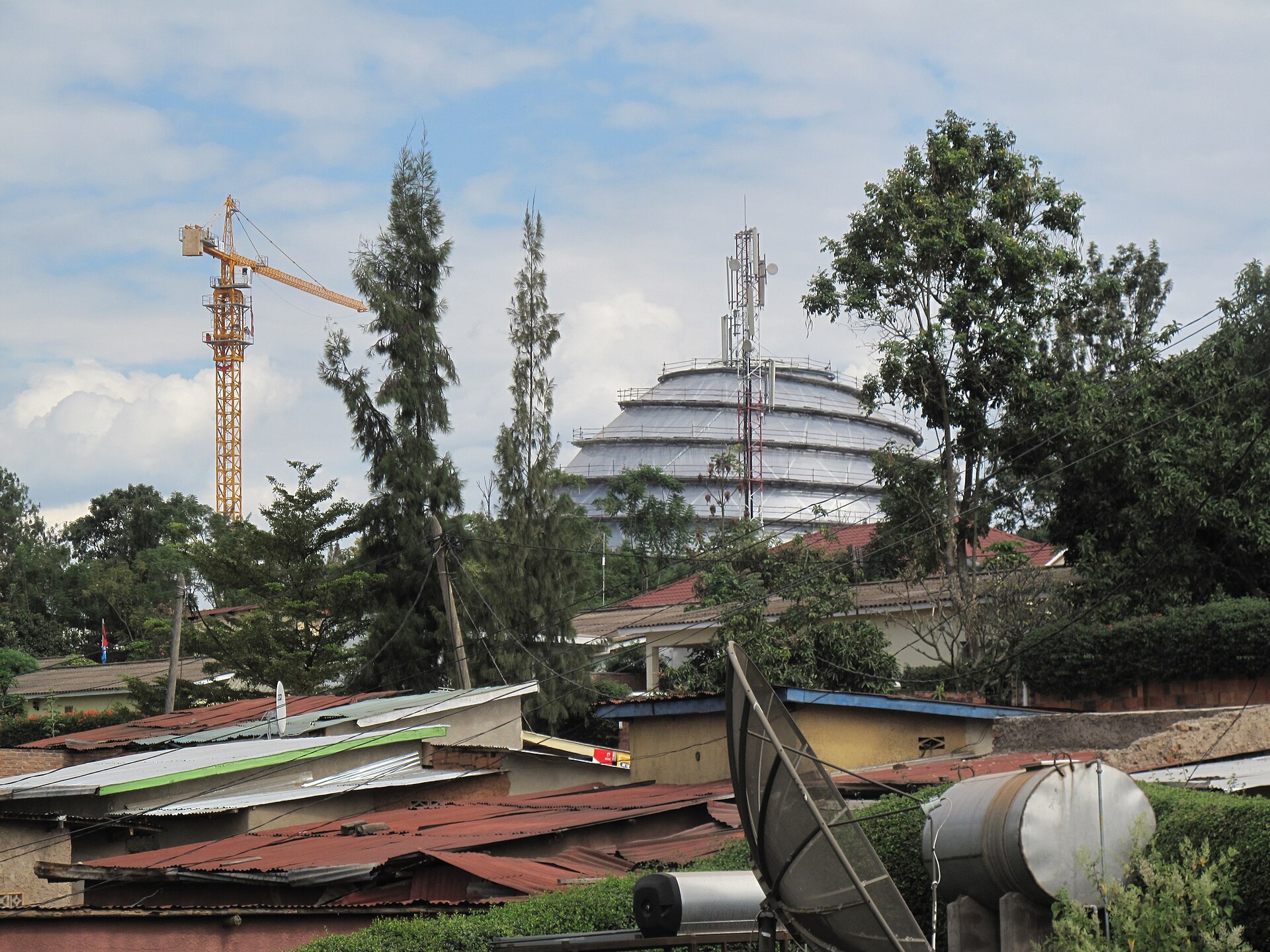
Perched on one of Kigali’s rolling hills, the Kigali Convention Centre is a striking presence in the city’s skyline—a building that seems to hover between the past and the future. Its design is unmistakably modern, with sweeping curves and a glass façade that catches the light at different angles throughout the day. From a distance, it resembles a vast, futuristic structure, almost like something out of science fiction. Yet up close, the details reveal a deeper story: the dome-like shape echoes traditional Rwandan architecture, reimagined in steel and glass rather than mud and thatch. It’s a place where global ambition meets local identity, a physical manifestation of Rwanda’s determination to carve out a new role on the continent.
The centre wasn’t built just to impress—it was a statement. In the mid-2010s, Rwanda was in the midst of a rapid transformation, shedding the shadows of its tragic history and positioning itself as a hub for business, technology, and diplomacy in Africa. The government invested heavily in infrastructure, and the convention centre became one of the most visible symbols of that shift. Its opening coincided with major international events, including the African Economic Forum, which helped establish Kigali as a serious contender for hosting high-profile gatherings. Today, it remains a key venue for discussions on everything from climate change to digital innovation, drawing leaders, investors, and thinkers from across the globe.
Inside, the space is designed for both function and impact. The main hall is vast, capable of accommodating thousands, yet the layout avoids feeling overwhelming. Natural light floods the interiors, softened by wooden panels and stone accents that add warmth without sacrificing professionalism. Meeting rooms are equipped with the latest technology, but the design never feels sterile. There’s a deliberate effort to balance efficiency with comfort, ensuring that even during long negotiations or packed conferences, the environment remains inviting. For many visitors, this is their first impression of Rwanda—a country that, despite its past, is now focused on progress and precision.
The view from the upper floors is one of the centre’s quietest yet most compelling features. Kigali sprawls across the hills below, a patchwork of low-rise buildings, lush greenery, and the occasional modern high-rise. On clear days, the horizon stretches toward distant mountains, a reminder of how compact yet diverse the country is. It’s a perspective that encapsulates Rwanda’s duality: a nation deeply rooted in its history but unwilling to be defined by it. The convention centre, like much of the city, stands as proof that rebuilding doesn’t mean erasing the past—it means finding a way to move forward without losing sight of where you’ve been.
For locals, the building carries a different kind of significance. Many Rwandans remember a time when Kigali was a city struggling to recover, its streets marked by the scars of conflict. The convention centre, with its sleek lines and international stature, is a tangible sign of how far the country has come. It’s not just a place for foreign delegates; it’s part of the city’s daily rhythm. Cultural events, art exhibitions, and even public gatherings occasionally take place here, making it a space that belongs to the people as much as to the government. When the centre opens for tours, residents often visit, walking through its halls with a mix of pride and curiosity, seeing firsthand the scale of their country’s ambitions.
The area around the convention centre has evolved alongside it. What was once a quiet stretch of hillside is now a growing business district, with hotels, cafés, and offices filling the gaps between older buildings. The centre itself is a hub of activity, not just during major events but in the quieter moments in between. The ground-floor café is a popular spot for post-meeting conversations, where diplomats and entrepreneurs linger over coffee, and the occasional pop-up market offers handwoven baskets or locally made jewelry. It’s a place where the global and the local intersect, where a visiting CEO might share a table with a Rwandan student, both drawn by the same sense of possibility.
Rwanda is a country of contrasts, and the convention centre embodies that duality. It’s a building that looks forward while acknowledging its roots, a space where tradition and innovation coexist without tension. The materials—glass, steel, wood—are modern, but the shapes and rhythms are distinctly Rwandan. Even the way the centre integrates into the city reflects this balance: it doesn’t dominate the skyline but complements it, standing out without overshadowing the older, more modest structures around it. For visitors, it’s often an unexpected highlight of a trip to Kigali, a reminder that Africa’s story isn’t just about wildlife and landscapes but also about cities that are dynamic, forward-thinking, and unafraid to redefine themselves.
There’s a quiet confidence to the Kigali Convention Centre, a sense that it was built not just for today but for the future. It doesn’t shout its importance; it simply exists, a place where ideas are exchanged, deals are made, and perspectives shift. For a country that has faced unimaginable hardship, the centre is more than architecture—it’s a symbol of resilience. It doesn’t erase the past, nor does it dwell on it. Instead, it offers a different narrative: one of a nation that has chosen to rebuild, to innovate, and to welcome the world on its own terms. Whether you’re here for a conference, a tour, or just a moment of reflection, the building leaves an impression—not because it’s flashy, but because it feels real.