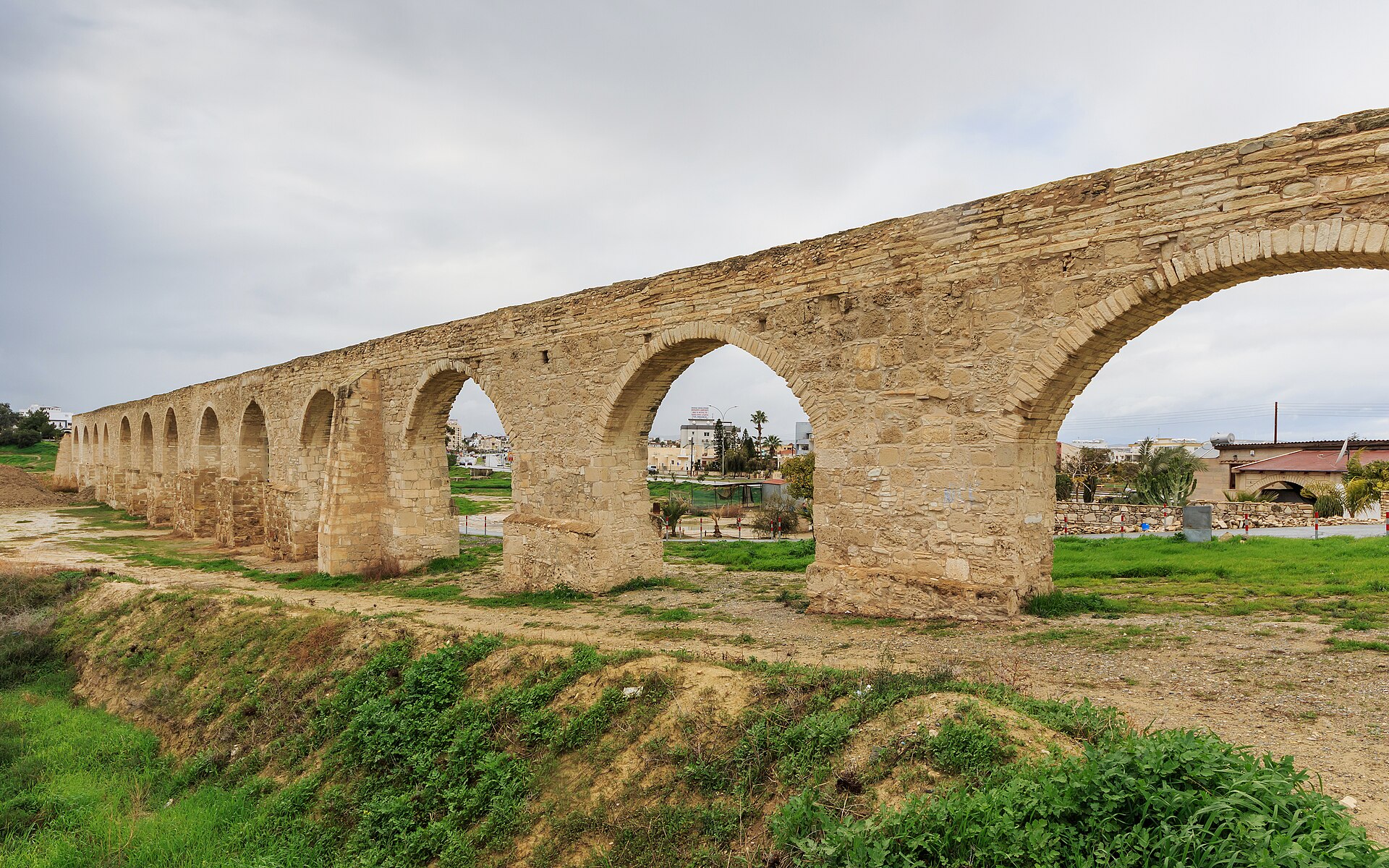
Larnaca’s Kamares Aqueduct is one of those quiet landmarks that doesn’t demand attention but rewards those who pause to consider its place in the city’s story. Built in the 18th century under Ottoman rule, it was once the lifeline of Larnaca, carrying water from springs near the village of Arpera to the thirsty streets of a growing port town. The aqueduct’s arches stretch along the road toward the old harbor, standing as silent witnesses to centuries of change—shifting powers, the rise and fall of trade, and the daily rhythms of a community for whom water meant survival.
The aqueduct’s construction is credited to Abu Bekir Pasha, an Ottoman governor who sought to modernize Larnaca’s infrastructure. At the time, the city was a vital Mediterranean port, and without a reliable water supply, its expansion would have been impossible. The system relied on gravity, channeling water through stone troughs supported by the aqueduct’s arches, then distributing it to public fountains and wells. A few of these fountains still exist today, though most no longer function, their stone basins worn smooth by time and use.
The architecture of Kamares is unmistakably Ottoman, its thirty-six arches built from local limestone that has mellowed into a warm, golden hue. Each arch varies slightly in height and shape, giving the structure a subtle asymmetry that feels organic rather than designed. In places, you can spot signs of repair—brick patches or darker stones filling cracks—yet the aqueduct retains a sense of wholeness, as if time has only gently weathered its surface.
Though it no longer serves its original purpose, the aqueduct remains deeply woven into Larnaca’s identity. Locals simply call it Kamares, meaning "arches" in Greek, a name that stuck despite its official title. Over the years, a small park has grown around it, offering shade and a quiet place to walk. In the evenings, soft lights illuminate the stones, casting long shadows that shift with the breeze.
For visitors, Kamares isn’t a destination in itself but rather a piece of the city’s fabric, best discovered while wandering Larnaca’s streets. There’s no grand entrance or guided tour—just the chance to step closer and notice the details: the grooves worn into the stone by ropes that once hauled water, or the faint inscriptions carved into the arches. On rainy days, water still trickles through the old channels, a reminder that this was built for necessity, not ornament.
Like many old structures, the aqueduct has its share of local lore. Some say a treasure is hidden beneath one of the arches, left behind by Ottoman soldiers. Others dismiss the story, though the idea lingers, adding a touch of mystery to the place. Most people who come here aren’t searching for gold, though—they’re here to photograph the arches at sunset, when the light turns the stone to amber, or to sit on a bench and watch the city move around them.
There have been debates over the years about how best to preserve Kamares. Some argued for turning it into an open-air museum, while others believed it should be left untouched, allowed to age naturally. In the end, a middle path was chosen: the aqueduct was restored, but carefully, without erasing the marks of time. Today, it stands as a bridge between past and present, a structure that no longer carries water but still carries meaning.
Walking beneath the arches, it’s hard not to imagine the generations who passed this way—merchants hurrying to the harbor, women balancing clay jars on their shoulders, children darting between the stones. Now, the sounds are different: the hum of traffic, the murmur of voices, the occasional laughter of passersby. But if you listen closely, the past doesn’t feel so far away. The aqueduct doesn’t shout its history; it lets you find it, one quiet moment at a time.