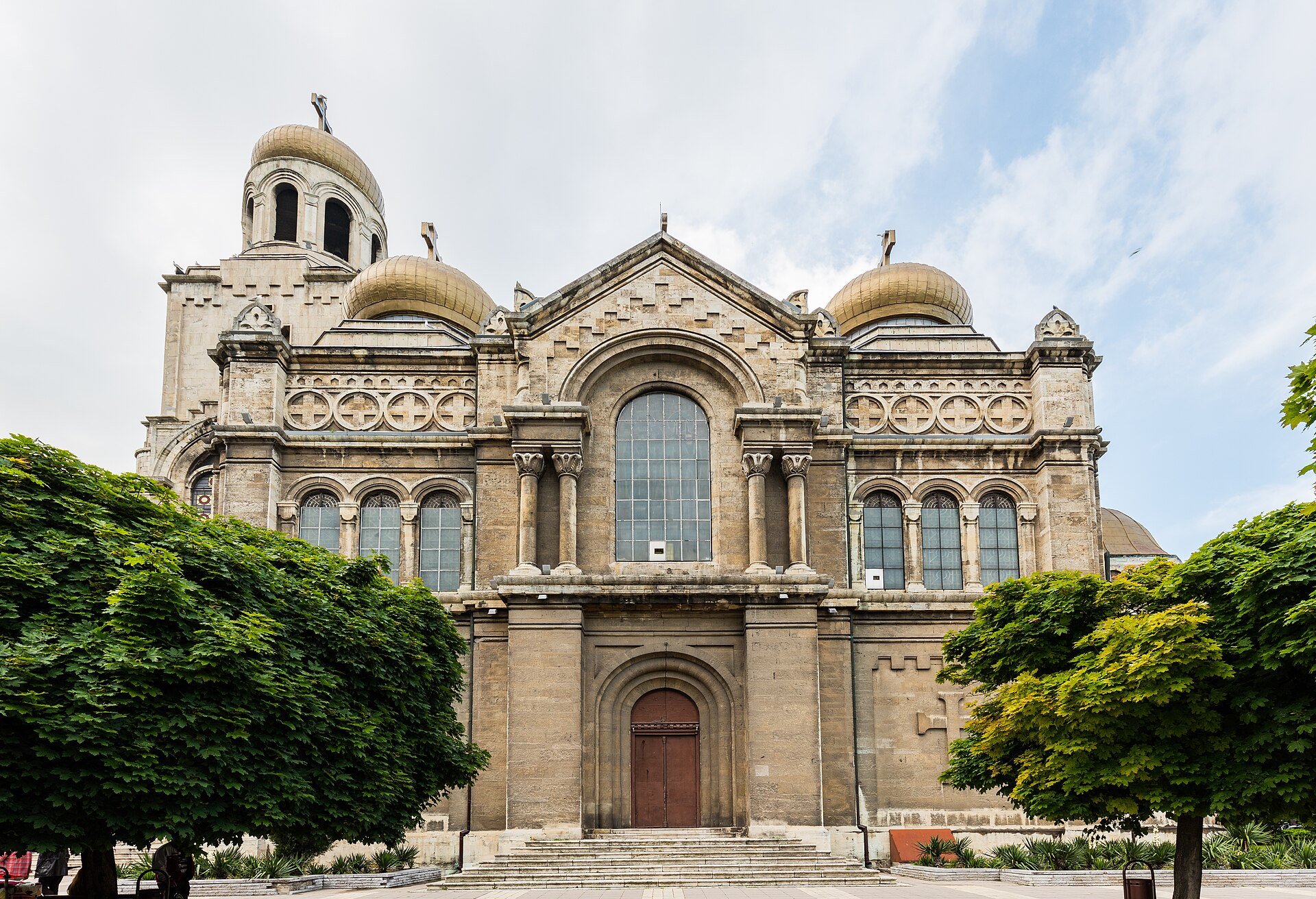
Photo: Diego Delso, CC BY-SA 4.0
Assumption Cathedral
out of 5 0 ratingsVarna’s Cathedral of the Dormition of the Theotokos stands at the heart of the city, not just as a place of worship but as a quiet witness to the layers of history that have shaped this Black Sea port. Built in the late 19th century, the cathedral was conceived during a time when Varna was emerging as a key urban center under Ottoman rule, a period marked by both tension and cultural revival. The decision to construct a grand Orthodox church was as much a spiritual statement as it was a symbol of national identity, reflecting the growing Bulgarian desire for self-determination. Its completion in 1886, just two years after the country regained full independence, gave the cathedral an almost immediate significance—it became a focal point for the city’s celebrations, mourning, and daily life.
The architecture of the cathedral blends elements that feel both familiar and distinct within the Orthodox tradition. The exterior is dominated by a large central dome flanked by two smaller ones, a design that echoes the Byzantine style while incorporating local influences. The bell tower, added later, rises above the surrounding rooftops, its height making it one of the most visible landmarks in Varna. Inside, the space is expansive yet intimate, with thick stone walls that mute the city’s noise and high arched windows that filter light in soft, shifting patterns. The iconostasis, a masterpiece of woodcarving, draws the eye with its intricate details, though the icons themselves are more restrained in style, favoring clarity over ornamentation.
What makes the cathedral particularly striking is how it has absorbed the rhythms of the city around it. Unlike some religious sites that feel removed from everyday life, this one remains deeply embedded in Varna’s daily pulse. Locals come here not only for services but to mark personal milestones—weddings, baptisms, funerals—or simply to sit in the cool interior during the summer heat. The square in front of the cathedral is often lively, with street vendors selling flowers and candles, and the occasional sound of a choir rehearsing drifting through the open doors. On major feast days, the building fills with the scent of incense and the murmur of prayers, while during quieter times, it offers a space for reflection amid the city’s hustle.
The cathedral’s role in Varna’s history extends beyond its religious function. During the Russo-Turkish War of the 1870s, the site where it now stands was used as a military hospital, a reminder of the turbulent years that preceded Bulgaria’s liberation. Later, in the 20th century, the building weathered the ideological shifts of socialism, when religious institutions were often sidelined. Yet it endured, becoming a place where people could reconnect with traditions that the state sought to suppress. Today, it stands as one of the few constants in a city that has seen rapid change—from a provincial Ottoman town to a modern European port.
Visitors often note the cathedral’s understated beauty, which can be easy to overlook if you’re expecting something more overtly grand. There are no gilded domes or towering spires here; instead, the charm lies in the details—the way the light plays across the stone floors, the worn steps leading to the entrance, the quiet dignity of the icons. The interior is less about spectacle and more about creating a sense of continuity, a place where the past feels present. The frescoes, though not as elaborate as those in older Bulgarian churches, carry a warmth that comes from their simplicity, their figures rendered with a gentle humanity rather than divine grandeur.
For those who take the time to explore, the cathedral offers more than just a glimpse into Orthodox Christianity. It’s a place where you can sense the weight of history without it being overpowering. The building has seen empires rise and fall, regimes change, and generations of Varnians pass through its doors. Yet it remains a living space, not a museum. The occasional sound of a priest’s voice, the rustle of a prayer book, or the soft footsteps of a visitor crossing the nave all serve as reminders that this is still a place of active faith. Even the air inside carries a sense of timelessness, as if the centuries have settled into the very stones.
Outside, the cathedral’s presence shapes the surrounding streets. The nearby park, with its benches and shaded paths, is a popular spot for locals to gather, and the area around the church often buzzes with activity. On weekends, you might see families strolling past after a visit, or elderly men playing backgammon in the square. The cathedral doesn’t dominate the cityscape in the way some European cathedrals do, but its influence is felt in subtler ways—it’s a reference point, a place people orient themselves by, whether they’re heading to the market, the sea, or just home.
If you visit, it’s worth lingering for a while, not just inside but in the spaces around the cathedral. The nearby streets are lined with small shops selling religious items, from hand-painted icons to simple wooden crosses, and the scent of freshly baked bread often drifts from nearby bakeries. The cathedral itself is open throughout the day, though services are held in the early morning and evening. There’s no admission fee, and visitors are welcome to light a candle or sit quietly in one of the pews. It’s a place that invites you to slow down, to step out of the rush of modern life and into a quieter, more reflective rhythm.
In the end, the Cathedral of the Dormition of the Theotokos is more than just a building. It’s a thread in the fabric of Varna, one that connects the city’s past to its present. Whether you’re drawn by faith, history, or simply curiosity, it offers a space to pause and consider the layers of meaning that accumulate in a place where so many lives have intersected. And perhaps that’s its greatest strength—not in its size or splendor, but in its ability to feel like a part of the city’s living story.
Day around this place
Where else to go on the same day
Building the day…
Where it is
43.20528, 27.91000