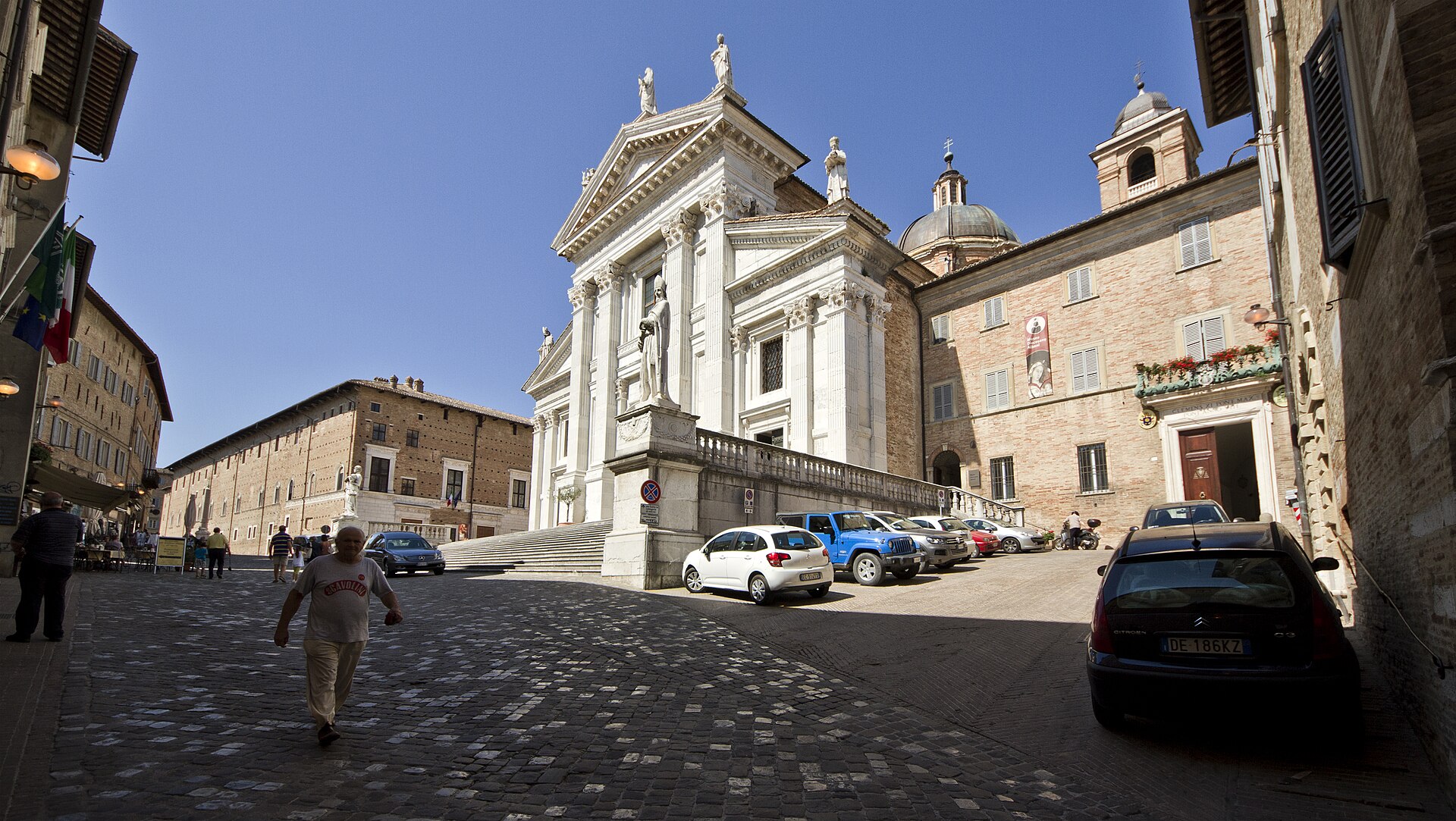
Photo: trolvag, CC BY-SA 3.0
Urbino Cathedral
out of 5 0 ratingsUrbino’s cathedral is one of those places where history isn’t just remembered—it’s still alive. Standing in the heart of the city, it occupies the same ground where an ancient church once honored Saint Sergius, though little remains of that original structure. What you see today is the result of centuries of rebuilding, a slow evolution that began in the Middle Ages and only concluded in the 18th century. The building carries the marks of every era it has passed through, blending the clean lines of neoclassicism with the softer curves of the Baroque, while traces of earlier styles linger in the details. It’s a quiet testament to how time reshapes even the most enduring places.
From the outside, the cathedral appears almost severe. The pale stone facade is uncluttered, its simplicity giving it a certain dignity rather than grandeur. Columns and pilasters frame the entrance, and high windows let in a diffused light that softens the stone’s coolness. The dome, rising above the rooftops, is one of the city’s most recognizable features, though it doesn’t dominate the skyline so much as settle into it. The building doesn’t invite you in with fanfare; it waits, and when you finally step inside, the contrast is striking. The interior is vast, filled with a stillness that feels almost tangible, as if the air itself has been undisturbed for centuries.
Inside, the cathedral’s beauty lies in its restraint. Unlike many Italian churches, where ornamentation can overwhelm, here every element feels deliberate, almost understated. The main nave, divided by columns into three aisles, draws the eye toward the altar with a sense of quiet inevitability. The walls are adorned with frescoes and paintings, many by local artists like Federico Barocci and Domenichino, whose works from the 16th and 17th centuries still glow with rich, deep colors. There’s no excess here—just a careful balance of space, light, and artistry that makes the whole feel greater than the sum of its parts.
One of the most striking spaces within the cathedral is the Chapel of San Giovanni Battista, where the relics of Saint Crescentino are kept. The chapel is a rare burst of opulence in an otherwise restrained interior, its marble and gilding catching the light in a way that feels almost theatrical. Nearby, the tomb of Federico da Montefeltro, the Renaissance duke who shaped Urbino’s golden age, stands as a reminder of the city’s past. The marble effigy of the duke, carved with precision, seems to watch over the space, a silent witness to the conversations and ideas that once filled these walls.
The cathedral’s history is inseparable from that of Urbino itself, particularly during the rule of the Montefeltro family. Under Federico da Montefeltro, the city became a beacon of Renaissance culture, attracting artists, scholars, and thinkers. The cathedral wasn’t just a place of worship—it was a gathering point, where sermons and debates on humanism unfolded beneath its vaulted ceilings. Even now, stepping inside feels like entering a space where time moves differently. The echoes of those long-ago discussions aren’t audible, but they’re present in the way the light falls across the stone, in the quiet rhythm of footsteps on the floor.
What makes Urbino’s cathedral unusual is that it hasn’t been reduced to a museum piece. It remains a living part of the city, where services are still held, where the organ plays, and where locals come to pray or simply sit in silence. There’s no sense of performance here, no pressure to be anything other than what it is—a place where faith, history, and daily life intersect. That authenticity is rare in a country where so many historic sites have been polished for tourists.
For anyone with an interest in art or architecture, the cathedral is a treasure trove. The frescoes alone could occupy hours, their details revealing themselves slowly under shifting light. The play of morning sunlight through the stained glass transforms the interior into a warm, golden space, while the flicker of candlelight in the evening lends it an almost mystical quality. There’s no need to rush; the cathedral rewards patience, whether you’re studying the brushstrokes of a painting or simply sitting on a pew, letting the atmosphere settle over you.
Urbino isn’t the kind of place that draws crowds. It’s not Florence or Rome, and it doesn’t try to be. That’s part of its charm—the city feels like a secret, one that reveals itself only to those who take the time to look. The cathedral is a perfect example of this. It doesn’t demand attention, doesn’t rely on spectacle. Instead, it offers something quieter, something that lingers long after you’ve left: the sense of stepping into a story that’s still being written, one where the past isn’t just preserved but alive in the present.
Day around this place
Where else to go on the same day
Building the day…
Where it is
43.72497, 12.63643