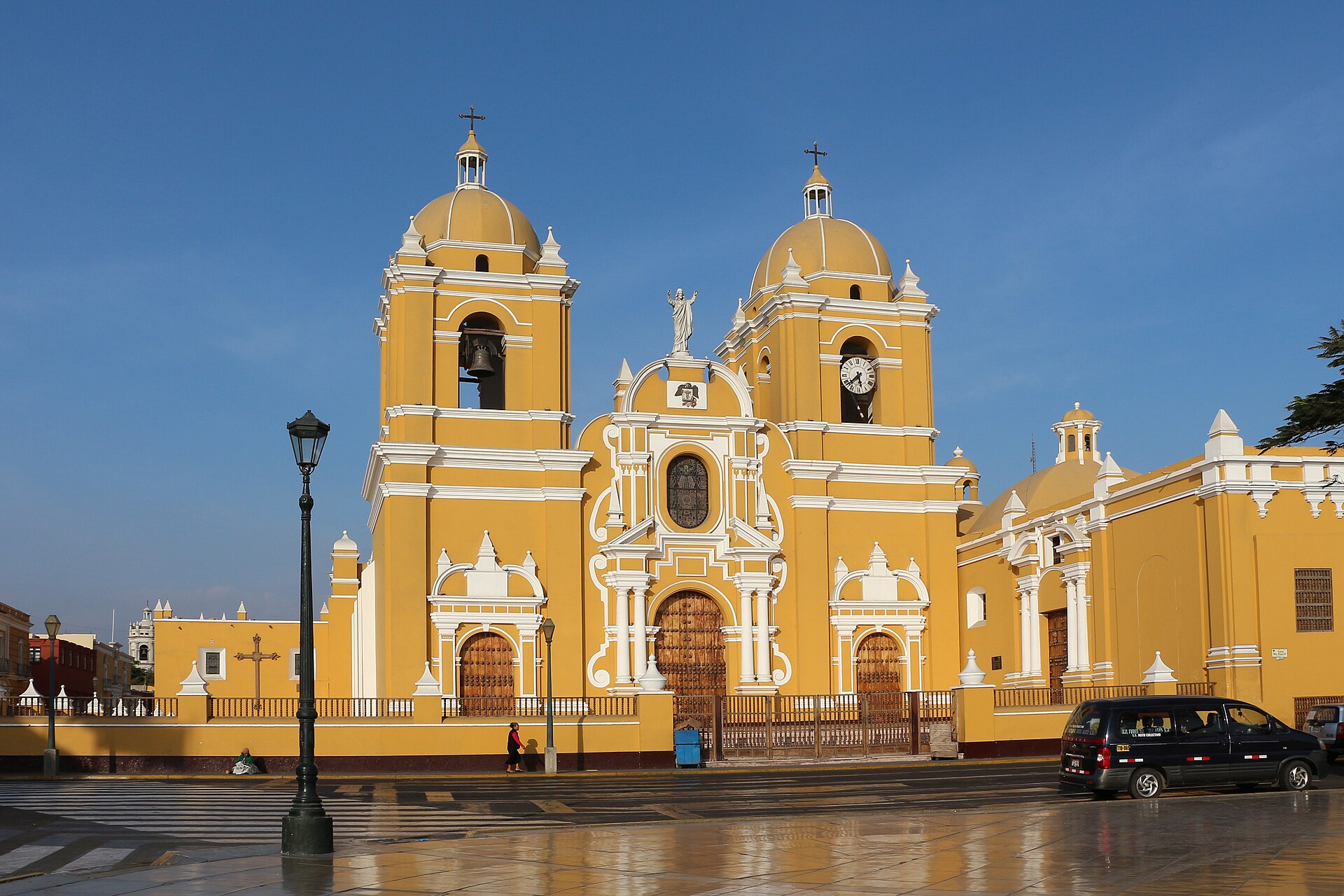
Photo: Bernard Gagnon, CC BY-SA 3.0
Trujillo Cathedral
out of 5 0 ratingsTrujillo’s Cathedral stands at the heart of the city’s main square, a quiet witness to centuries of change. Built in the mid-1600s, its origins are older still—an earlier church once occupied this spot, though earthquakes, common in the region, repeatedly forced its reconstruction. The version that survives today took shape in the 18th century, when builders reinforced its walls and gave it the sturdy, understated elegance of colonial Baroque. There’s nothing flashy about its facade—just thick buttresses, a modest entrance, and a sense of solidity that feels almost defiant, as if the structure itself refuses to be shaken by time.
Inside, the cathedral doesn’t overwhelm with opulence. Instead, it offers a kind of quiet dignity. The high vaulted ceilings, supported by thick columns, create an unexpected sense of space, while the Baroque altar, gilded and intricately carved, draws the eye without dominating the room. The overall effect is restrained, almost humble, as if the craftsmen who worked here were more concerned with devotion than display. Scattered throughout are paintings and sculptures, some imported from Spain, others made locally but clearly influenced by European styles. They hang in the dim light like fragments of another era, their details softened by age.
This was never just a place of worship. The cathedral has been a stage for Trujillo’s history, from the colonial period through the struggle for independence. Wealthy families were married and buried within its walls, and decisions made here shaped the region’s fate. When Peru fought for freedom in the early 19th century, the cathedral became a symbol of change. It was here that calls for independence first echoed, and later, when the country won its sovereignty, the building hosted services celebrating the new republic. Even now, the past feels close—less like a story and more like something that lingers in the air.
What makes the cathedral unusual is that it hasn’t been turned into a museum. It’s still a working church, and that gives it a different kind of life. On Sundays, the pews fill with worshippers, their voices rising in hymns that have been sung here for generations. On weekdays, visitors can step inside, though it’s best to come when services aren’t in session. The quiet hours offer a chance to take in the details—the worn stone floors, the flicker of candlelight on gold leaf, the way the afternoon sun slants through the high windows. In those moments, the cathedral feels less like a relic and more like a place where the past and present overlap.
The square outside is always alive. Locals gather under the shade of the cathedral’s walls, vendors sell fruit and handmade crafts, and children dart between the benches. Tourists pause to take photos, but the real rhythm belongs to Trujillo itself—unhurried, but never still. In the evenings, when the streetlights come on, the square transforms. The cathedral’s facade glows in the soft light, its silhouette sharp against the darkening sky. It’s a scene that hasn’t changed much in centuries, though the city around it has.
Trujillo is a place of contrasts—colonial grandeur alongside modern energy, quiet alleys next to bustling markets, tradition clashing with youthful restlessness. The cathedral is where that tension feels most visible. From here, it’s easy to explore the rest of the historic center, where every building seems to hold a story. Nearby are monasteries, museums, and the former homes of the city’s elite, all once centers of power and influence. But even if you don’t venture far, the streets around the cathedral offer a sense of Trujillo’s layered past. The low, brightly painted houses, the uneven cobblestones, the way the light slants across the plaza—it all feels like stepping into a place that has refused to let go of its history.
The cathedral has survived earthquakes, wars, and revolutions, yet it remains essentially the same. That might be why it draws people in—not for its grandeur, but for its steadiness. There’s no need for plaques or guided tours to feel its weight. You sense it in the cool dimness of the nave, in the echo of footsteps on the stone, in the way the building seems to breathe with the city around it. It’s a place where history isn’t something you read about, but something you stand inside.
Day around this place
Where else to go on the same day
Building the day…
Where it is
-8.11064, -79.02814