- Home
- United States
- Charleston
- St. John the Baptist Cathedral
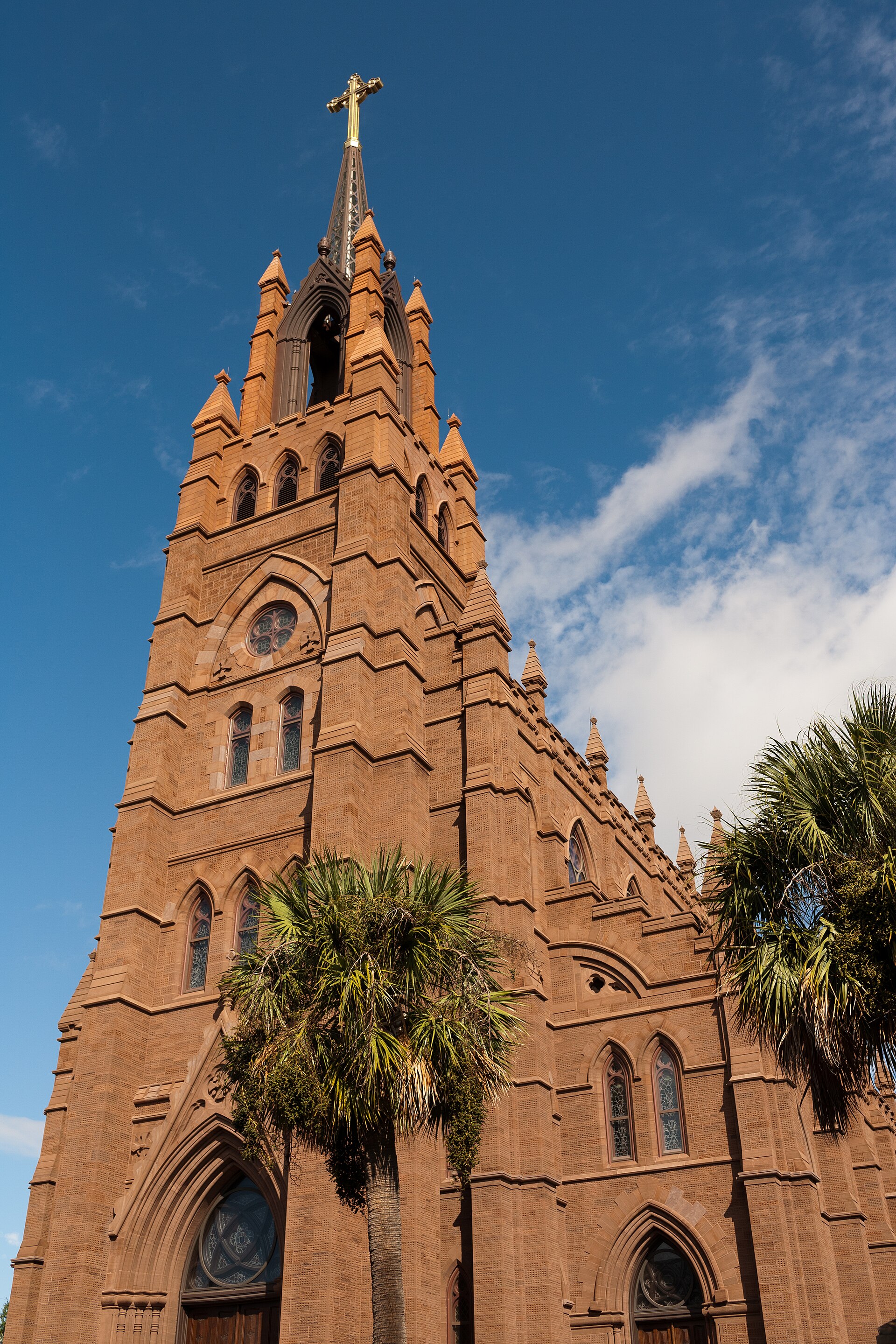
Photo: Wikimedia Commons, CC BY-SA 3.0
St. John the Baptist Cathedral
out of 5 0 ratingsSt. John the Baptist Cathedral in Charleston is one of those rare places where the city’s layered past feels almost tangible. Rising at the intersection of Broad and Queen Streets, it occupies a quiet corner of the historic district, where the weight of history lingers in the cobblestones and the facades of centuries-old buildings. The cathedral’s spire cuts a striking silhouette against the skyline, visible from blocks away—a silent landmark that draws the eye even of those who might not usually seek out religious architecture.
The story of the cathedral is one of resilience. The first Catholic church on this site was built in 1854, only to be destroyed during the Civil War. For decades afterward, the congregation worshipped in temporary spaces while slowly gathering the funds to rebuild. The task fell to architect Patrick Keely, who looked to the Gothic cathedrals of Europe for inspiration. Construction stretched over years, with the final structure consecrated in 1907. Today, it stands as one of the few places in Charleston where Gothic architecture is rendered with such clarity—its pointed arches, ribbed vaults, and soaring vertical lines a deliberate contrast to the city’s more common neoclassical and colonial styles.
Inside, the cathedral feels both vast and intimate. The high ceilings, supported by sturdy columns, create a sense of openness, while the stained-glass windows cast shifting patterns of light across the stone floors. The silence here is thick, broken only by the occasional creak of a pew or the distant murmur of a visitor. The marble altar dominates the space, its cool elegance softened by the warm tones of the carved wooden pews. The organ, installed in the 1990s, fills the nave with sound during services and concerts, its deep notes resonating through the arched ceilings.
Beyond its religious function, the cathedral has become a cultural touchstone for the city. It hosts classical music performances, lectures, and community events, many of them open to the public. In recent years, it has also gained a reputation as a wedding venue, not just for Catholics but for couples of all backgrounds. There’s something about the space—its quiet grandeur, its sense of timelessness—that makes it feel removed from the ordinary. It’s the kind of place where even a secular ceremony takes on a weight it might not elsewhere.
The cathedral welcomes visitors of all faiths, or none at all. Some come to admire the architecture, others to sit in the hush of the nave, to think or simply to escape the noise of the city. Unlike many of Charleston’s more crowded attractions, the cathedral rarely feels overrun. Even on busy weekends, the atmosphere inside remains calm, as if the building itself absorbs the outside world’s clamor.
The surrounding neighborhood is worth exploring in its own right. Broad and Queen Streets are lined with pastel-colored houses, their wrought-iron balconies and shuttered windows straight out of another era. Nearby, the Charleston City Market hums with activity, selling everything from sweetgrass baskets to local art. The cathedral fits seamlessly into this setting, its Gothic lines a counterpoint to the softer, more domestic architecture around it. Together, they create a sense of place that feels distinctly Charleston—old, but not frozen in time.
For those interested in history, the cathedral offers more than just an architectural experience. It’s a testament to the Catholic community’s place in Charleston, a city where Catholicism was once a rarity. In the 19th century, the congregation was small, and the church served as both a spiritual and social anchor. Today, the community is more diverse, but the cathedral remains a gathering place, a reminder that faith and culture have always been intertwined here.
Visiting St. John the Baptist Cathedral is a chance to see Charleston from a different angle. The city is often associated with its plantations, its role in the slave trade, and its Civil War history—stories that are painful and necessary to remember. But the cathedral tells another side of the city’s past, one of perseverance, adaptation, and the quiet beauty that emerges when different traditions coexist. It stands as a reminder that Charleston’s history is not monolithic, but a tapestry woven from many threads.