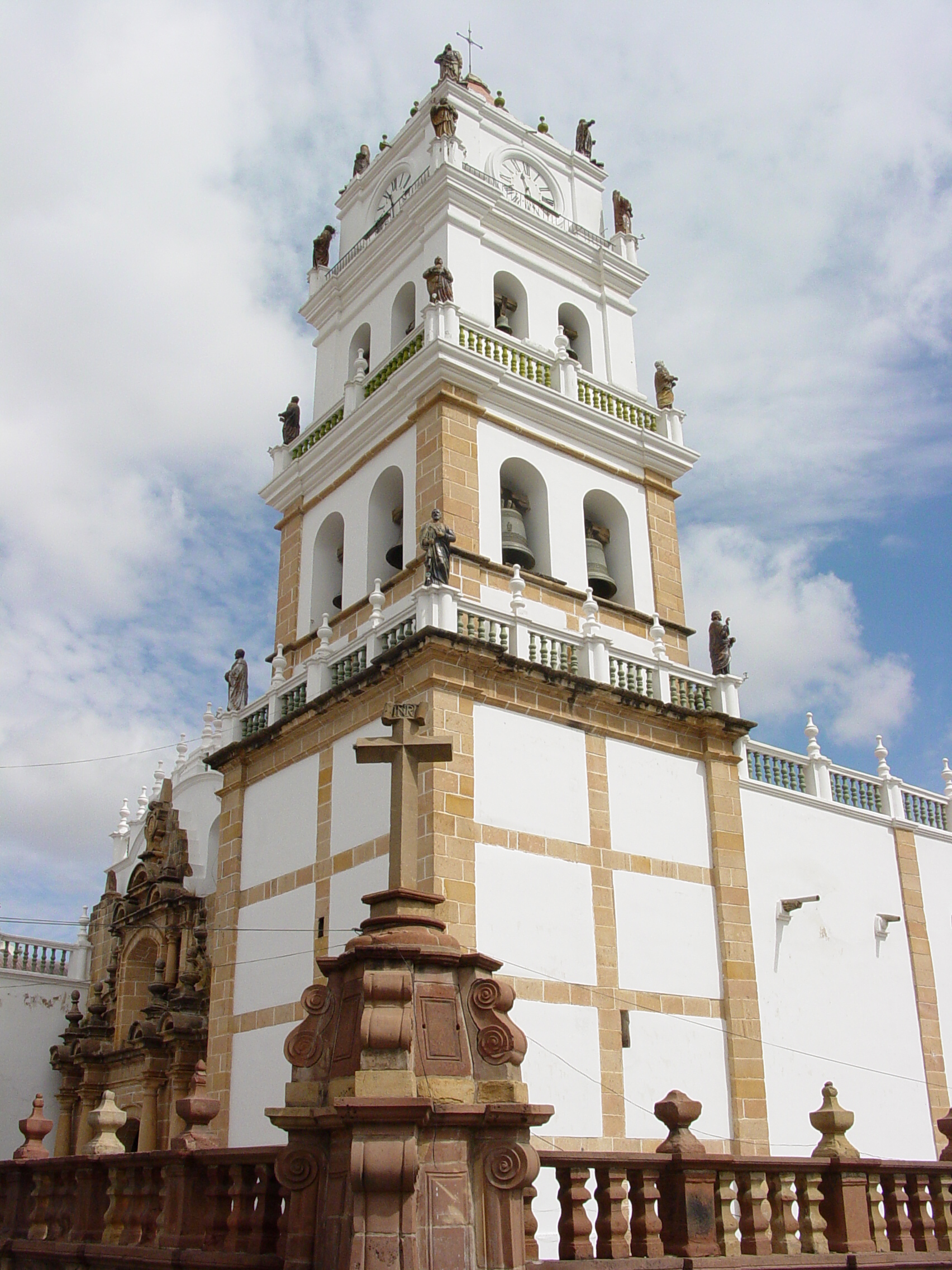
Photo: Adam Jones, Ph.D, CC BY-SA 2.0
Sucre Cathedral
out of 5 0 ratingsSucre’s cathedral sits quietly at the heart of the city, its pale stone facade glowing under the Andean sun. It has stood on Plaza 25 de Mayo for centuries, watching over the whitewashed colonial buildings that surround it, as if time here has barely moved at all. Construction began in the early 1500s, not long after the Spanish founded the city—then called La Plata—as a key administrative hub in South America. The building took decades to complete, and over the years, its architecture absorbed influences from Renaissance to Baroque, each layer telling a different part of its story.
From the outside, the cathedral appears solid and dignified, without the ornate excess of some Latin American churches. Its two sturdy towers frame the entrance, while arched windows and delicate carvings hint at the craftsmanship of the artisans who shaped it. Inside, the space feels airy and bright, with high vaulted ceilings resting on slender columns. Light filters through stained glass, casting soft hues across the stone floors, and the quiet hum of the city fades into the background.
The golden altar is the centerpiece, widely regarded as one of Bolivia’s most beautiful. Intricately carved figures of saints rise from gilded wood, their details catching the light in a way that makes the whole space feel alive. Nearby, a small chapel holds a revered statue of the Virgin Mary, said to have been brought from Spain during colonial times. For many in Sucre, this figure is more than just a religious symbol—it’s a guardian of the city, a silent witness to its history.
Beyond its spiritual role, the cathedral has long been a cultural landmark. On feast days and special occasions, its ancient organ fills the nave with music, its deep tones resonating through the centuries. Sometimes, choirs perform here, their voices weaving through the stone arches, making the past feel almost tangible. The building has seen more than just prayers—it has been part of the city’s life in ways that go beyond religion.
One of the most significant moments in Bolivia’s history unfolded right here. In 1825, the cathedral’s steps became the stage for the proclamation of independence for Upper Peru, which would soon become the Republic of Bolivia. Crowds gathered to hear speeches that would shape a new nation, and the building stood as a silent participant in that turning point. Today, a small plaque near the entrance marks the occasion, though most visitors walk past without noticing.
A modest museum inside the cathedral offers a glimpse into its past. Display cases hold silver chalices, embroidered vestments, and centuries-old manuscripts, each piece a fragment of the religious life that once thrived here. The collection isn’t vast, but it feels intimate, as if the objects still carry the weight of the hands that once used them. Spending time here is less about grand revelations and more about small discoveries—the way a faded painting’s brushstrokes catch the light, or how a tarnished candlestick bears the marks of countless services.
Sucre itself is often called a living museum, and the cathedral is its quiet anchor. It isn’t as imposing as European cathedrals, nor as lavish as some of Latin America’s grander churches. Instead, it has a quiet presence, a sense of being exactly where it belongs. Visitors often remark on how easy it is to lose track of time here, especially on a weekday when the crowds thin out. The stillness inside feels like an invitation—to sit, to listen, to let the weight of history settle around you.
If you find yourself in Sucre, the cathedral is worth visiting not just for what it contains, but for what it offers. There’s no need to rush. You can take a seat on one of the wooden pews and let the quiet seep in—the distant chime of bells, the occasional murmur of a prayer, the way the light shifts across the stone. It’s a place that doesn’t demand admiration, only attention. And perhaps that’s why it lingers in the memory long after you’ve left.
Day around this place
Where else to go on the same day
Building the day…
Where it is
-19.04854, -65.26021