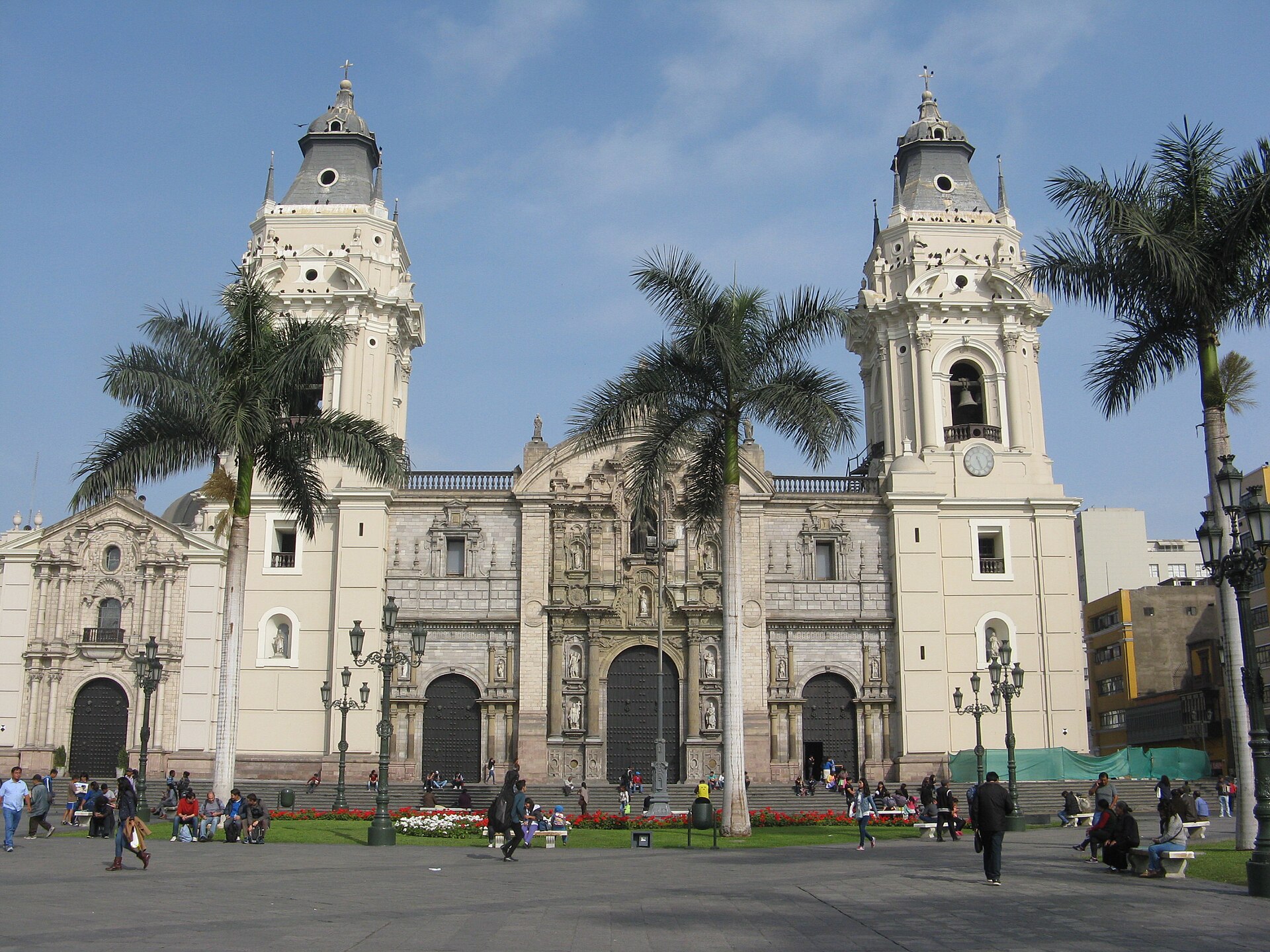
Photo: Wasiwatana, CC BY-SA 4.0
Lima Cathedral
out of 5 0 ratingsLima’s Cathedral stands at the heart of the city, a quiet witness to centuries of change. Built on the Plaza de Armas, the main square of the Peruvian capital, its towering façade has watched over Lima since the earliest days of Spanish rule. The cathedral is more than just a building—it’s a place where history feels tangible, where the layers of time are visible in every stone and arch. Here, the colonial past meets the present, blending European traditions with the rhythms of modern Peru.
Construction began in 1535, shortly after Francisco Pizarro founded the city. The first version was modest, but Lima’s growing importance as the capital of the Viceroyalty of Peru soon demanded something grander. Over the centuries, fires, earthquakes, and the ambitions of successive architects reshaped the cathedral. The structure we see today took form mostly in the 17th and 18th centuries, with Baroque flourishes giving way to neoclassical restraint after the devastating earthquake of 1746. Despite these changes, the cathedral has always remained the spiritual center of the city.
Inside, the air is cool and still, the silence broken only by the echo of footsteps on the stone floor. The main nave stretches upward, its high vaults bathed in light filtering through stained glass. Gilded altars gleam under the soft glow, their intricate carvings telling stories of faith and history. The walls are adorned with frescoes depicting biblical scenes alongside moments from Peru’s past. One of the most striking features is the chapel holding the remains of Francisco Pizarro—a simple monument to the man who founded the city, his legacy as complicated as the history of the place itself. Nearby, other figures from the colonial era rest in quiet dignity, their presence a reminder of the cathedral’s role in shaping Peru’s identity.
The architecture is a conversation between styles. The façade, with its twin towers and three grand portals, is a study in neoclassical symmetry, but step inside, and the details become richer. Gothic influences linger in the pointed arches, while Baroque opulence appears in the ornate woodwork of the choir stalls. The sacristy holds treasures from another era—vestments embroidered with silver thread, chalices of polished metal, and paintings that capture the artistic sensibilities of colonial Peru. These objects are more than religious artifacts; they’re a testament to the skill of the craftsmen who created them, their work still vivid after centuries.
Beyond its religious significance, the cathedral has been a stage for Lima’s public life. Viceroys were crowned here, and during the wars of independence, it became a gathering place for those who dreamed of a free Peru. Even after the country gained sovereignty in the 19th century, the cathedral remained a symbol of continuity, bridging the colonial past with the new nation. Today, it’s still an active place of worship, where weddings and baptisms take place alongside daily Mass. Yet it’s also open to visitors, offering a chance to step into history without the distance of a museum.
A visit here is less about ticking off a landmark and more about slowing down to absorb the atmosphere. You can spend hours tracing the details of the carvings, listening to the stories of the guides, or simply sitting on a wooden pew, watching how the light shifts across the stone. Occasionally, the sound of the organ fills the space, its deep notes resonating through the vaulted ceilings. Even if you’re not religious, there’s something about the cathedral that lingers—an intangible sense of time standing still.
The cathedral doesn’t exist in isolation. It’s part of a larger ensemble on the Plaza de Armas, surrounded by the Government Palace, the Archbishop’s Palace, and the City Hall. Together, these buildings create a sense of stepping into another era, where every corner holds a piece of history. In the evening, when the square is lit by lamplight, the cathedral’s silhouette becomes even more striking, its presence reflected in the windows of the buildings around it. It’s a place where Lima’s past and present coexist, where the city’s heartbeat is palpable.
Like any living monument, the cathedral is constantly evolving. Restoration work is ongoing, ensuring that its legacy endures for future generations. Recent efforts have focused on preserving the frescoes and reinforcing the foundation, a necessary precaution in a city where earthquakes remain a threat. The cathedral isn’t just a relic of the past; it’s a reminder of how fragile history can be—and how important it is to protect it. Walking through its doors, you’re not just seeing a building. You’re touching the layers of a story that’s still being written.
Day around this place
Where else to go on the same day
Building the day…
Where it is
-12.04647, -77.03004